

🎓 What to Do After MSCE Results: A Complete Guide for Form 4 Graduates
Results day has arrived. You open the slip, check the grades, and feel a mix of relief, excitement, or maybe disappointment. Now the big question hits: "What's next?"
Don't worry. Your MSCE results are not the end of the road — they're the starting line. Whether you scored distinctions, credits, or passes, there's a clear path forward. This guide shows you exactly what to do next, step by step.
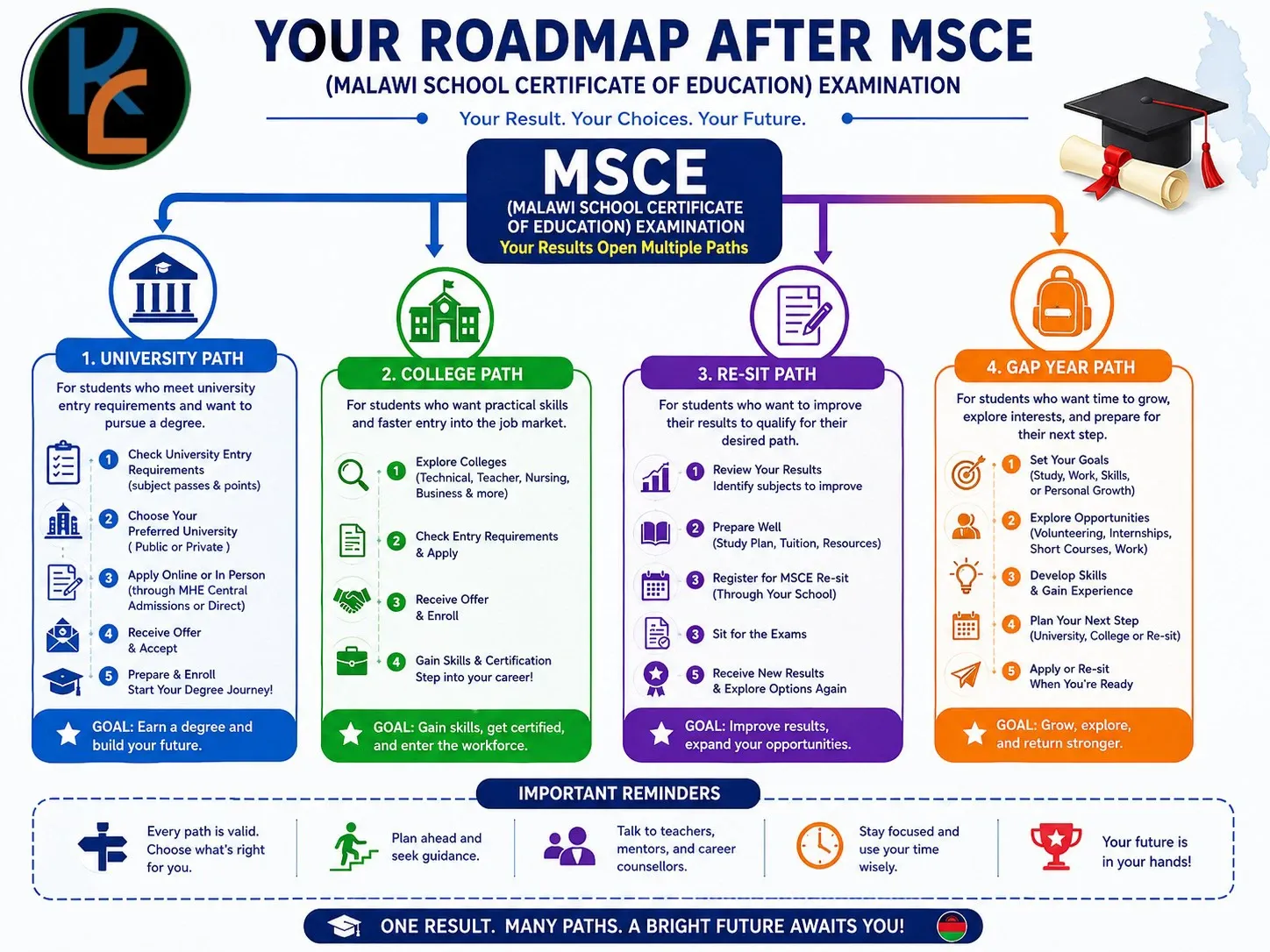
Your results don't define your future. Your next steps do.
📊 Step 1: Understand What Your Results Actually Mean
Before making any decisions, break down your results clearly:
- Grades 1-6 = Credits → Count for university/college admission
- Grades 7-8 = Passes → Count for certificate, but not for university
- Grade 9 = Fail → Subject not passed
Quick check:
- ✅ 6+ credits → Eligible for university or degree programs
- ✅ 4-5 credits → Eligible for diplomas, colleges, or re-sit 1-2 subjects
- ✅ 3 or fewer credits → Consider TEVET, vocational training, or full re-sit
Don't rush decisions. Take 24-48 hours to process, then plan your next move strategically.
🗺️ Step 2: Choose Your Path Based on Your Results
🎯 Path A: University Applications (6+ Credits)
If you have 6+ credits with strong grades in core subjects, university is your next step.
Key universities in Malawi:
- UNIMA → Arts, Sciences, Education, Law
- MUBAS → Engineering, Technology, Business
- LUANAR → Agriculture, Environmental Science, Food Tech
- Must/Catholic/Privates → Nursing, IT, Business, Education
Application window: January – April (check university websites for exact dates)
Documents needed: MSCE certificate/results slip, national ID, birth certificate, passport photos, application fee.
🏫 Path B: Colleges & Diploma Programs (4-5 Credits)
Universities aren't the only route. Colleges offer faster, career-focused training with high employment rates.
Popular options:
- Teacher Training Colleges (PTC, TTC) → 2-3 year diploma
- Malawi College of Health Sciences → Nursing, Lab Tech, Clinical Medicine
- TEVET Institutions → Electrical, Plumbing, ICT, Automotive, Hospitality
- Business/IT Colleges → Accounting, Secretarial, Computer Packages
Advantage: Shorter duration (1-3 years), hands-on skills, quicker entry into workforce.
📝 Path C: Re-Sit MSCE (Improve Grades)
If you're 1-2 subjects away from your dream program, re-sitting is a smart investment.
When to re-sit:
- You need 1 more credit for university/diploma entry
- You failed a core subject (e.g., English, Mathematics)
- You want to improve your overall "6" score for competitive programs (Medicine, Law, Engineering)
Registration period: May – June (via MANEB or accredited centers)
Pro tip: Don't just repeat the same study habits. Use past papers, active recall, and targeted revision. Free past papers are available here.
🌍 Path D: Gap Year, Work, or Entrepreneurship
Sometimes, a gap year is the best decision. Use it to:
- Work and save for tuition
- Gain practical skills (ICT, driving, bookkeeping)
- Volunteer or start a small business
- Re-apply next year with stronger experience
Remember: A gap year is only productive if you plan it. Set 3 clear goals before September.
💰 Step 3: Understand HESLGB Loans & Scholarships
University is expensive, but you don't need upfront cash if you qualify for support.
HESLGB Student Loans
- Covers: Tuition, accommodation, books, pocket money
- Eligibility: Malawian citizens, MSCE credits, accepted to accredited institution
- Repayment: Starts 12 months after graduation
- Application: Online via HESLGB portal (opens January)
Private Scholarships
Many NGOs, churches, and companies offer scholarships based on merit or need. Check:
- University financial aid offices
- Local NGOs (e.g., CAMFED, Mastercard Foundation)
- Community development committees
Apply early. Deadlines are strict, and slots fill quickly.
📅 Step 4: What to Do While Waiting for Admission
Don't wait until September to start preparing. Use this time wisely:
1. Get Certified in High-Demand Skills
- Computer literacy (Microsoft Office, basic coding)
- First Aid / Community Health certificates
- Driving license (increases employability)
2. Build a Professional Profile
- Create a simple CV (highlight MSCE subjects, skills, volunteer work)
- Set up a LinkedIn profile (free)
- Practice interview skills with friends or mentors
3. Stay Academically Sharp
- Read daily (newspapers, novels, educational articles)
- Practice basic Mathematics and English
- Join study groups or online learning communities
📂 Free Resources to Prepare for Your Next Steps
Whether you're applying to university, preparing for re-sits, or building skills, we've got free resources to help:
📘 Mathematics Past Papers (2019-2024) — Essential for university & college entrance
📗 English Revision Guides — Grammar, comprehension, essays
📁 Browse All MSCE Resources — 250+ free past papers, notes, pamphlets
🎯 Your Action Plan for the Next 30 Days
Don't overthink. Just follow this simple checklist:
- Week 1: Verify results, understand credits, research 3 programs that match your grades
- Week 2: Gather documents (ID, birth certificate, passport photos), check application deadlines
- Week 3: Start HESLGB loan application (if applicable), apply to at least 2 institutions
- Week 4: Build a simple CV, practice interview questions, set 3 goals for your next phase
Final word: Your MSCE results are a milestone, not a ceiling. Thousands of successful Malawians started exactly where you are today. Plan carefully, act consistently, and your next chapter will be even better.
📥 Free Resources for Your Next Step
Past papers, revision notes, and study planners to keep you ahead.
Access Free MSCE Resources
✅ 100% free • No signup required • Works offline
Written for every Form 4 graduate in Malawi ready to turn results into opportunity.
— Kizito Chikuni, Educator & Developer



Sign in securely with Google to join the discussion.