

🎯 Understanding Competency-Based Learning: What It Means for Malawian Students
For decades, Malawian education has focused on one question: "What do you know?" Students memorised facts, regurgitated them in exams, and moved on. But knowledge alone isn't enough in today's world.
Malawi's new Curriculum and Assessment Framework (July 2025) introduces a transformative shift: Competency-Based Learning (CBL). Now the question is: "What can you do with what you know?"
This guide explains what competency-based learning means, how it works in Malawian classrooms, and why it better prepares students for life, work, and further education.
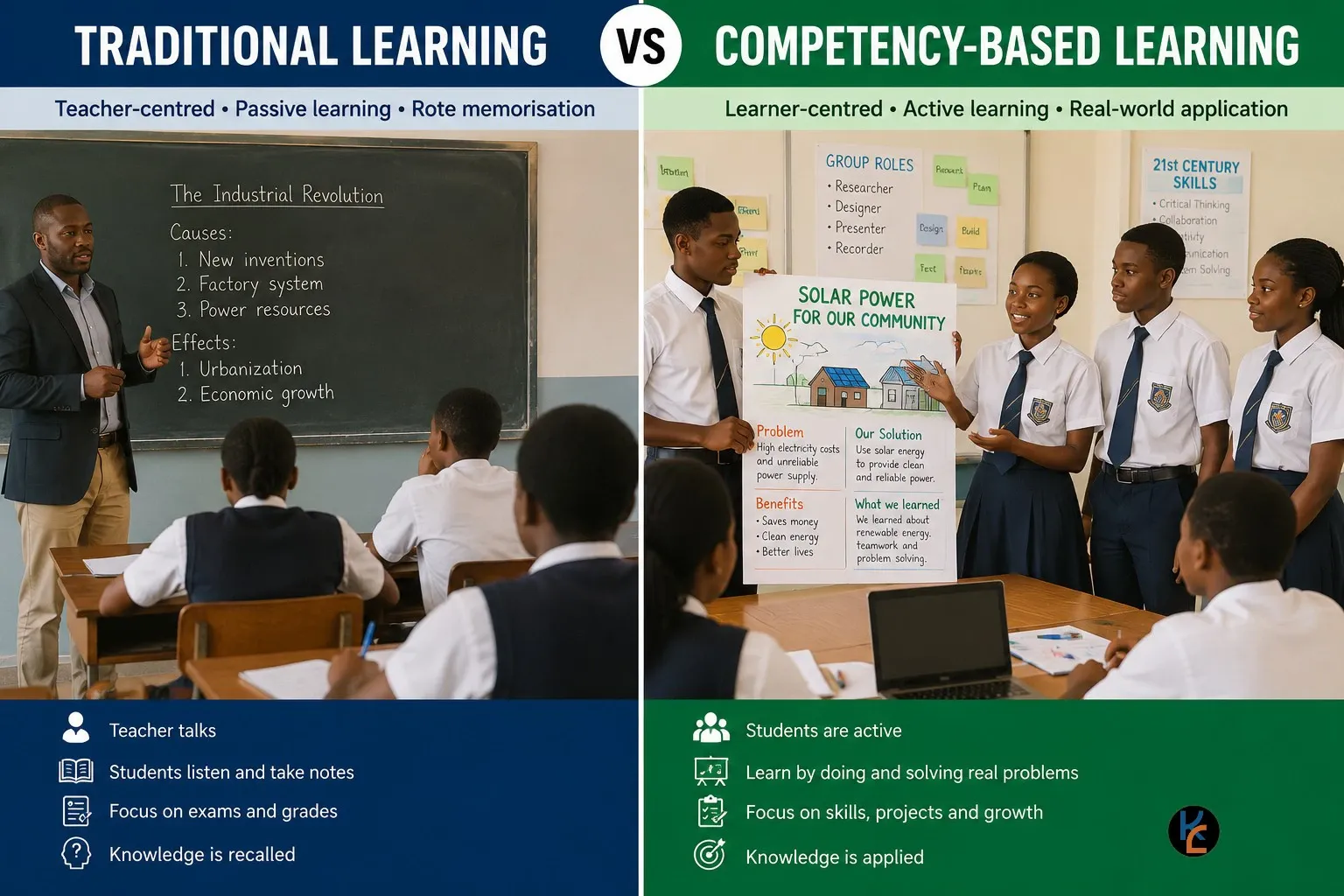
From memorising to mastering: The new way of learning.
🔄 What Is Competency-Based Learning?
Competency-Based Learning (CBL) is an approach where students progress by demonstrating mastery of specific skills and knowledge, rather than just spending time in class or passing written exams.
Traditional learning vs. Competency-Based Learning:
| Traditional Learning | Competency-Based Learning |
|---|---|
| Focus on memorising facts for exams | Focus on applying knowledge to real-world problems |
| All students move at the same pace | Students progress when they master a skill, at their own pace |
| Assessment = final exams only | Assessment = continuous feedback + projects + exams |
| Teacher-centred: "I teach, you listen" | Learner-centred: "You explore, I guide" |
| Success = high exam scores | Success = ability to solve problems, collaborate, create |
In simple terms: Instead of just knowing that "photosynthesis is the process by which plants make food," a student in a CBL classroom can design an experiment to test how light affects plant growth, analyse the results, and explain the implications for agriculture in Malawi.
🧩 The 8 Core Competencies Every Malawian Student Will Develop
Under the new curriculum, all learners — from Primary to Secondary — will develop eight core competencies that prepare them for the 21st century:
- Communication & Collaboration — Express ideas clearly, listen actively, work effectively in teams
- Digital & Technological Literacy — Use technology responsibly, evaluate digital content, solve problems with digital tools
- Creativity & Innovation — Generate original ideas and apply them to solve real problems
- Critical Thinking & Problem Solving — Analyse information, question assumptions, make reasoned decisions
- Citizenship — Understand rights/responsibilities, respect diversity, participate in community development
- Wealth Creation & Entrepreneurship — Manage resources, identify opportunities, start ventures
- Learning to Learn (Meta-Learning) — Set goals, reflect on progress, adapt to new challenges
- Adaptability & Resilience — Adjust to change, recover from setbacks, stay motivated
Why these matter: These aren't just "soft skills." They're the exact abilities employers, universities, and communities need. A student who can think critically, collaborate, and adapt will thrive whether they become a farmer, engineer, teacher, or entrepreneur.
🏫 How Competency-Based Learning Works in Malawian Classrooms
You won't see a complete overnight change, but here's what to expect as schools transition:
For Primary Students (Grades 1–6)
- More group work: Students solve problems together, not just individually
- Hands-on projects: Building models, conducting simple experiments, creating presentations
- Continuous feedback: Teachers give regular guidance, not just end-of-term grades
- Real-life connections: Learning maths through market scenarios, science through local agriculture
For Secondary Students (Forms 1–6)
- Pathway-specific projects: STEM students design solutions; TEVET students build prototypes; Arts students create portfolios
- Community engagement: Students apply learning to local challenges (e.g., water conservation, business plans)
- Portfolio assessments: Collections of work that show growth over time, not just one exam
- Peer review: Students learn to give and receive constructive feedback
For Teachers
- Shift from "sage on stage" to "guide on side": Teachers facilitate learning rather than just lecturing
- More planning time: Designing projects and assessments that measure competencies
- Professional development: Training on CBL methods, digital tools, and inclusive teaching
📊 How Assessment Changes Under Competency-Based Learning
Exams aren't disappearing — but they're no longer the only measure of success.
New assessment mix (Secondary level):
- 60% Formative Assessment: Projects, presentations, portfolios, classwork, peer reviews
- 40% Summative Assessment: End-of-term exams, national assessments
What this means for students:
- ✅ Your effort throughout the term counts — not just exam day
- ✅ You can show mastery in multiple ways (not just written tests)
- ✅ Teachers identify gaps early and help you improve before final exams
- ✅ Skills like collaboration and creativity are recognised and valued
Pro tip: Start building a learning portfolio now. Save your best projects, presentations, and reflections. This will become valuable evidence of your competencies.
🤔 Common Concerns — And the Reality
| Concern | Reality |
|---|---|
| "Will my child still learn core subjects like Maths and English?" | Yes — but they'll learn them through application. Maths isn't just formulas; it's solving real problems. |
| "How will universities assess applicants without just exam scores?" | Universities are adapting. Portfolios, competency certificates, and interviews will complement exam results. |
| "What if my child learns slower than others?" | CBL allows personalised pacing. Students get support until they master a skill — no one is left behind. |
| "Will teachers be ready for this change?" | Teacher training is a priority. CPD programmes, mentorship, and resources are being rolled out nationwide. |
🎯 How Students & Parents Can Prepare Now
You don't need to wait for the new curriculum to start developing competencies. Here's how to get ahead:
For Students
- Ask "why?" and "how?" — Don't just memorise; seek to understand and apply
- Work on group projects — Practice collaboration, communication, and leadership
- Use digital tools responsibly — Explore educational apps, create content, learn basic coding
- Keep a reflection journal — Note what you learned, what was hard, and how you improved
- Solve real problems — Apply school knowledge to home, community, or personal challenges
For Parents
- Encourage curiosity — Ask open-ended questions: "What did you discover today?"
- Value effort over grades — Praise persistence, creativity, and problem-solving
- Support practical learning — Help with projects, visit libraries, explore local industries
- Stay informed — Follow MoBSE updates, attend school meetings, ask teachers about CBL
📂 Free Resources to Build Competencies
While the curriculum evolves, foundational knowledge remains essential. Use our free resources to build the skills you'll need:
📘 Mathematics Past Papers — Practice problem-solving and critical thinking
📗 English Revision Guides — Strengthen communication and comprehension
📁 Browse All Secondary Resources — 250+ free past papers, notes & pamphlets for all subjects
🚀 The Bottom Line
Competency-Based Learning isn't about making education easier — it's about making it more meaningful.
Instead of asking "Did you pass the test?", we're now asking: "Can you use what you've learned to make a difference?"
That shift prepares Malawian students not just for exams, but for life: to innovate, to lead, to adapt, and to thrive in a rapidly changing world.
📥 Free Resources to Build Future-Ready Skills
Past papers, revision notes, and study planners to keep you ahead.
Access Free Secondary Resources
✅ 100% free • No signup required • Works offline
Written for every Malawian student, parent, and teacher embracing the future of learning.
— Kizito Chikuni, Educator & Developer
Sign in securely with Google to join the discussion.