

🚫 Top 10 Study Mistakes Malawian Students Make (And How to Fix Them)
You spend hours with books open. You highlight entire pages. You stay up late reviewing notes. But when exam results come, the grades don't match the effort.
If this sounds familiar, you're not alone. Many Malawian students fall into the same study traps — not because they're not smart, but because no one taught them how to study effectively.
This guide reveals the 10 most common study mistakes we see in Malawian classrooms — and the simple, proven fixes that can transform your results before your next exam.
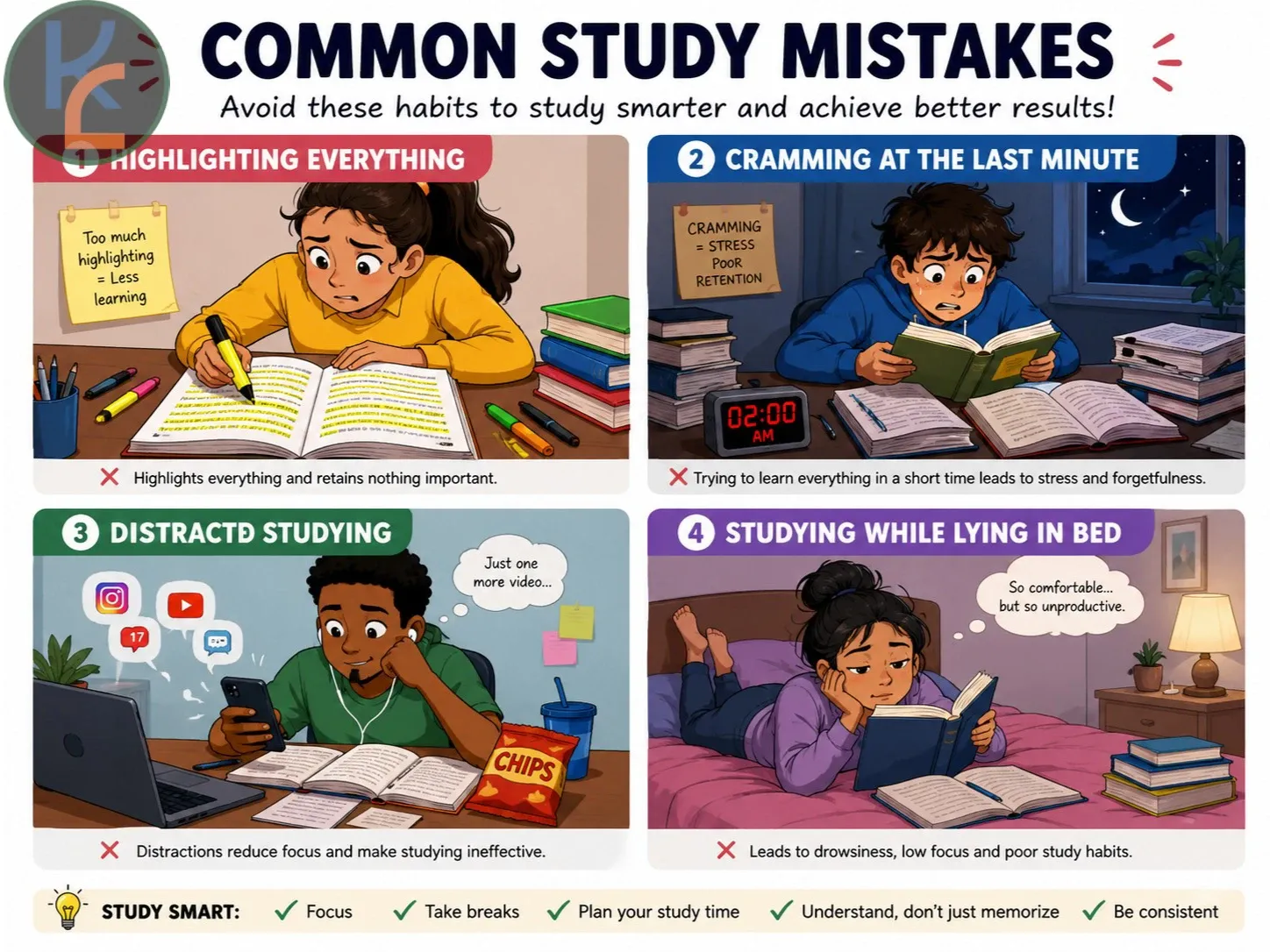
Studying smarter, not harder, is the key to better grades.
❌ Mistake #1: Reading Notes Without Testing Yourself
The problem: You re-read your notes, highlight key points, and feel like you "know" the material. But when the exam asks you to explain a concept in your own words, you freeze.
Why it fails: Passive reading creates familiarity, not understanding. Your brain recognizes the words but can't retrieve or apply the knowledge.
✅ The fix: Active Recall
- Read a section of your notes
- Close the book
- Write down everything you remember — without looking
- Open your notes and check what you missed
- Repeat until you can recall 90% without help
Pro tip: Use our free Mathematics past papers to test yourself under real exam conditions.
❌ Mistake #2: Cramming the Night Before
The problem: You wait until the last minute, then pull an all-nighter trying to memorize everything. You're exhausted, stressed, and still forget half of it.
Why it fails: Sleep is when your brain consolidates memories. Cramming skips this critical step, so information never moves from short-term to long-term memory.
✅ The fix: Spaced Repetition
- Day 1: Learn the topic
- Day 2: Review for 10 minutes
- Day 7: Review for 5 minutes
- Day 14: Quick 3-minute refresher
- Exam day: Confident recall
Pro tip: Download our free Primary study planners to schedule your review sessions.
❌ Mistake #3: Studying Without a Plan
The problem: You sit down to "study" but spend 30 minutes deciding what to do, then jump between subjects without finishing anything.
Why it fails: Decision fatigue drains mental energy. Without a plan, you waste time on low-priority topics and neglect weak areas.
✅ The fix: The 3-2-1 Daily Plan
Every study session, plan:
- 3 specific topics to cover
- 2 practice questions per topic
- 1 past paper section to complete
Write this down before you start. Check off each item as you finish.
❌ Mistake #4: Ignoring Your Weak Subjects
The problem: You love Mathematics, so you spend 80% of your time on it. You dread Chichewa, so you avoid it. Result: Strong subject gets stronger, weak subject stays weak.
Why it fails: University admission requires credits in all core subjects. One weak subject can block your path, no matter how strong you are elsewhere.
✅ The fix: The 60/40 Rule
- Spend 60% of study time on your 2 weakest subjects
- Spend 40% maintaining your strong subjects
- Rotate focus weekly so no subject gets neglected
Pro tip: Use our free Chichewa revision guides to build confidence in tough subjects.
❌ Mistake #5: Highlighting Everything
The problem: Your textbook looks like a rainbow — every sentence is highlighted in a different color. But when you review, nothing stands out.
Why it fails: Highlighting feels productive, but it's passive. If everything is important, nothing is important.
✅ The fix: The 3-Color System
- 🔴 Red: Key definitions/formulas (memorize these)
- 🟡 Yellow: Important concepts (understand these)
- 🟢 Green: Examples/applications (review these)
Limit highlighting to 10% of the text. If you highlight more, you're not prioritizing.
❌ Mistake #6: Studying in a Distracted Environment
The problem: You try to study with the radio on, phone buzzing, siblings talking nearby. You "study" for 2 hours but only focus for 20 minutes.
Why it fails: Every distraction breaks your concentration. It takes ~15 minutes to re-enter deep focus after an interruption.
✅ The fix: The Focus Zone
- Choose one quiet corner (even if it's just a mat in a quiet room)
- Put your phone in another room or use "Do Not Disturb"
- Use earplugs or white noise if needed
- Study in 45-minute blocks with 10-minute breaks
Pro tip: Tell your family your study schedule so they know when not to interrupt.
❌ Mistake #7: Not Using Past Papers Early Enough
The problem: You save past papers for "last month before exams." By then, it's too late to fix fundamental gaps.
Why it fails: Past papers aren't just for testing — they're for learning. They show you exactly what MANEB expects and how questions are phrased.
✅ The fix: Past Papers from Day 1
- Week 1: Do one past paper section to diagnose weak areas
- Week 2-4: Study weak topics using notes + targeted practice
- Week 5: Do another past paper section to measure progress
- Repeat until exam day
Pro tip: Our free MSCE past paper library has 5+ years of papers for every subject.
❌ Mistake #8: Studying Alone Without Feedback
The problem: You mark your own practice answers generously. "I'll give myself 70%... close enough." But exams don't give partial credit for "close."
Why it fails: Without honest feedback, you don't know what you don't know. Small misunderstandings compound into big gaps.
✅ The fix: The Study Buddy System
- Find 1-2 serious classmates preparing for the same exams
- Meet weekly (in person or via WhatsApp)
- Swap practice answers and mark each other honestly
- Explain difficult concepts to each other (teaching reinforces learning)
Pro tip: No study buddy? Join our free student WhatsApp group to connect with peers.
❌ Mistake #9: Skipping Breaks and Sleep
The problem: You think "more hours = better results," so you skip breaks, meals, and sleep to study longer.
Why it fails: Your brain needs rest to consolidate memories. Exhaustion reduces focus, retention, and problem-solving ability.
✅ The fix: The 50/10 Rule + Sleep Priority
- Study 50 minutes, rest 10 minutes (walk, stretch, hydrate)
- After 3 cycles, take a 30-minute break (eat, relax)
- Sleep 7-8 hours every night — non-negotiable
Science fact: Students who sleep 7+ hours score 15-20% higher on average than those who cram all night.
❌ Mistake #10: Not Reviewing Mistakes
The problem: You do a practice paper, see you got Question 5 wrong, think "Okay, noted," and move on. Next week, you make the same mistake again.
Why it fails: Mistakes are your best teachers — but only if you learn from them. Ignoring errors guarantees repetition.
✅ The fix: The Error Log
Create a simple notebook or digital note with 3 columns:
| Question | My Mistake | Correct Approach |
|---|---|---|
| Math Q12: Solve for x | Forgot to flip inequality sign when dividing by negative | Always flip inequality when multiplying/dividing by negative number |
| English Q3: Comprehension | Answered based on opinion, not text evidence | Always quote or paraphrase text to support answers |
Review your Error Log for 10 minutes before each study session.
🎯 Your Action Plan: Start Today
Don't try to fix all 10 mistakes at once. Pick one to focus on this week:
- Today: Choose your #1 mistake from the list above
- This week: Apply the fix consistently
- Next week: Add a second fix
- Before exams: You'll have transformed your study habits
Remember: Small, consistent improvements beat occasional heroic efforts every time.
📥 Free Resources to Help You Study Smarter
Past papers, revision guides, and study planners — all free for Malawian students.
Access Free Study Resources
✅ 100% free • No signup required • Works offline
Written for every Malawian student who's ready to turn effort into results.
— Kizito Chikuni, Educator & Developer



Sign in securely with Google to join the discussion.