
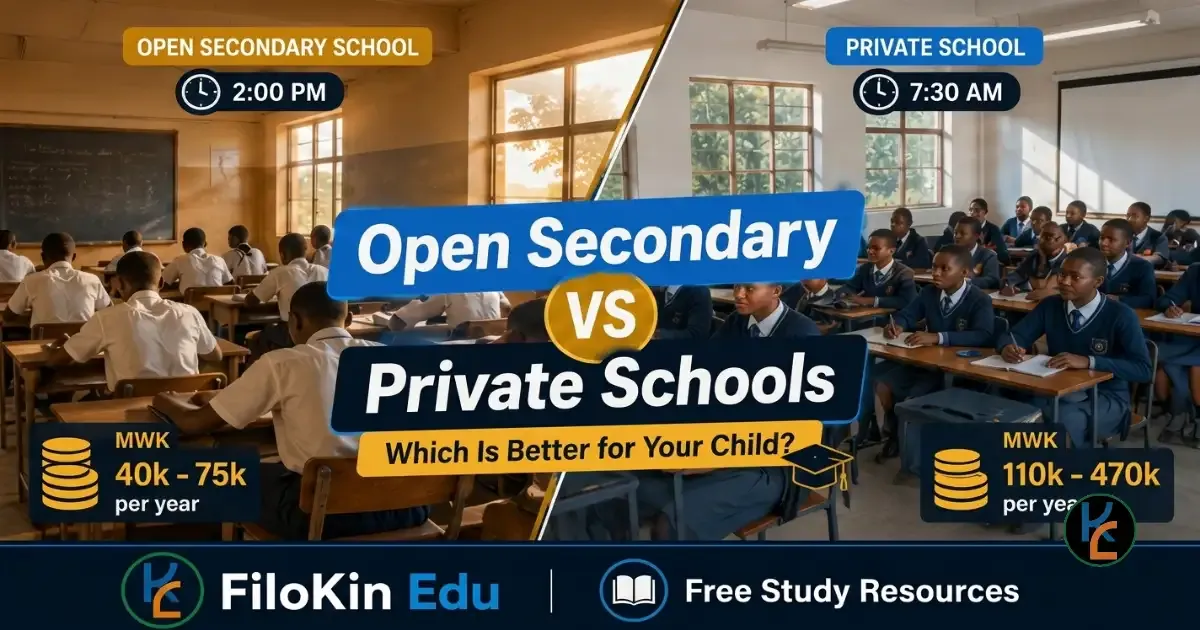
Open Secondary vs Private Schools: Which Is Better for Your Child? (2026 Guide)
Your child has passed the Primary School Leaving Certificate of Education (PSLCE) exams, but they weren't selected for secondary school placement by the Ministry of Education. You're facing a critical decision:
Should you enroll them in an Open Secondary School (CDSS) or a Private Secondary School?
Both options have advantages and disadvantages. As a parent, you want the best education for your child, but you also need to consider cost, quality, and practicality.
This comprehensive guide compares both options across 7 critical factors to help you make an informed decision before schools open on 14th September 2026.
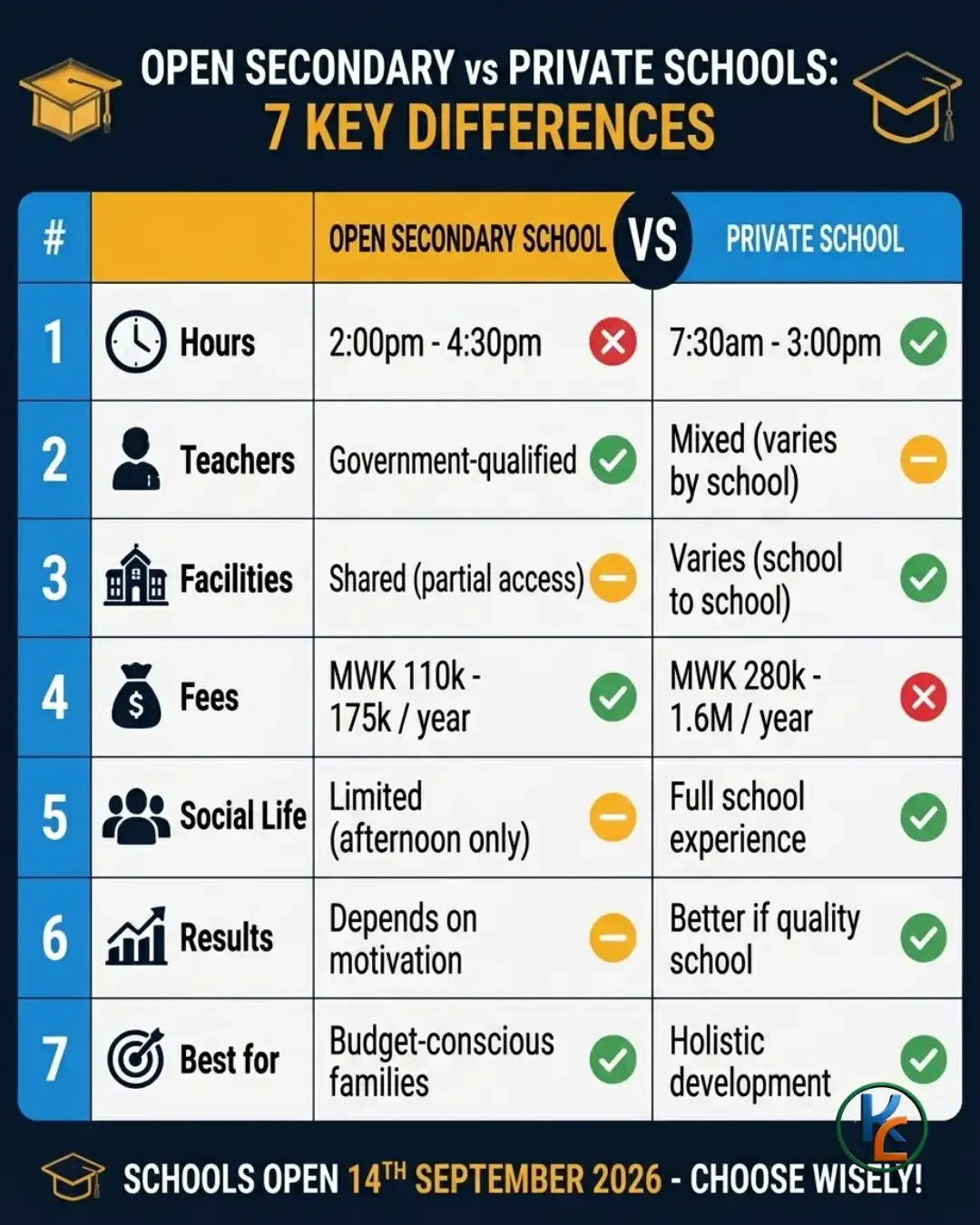
Quick Comparison Table
| Factor | Open Secondary (CDSS) | Private Secondary School |
|---|---|---|
| School Hours | 2:00 PM - 4:30 PM | 7:30 AM - 3:00 PM |
| Teachers | Government-qualified teachers | Mixed qualifications (varies by school) |
| Facilities | Shared (partial access after 2pm) | Varies (some lack labs/libraries) |
| Annual Fees | MWK 110,000 - 175,000 | MWK 280,000 - 1,600,000+ |
| Social Life | Limited (part-time) | Full (clubs, sports, activities) |
1. ⏰ Learning Hours: Which Schedule Is Better?
Open Secondary Schools (CDSS): 2:00 PM - 4:30 PM
The Reality:
- Students attend classes after regular government-selected students finish
- Only 2.5 hours of instruction per day
- Share facilities with regular students (limited access to labs, library, sports grounds)
- Often feel like "second-class" students in the same school
Pros:
- ✅ Cheaper fees
- ✅ Government-qualified teachers
- ✅ Can help with family chores in the morning
Cons:
- ❌ Very limited learning time (2.5 hours vs 7.5 hours)
- ❌ Rushed lessons - teachers must cover the same syllabus in less time
- ❌ Students are tired by 2pm (less concentration)
- ❌ No time for remedial classes or extra support
- Limited access to science labs, computer labs, and library
Private Secondary Schools: 7:30 AM - 3:00 PM
The Reality:
- Full school day (approximately 7.5 hours)
- Normal school routine like government schools
- Time for morning assembly, full lessons, break time, and co-curricular activities
- Students feel like "regular" secondary school students
Pros:
- ✅ Triple the learning time compared to open secondary
- ✅ More time for each subject
- ✅ Time for remedial classes and extra tuition
- ✅ Full access to school facilities (when available)
- ✅ Better for students transitioning from primary school (full-day structure)
Cons:
- ❌ Higher fees
- ❌ Teacher quality varies significantly between schools
- ❌ Some schools lack proper facilities
💡 Expert Verdict on Learning Hours:
For a student just coming from primary school, Private Secondary Schools offer a better learning environment due to full-day structure, more instructional time, and better transition from the primary school routine. However, this advantage only holds if the private school has qualified teachers and adequate facilities.
2. 👨🏫 Teacher Quality: Who Teaches Better?
Open Secondary Schools (CDSS)
Teacher Qualifications:
- ✅ All teachers are government-employed and TCM-registered
- ✅ Minimum qualifications: Diploma or Degree in Education
- ✅ Often experienced teachers (many have taught for 10+ years)
- ✅ Regular training and supervision by Ministry of Education
But there's a catch:
- ⚠️ Teachers teach both regular students (morning) and open students (afternoon)
- ⚠️ By 2pm, teachers are tired and may rush through lessons
- ⚠️ Less time for individual attention
Private Secondary Schools
Teacher Qualifications:
- ✅ Varies widely - from excellent to poor
- ✅ Top private schools hire highly qualified, experienced teachers
- ️ Some lower-tier private schools hire underqualified teachers to cut costs
- ️ May have teachers without proper TCM registration
How to check teacher quality before enrolling:
- Ask the school: "What percentage of your teachers are TCM-registered?"
- Request to see teachers' qualifications
- Ask about teacher turnover rate (high turnover = red flag)
- Talk to current parents about teacher quality
- Check the school's JCE/MSCE pass rates over the past 3 years
💡 Expert Verdict on Teacher Quality:
Open Secondary Schools have more consistent teacher quality because all teachers are government-qualified. However, private schools with excellent reputations often have better teachers who are more dedicated and provide individual attention. Research the specific private school before enrolling.
3. 🏫 Facilities: Labs, Libraries, and Learning Resources
Open Secondary Schools (CDSS)
The Reality:
- Share facilities with regular government students
- Science Labs: Limited access (only after 2pm when regular students finish)
- Library: May have restricted hours or limited borrowing privileges
- Computer Labs: Often unavailable or very limited access
- Sports Grounds: Can use after regular students finish
- Toilets/Water: Shared facilities (often overcrowded)
Impact on Learning:
- ❌ Science practicals are rushed or done in groups (less hands-on experience)
- ❌ Limited library time affects research and reading skills
- ❌ No computer literacy training (critical for modern education)
- ❌ Students may feel like "second-class" citizens
Private Secondary Schools
The Reality:
- Varies dramatically between schools
- ✅ Top-tier private schools: Excellent facilities (modern labs, libraries, computer rooms, sports facilities)
- ⚠️ Mid-tier schools: Basic facilities (small library, limited lab equipment)
- ❌ Lower-tier schools: May have no science lab, no library, or inadequate classrooms
Critical Questions to Ask Before Enrolling:
- "Do you have a functional science laboratory?"
- "How many computers do you have, and do students get computer lessons?"
- "Do you have a library? How many books?"
- "Can I tour the facilities before enrolling?"
- "What co-curricular activities do you offer?"
💡 Expert Verdict on Facilities:
Well-established private schools typically offer better facilities than open secondary schools. However, many low-cost private schools have worse facilities than CDSS. Always visit the school and inspect the facilities before paying fees. Don't rely on promises - see it with your own eyes.
4. 💰 School Fees: What Can You Afford? (2026 Price estimates)
Open Secondary Schools (CDSS)
Typical Annual Costs:
- Tuition Fees: MWK 35,000 - MWK 60,000 per year
- Examination Fees: MWK 15,000 - MWK 20,000
- Uniforms: MWK 40,000 - MWK 60,000
- Books & Materials: MWK 20,000 - MWK 35,000
- Total per year: Approximately MWK 110,000 - MWK 175,000
Advantages:
- ✅ Most affordable option
- ✅ No hidden costs
- ✅ Government-regulated fees
Private Secondary Schools
Typical Annual Costs:
- Tuition Fees: MWK 60,000 - MWK 700,000+ per year (varies widely)
- Registration Fees: MWK 5,000 - MWK 20,000 (one-time)
- Development Levy: MWK 20,000 - MWK 60,000
- Examination Fees: MWK 20,000 - MWK 80,000
- Uniforms: MWK 120,000 - MWK 300,000
- Books & Materials: MWK 35,000 - MWK 130,000
- Total per year: Approximately MWK 280,000 - MWK 1,600,000+
Warning Signs:
- ⚠️ Very cheap private schools (under MWK 200,000/year) often cut corners on teacher salaries and facilities
- ⚠️ Ask about hidden costs: PTA fees, sports fees, trip fees, remedial class fees
- ⚠️ Check if fees are paid per term or annually (some schools offer discounts for annual payment)
💡 Expert Verdict on Fees:
Open Secondary Schools are 3-5x cheaper than private schools. However, don't choose based on price alone. A MWK 450,000/year private school with excellent teachers and facilities may provide better value than a MWK 110,000/year open secondary school with limited learning time. Consider your budget, but also consider the return on investment - better education now leads to better opportunities later.
5. 👥 Social Life and Co-Curricular Activities
Open Secondary Schools (CDSS)
Limited Social Experience:
- ❌ No morning assembly (misses school culture and values)
- Limited or no sports teams
- ❌ No clubs or extracurricular activities
- ❌ Students go home immediately after classes
- ❌ Less bonding with classmates
- ❌ May feel isolated from the "main" school
Private Secondary Schools
Full School Experience:
- ✅ Morning assembly and school culture
- ✅ Sports teams and competitions
- ✅ Clubs (debate, drama, science club, etc.)
- ✅ School trips and educational tours
- ✅ Leadership opportunities (prefects, club leaders)
- ✅ Better social development and confidence building
Expert Verdict on Social Life:
Private schools offer a much richer social and co-curricular experience, which is crucial for holistic development. However, if finances are tight, parents can supplement open secondary education by enrolling children in weekend clubs, church youth groups, or community sports programs.
6. 📈 Academic Performance: Which Produces Better JCE Results?
The Truth: There's no definitive national data comparing JCE pass rates between open secondary and private schools. However, based on educational research and teacher observations:
Open Secondary Schools - Challenges:
- ❌ Limited instructional time (2.5 hours/day) affects syllabus coverage
- ❌ Students are tired by 2pm (lower concentration)
- Less time for revision and exam preparation
- ❌ Limited practical work in sciences
- ✅ BUT: Government-qualified teachers know the curriculum well
Private Secondary Schools - Advantages:
- ✅ More instructional time allows thorough syllabus coverage
- ✅ Time for remedial classes and exam preparation
- ✅ Better facilities support practical learning
- ✅ Smaller class sizes (in good schools) = more individual attention
- ⚠️ BUT: Teacher quality varies - poor teachers = poor results regardless of time
💡 Expert Verdict on Academic Performance:
A well-run private school with qualified teachers typically produces better JCE results than open secondary schools due to more learning time and better resources. However, a motivated student in open secondary who studies hard at home can still excel. The key factor is student motivation and parental support, not just the school type.
7. 🎯 Which Option Is Best for YOUR Child?
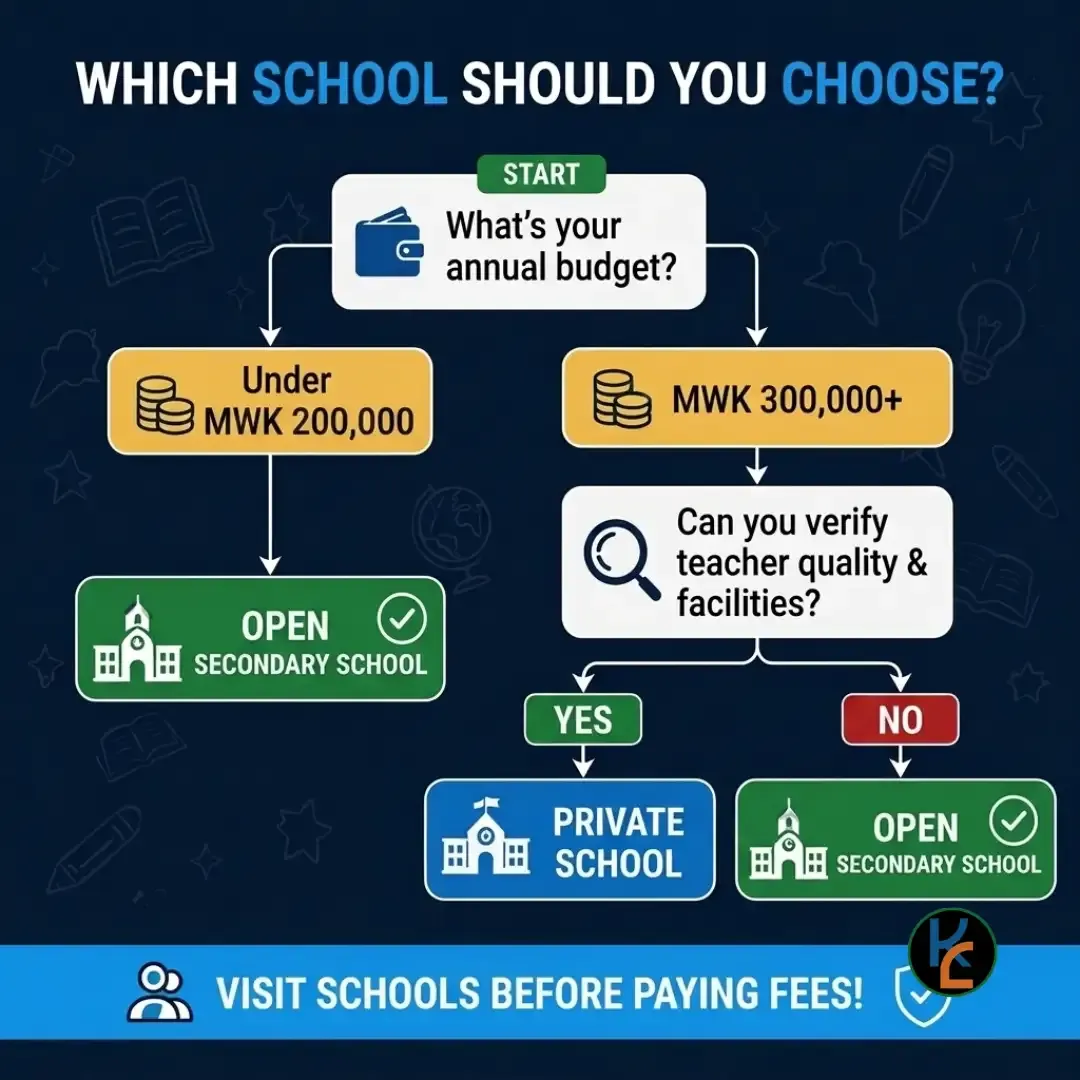
Choose Open Secondary School (CDSS) If:
- ✅ Your budget is very limited (under MWK 200,000/year)
- ✅ Your child is self-motivated and disciplined
- ✅ Your child can study independently at home
- ✅ You can provide additional tutoring or support
- ✅ Your child needs to help with family chores or work
- ✅ There are no quality private schools in your area
Choose Private Secondary School If:
- ✅ You can afford MWK 300,000+ per year
- ✅ The school has TCM-registered, experienced teachers
- ✅ The school has adequate facilities (labs, library, classrooms)
- ✅ Your child benefits from structured, full-day learning
- ✅ Your child needs more guidance and supervision
- ✅ You value co-curricular activities and holistic development
- ✅ The school has a good track record of JCE results
Before You Decide: A Parent's Checklist
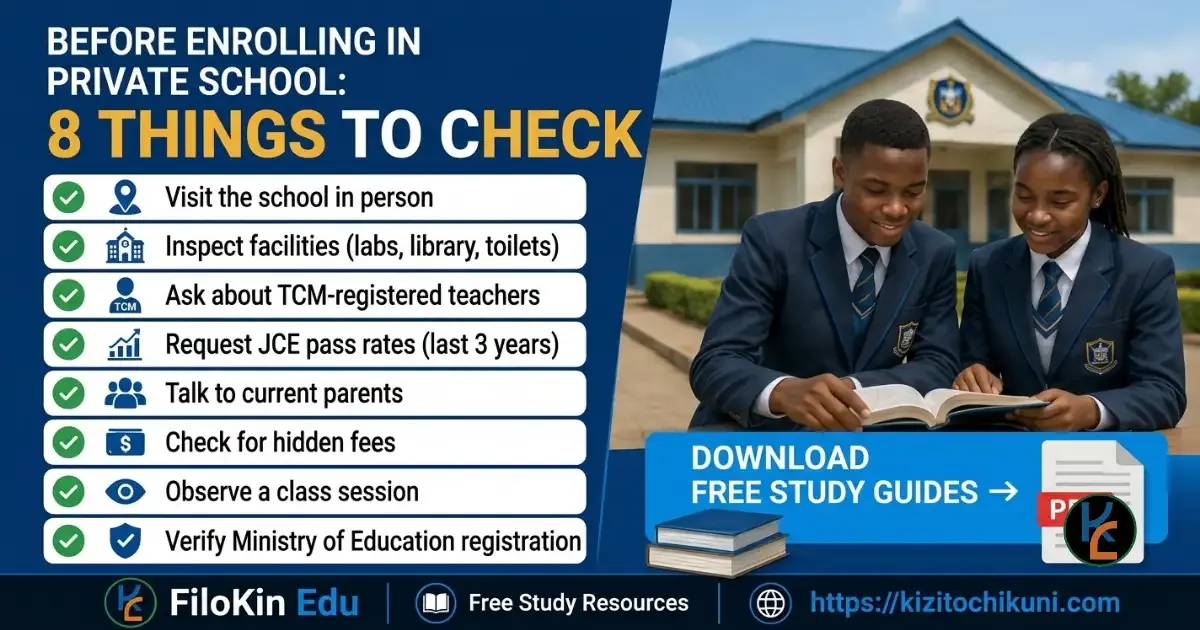
If considering a Private Secondary School, do this BEFORE paying fees:
- Visit the school in person - Don't rely on brochures or promises
- Inspect the facilities - Check classrooms, toilets, water supply, science lab, library
- Ask about teacher qualifications - "How many teachers are TCM-registered?"
- Request JCE pass rates - Ask for the last 3 years' results
- Talk to current parents - Ask about teacher quality, administration, and value for money
- Check the fee structure - Are there hidden costs? What happens if you miss a payment?
- Observe a class - Ask if you can sit in on a lesson to see teaching quality
- Check registration - Is the school registered with the Ministry of Education?
📚 Free Study Resources for Secondary Students
Whether your child joins open secondary or private school, they'll need quality study materials. Download free past papers, marking schemes, and study guides to help them excel in JCE.
Browse Free Secondary School Resources
✅ 100% Free • JCE & MSCE Past Papers • Works Offline
🌟 Final Thoughts: There's No "Wrong" Choice
Whether you choose open secondary or private school, remember:
- Your child's success depends more on their effort than the school type. A motivated student in open secondary can outperform a lazy student in the best private school.
- Parental involvement matters. Check homework, attend PTA meetings, and stay involved in your child's education regardless of which school they attend.
- This is not the end of the road. If your child starts in open secondary and excels, they can transfer to a better school later. Education is a marathon, not a sprint.
- Don't compare your child to others. Every child is different. Choose what works for YOUR child's learning style, YOUR budget, and YOUR family situation.
Schools open on 14th September 2026. Make your decision wisely, prepare your child emotionally and academically, and support them throughout their secondary school journey.
Need study materials to help your child succeed? Browse our free collection of past papers and study guides for JCE and MSCE subjects. Every student deserves quality resources, regardless of which school they attend.
Sign in securely with Google to join the discussion.