
📚 JCE Physics Complete Revision Guide: Topics, Formulas & Exam Tips (2026)
Preparing for your Junior Certificate of Education (JCE) Physics exam? You're in the right place!
This complete revision guide covers everything you need to know to score top marks in your JCE Physics examination. Whether you're struggling with difficult concepts or just want to polish your understanding, this guide will help you study smarter and achieve better results.
📋 What's in This Guide?
- ✅ All JCE Physics topics explained
- ✅ Key formulas you MUST memorize
- ✅ Practical experiments and what to expect
- ✅ Common exam mistakes to avoid
- ✅ Past paper strategies
- ✅ Study timetable template
📖 Section 1: All JCE Physics Topics Covered
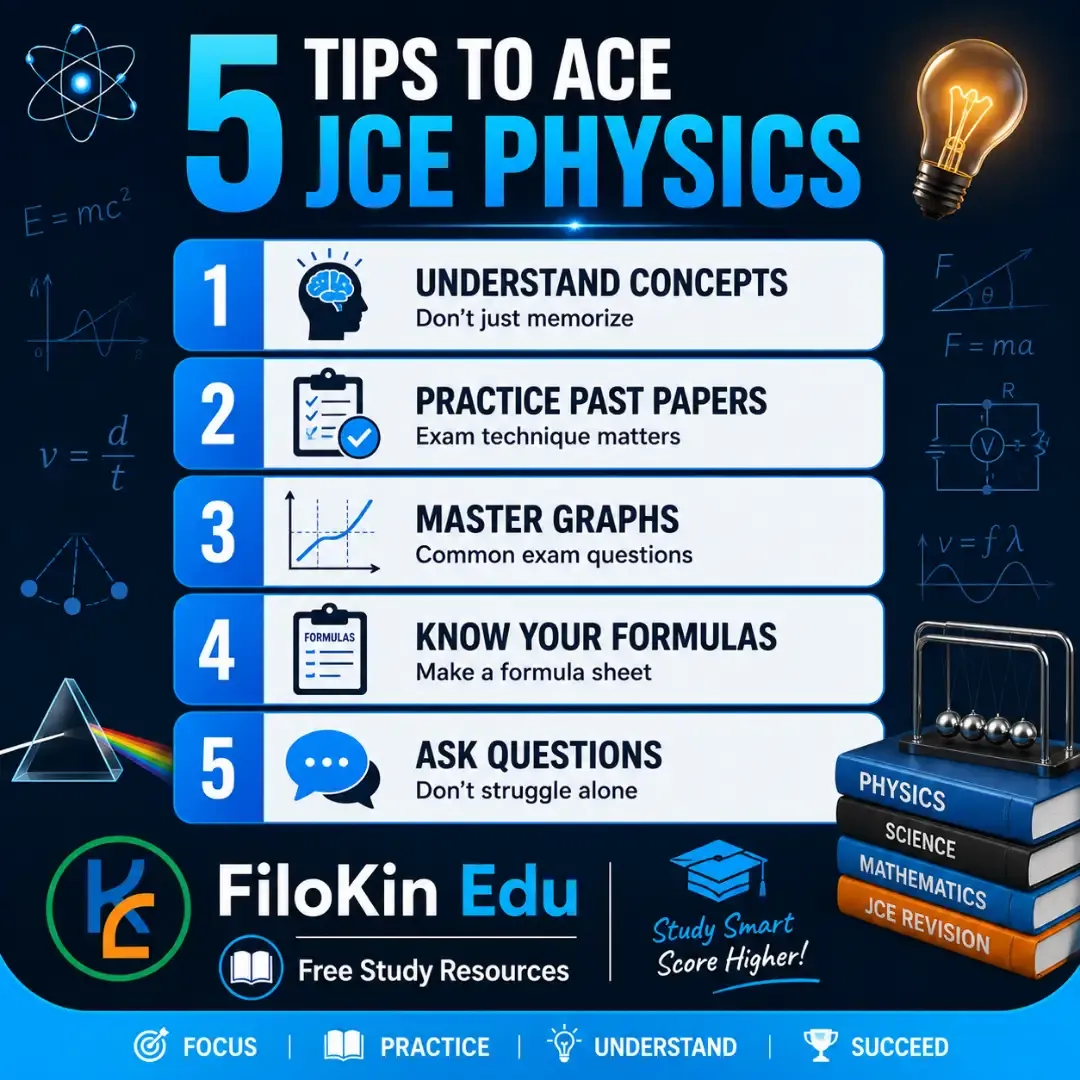
1. Measurements and Units
Key Concepts:
- SI units (meter, kilogram, second, ampere, kelvin)
- Prefixes: kilo (k), mega (M), giga (G), milli (m), micro (μ), nano (n)
- Scientific notation and standard form
- Significant figures
- Measuring instruments: meter rule, vernier calipers, micrometer screw gauge, stopwatch, measuring cylinder
Exam Tip: Always write units in your final answers. Marks are often lost for missing units!
2. Scalars and Vectors
Key Concepts:
- Scalar quantities: magnitude only (mass, time, distance, speed, energy)
- Vector quantities: magnitude + direction (force, velocity, displacement, acceleration)
- Vector addition using triangle and parallelogram methods
- Resolution of vectors into components
Formula to Remember:
Resultant of two perpendicular vectors: R = √(A² + B²)
3. Motion
Key Concepts:
- Distance vs displacement
- Speed vs velocity
- Acceleration and deceleration
- Uniform and non-uniform motion
- Velocity-time and distance-time graphs
Essential Formulas:
- Speed = Distance ÷ Time
(v = d/t) - Velocity = Displacement ÷ Time
(v = s/t) - Acceleration = Change in Velocity ÷ Time
(a = (v-u)/t) - Equations of Motion:
v = u + ats = ut + ½at²v² = u² + 2as
4. Force and Newton's Laws
Key Concepts:
- Newton's First Law: An object remains at rest or in uniform motion unless acted upon by an external force
- Newton's Second Law: F = ma (Force = mass × acceleration)
- Newton's Third Law: For every action, there is an equal and opposite reaction
- Friction and its effects
- Momentum and conservation of momentum
Formulas:
- Force:
F = ma - Weight:
W = mg(where g = 10 m/s²) - Momentum:
p = mv - Impulse:
Ft = mv - mu
5. Energy, Work and Power
Key Concepts:
- Forms of energy: kinetic, potential, thermal, electrical, light, sound, nuclear
- Law of conservation of energy
- Energy transformations
- Renewable and non-renewable energy sources
Essential Formulas:
- Work Done:
W = F × d(Force × distance) - Kinetic Energy:
KE = ½mv² - Potential Energy:
PE = mgh - Power:
P = W/torP = Fv - Efficiency:
Efficiency = (Useful Output / Total Input) × 100%
6. Pressure
Key Concepts:
- Pressure in solids, liquids, and gases
- Atmospheric pressure
- Pascal's principle
- Applications: hydraulic press, barometer, manometer
Formulas:
- Pressure:
P = F/A(Force Area) - Liquid pressure:
P = gh(density × gravity × height)
7. Heat and Temperature
Key Concepts:
- Temperature scales (Celsius, Fahrenheit, Kelvin)
- Thermal expansion of solids, liquids, and gases
- Heat transfer: conduction, convection, radiation
- Specific heat capacity
- Latent heat
Formulas:
- Heat Energy:
Q = mcΔT - Latent Heat:
Q = mL - Kelvin conversion:
K = °C + 273
8. Waves and Sound
Key Concepts:
- Transverse vs longitudinal waves
- Wave properties: amplitude, wavelength, frequency, period, speed
- Sound waves and their characteristics
- Reflection, refraction, and diffraction of waves
- Electromagnetic spectrum
Formulas:
- Wave speed:
v = fλ(frequency × wavelength) - Period:
T = 1/f - Speed of sound in air ≈ 330-340 m/s
9. Light and Optics
Key Concepts:
- Laws of reflection
- Plane and curved mirrors
- Refraction and Snell's Law
- Lenses (convex and concave)
- Applications: periscope, microscope, telescope, eye
Formulas:
- Refractive index:
n = sin i / sin r - Lens formula:
1/f = 1/u + 1/v - Magnification:
M = v/u = hi/ho
10. Electricity and Magnetism
Key Concepts:
- Electric charge and current
- Conductors and insulators
- Simple circuits (series and parallel)
- Ohm's Law
- Electrical power and energy
- Magnetic fields and electromagnets
- Motors and generators
Essential Formulas:
- Ohm's Law:
V = IR - Electrical Power:
P = VI = I²R = V²/R - Electrical Energy:
E = VIt - Series circuits:
Rtotal = R₁ + R₂ + R₃... - Parallel circuits:
1/Rtotal = 1/R₁ + 1/R₂ + 1/R₃...
11. Atomic Physics
Key Concepts:
- Structure of the atom (protons, neutrons, electrons)
- Atomic number and mass number
- Isotopes
- Radioactivity (alpha, beta, gamma radiation)
- Half-life
- Uses and dangers of radioactivity
📝 Section 2: Must-Know Formulas Summary
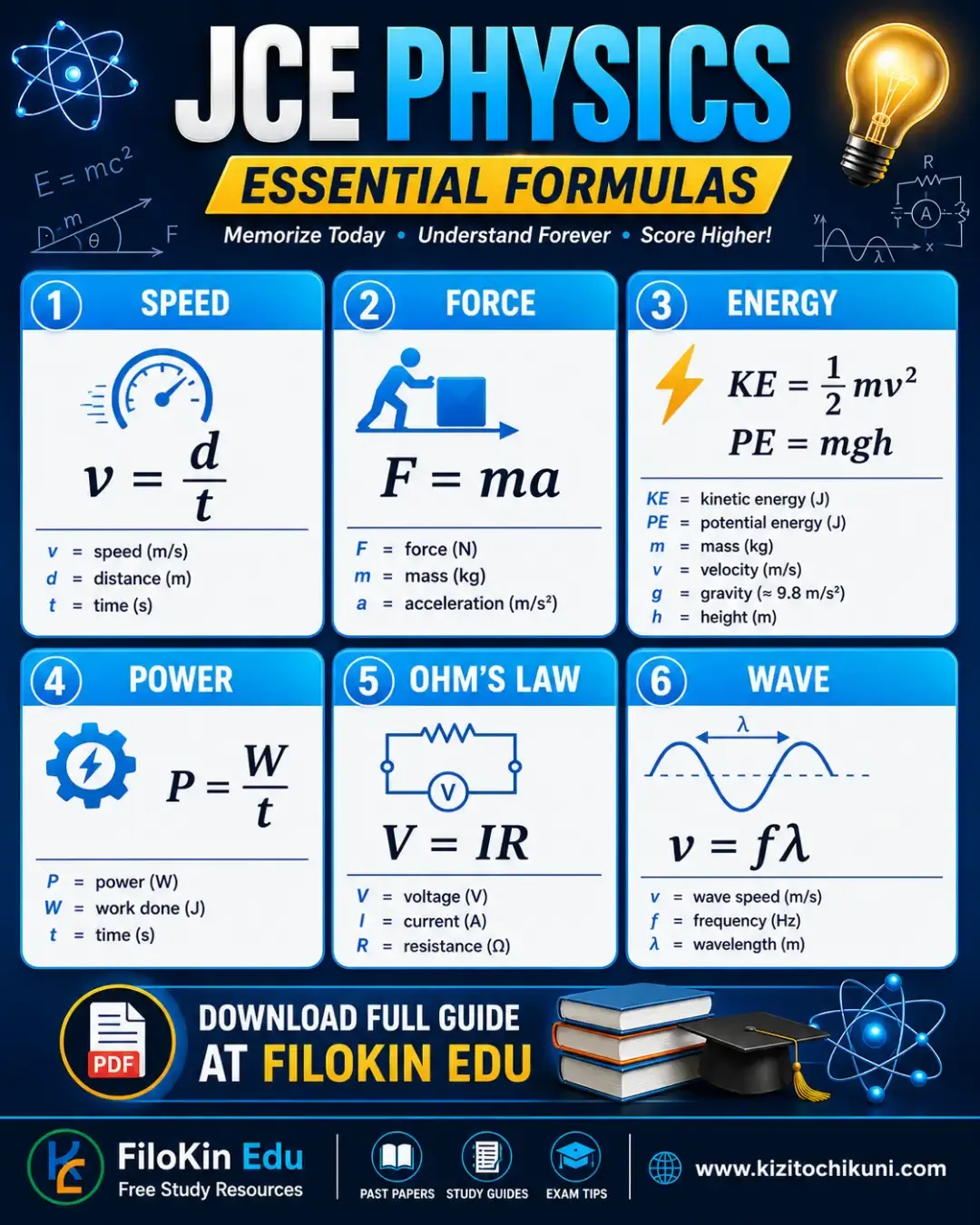
Print this out and memorize these formulas!
| Topic | Formula |
|---|---|
| Speed | v = d/t |
| Acceleration | a = (v-u)/t |
| Force | F = ma |
| Weight | W = mg |
| Work Done | W = F × d |
| Kinetic Energy | KE = ½mv² |
| Potential Energy | PE = mgh |
| Power | P = W/t |
| Pressure | P = F/A |
| Wave Speed | v = fλ |
| Ohm's Law | V = IR |
| Electrical Power | P = VI |
Section 3: Practical Experiments You Must Know
JCE Physics includes practical questions. Be familiar with these common experiments:
1. Determining Density of Irregular Objects
- Use a measuring cylinder with water
- Record initial volume, then volume after object is submerged
- Difference = volume of object
- Density = mass volume
2. Verification of Ohm's Law
- Set up circuit with resistor, ammeter, voltmeter, and variable resistor
- Vary current and record voltage
- Plot V against I graph - should be a straight line through origin
- Gradient = resistance
3. Determining Acceleration Due to Gravity (g)
- Use simple pendulum
- Measure time for 20 oscillations
- Calculate period T
- Use formula:
T = 2π√(L/g) - Plot T² against L graph
4. Finding Focal Length of a Convex Lens
- Use lens formula method or distant object method
- Measure object distance (u) and image distance (v)
- Use:
1/f = 1/u + 1/v
⚠️ Section 4: Common Mistakes to Avoid
- Forgetting Units: Always write units (m, s, kg, N, J, W, etc.) in your final answers.
- Wrong Formula: Read the question carefully. Don't confuse speed with velocity, or mass with weight.
- Calculation Errors: Show all your working. Even if your final answer is wrong, you can still get method marks.
- Not Converting Units: Convert cm to m, minutes to seconds, g to kg before calculating.
- Ignoring Directions: For vector quantities (force, velocity), direction matters!
- Rounding Too Early: Keep all decimal places during calculations, round only at the end.
- Poor Graph Drawing: Use a sharp pencil, label axes with units, use appropriate scales, draw best-fit line (not dot-to-dot).
📅 Section 5: 4-Week Study Timetable Template
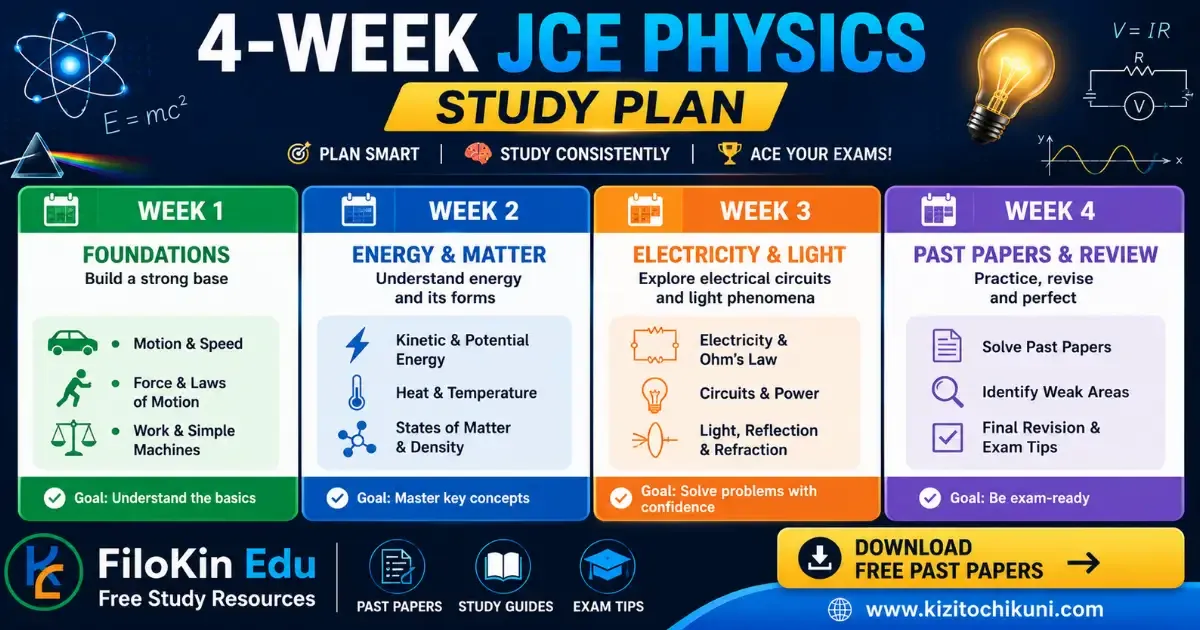
Use this template to organize your revision:
Week 1: Foundations
- Mon-Tue: Measurements, Units, Scalars & Vectors
- Wed-Thu: Motion (all formulas and graphs)
- Fri: Practice questions on Week 1 topics
- Sat: Force and Newton's Laws
- Sun: Rest & light revision
Week 2: Energy & Matter
- Mon-Tue: Energy, Work, Power
- Wed-Thu: Pressure, Heat & Temperature
- Fri: Practice questions
- Sat: Waves and Sound
- Sun: Rest & light revision
Week 3: Electricity & Light
- Mon-Tue: Light and Optics
- Wed-Thu: Electricity and Magnetism
- Fri: Practice questions
- Sat: Atomic Physics
- Sun: Rest & light revision
Week 4: Past Papers & Weak Areas
- Mon-Wed: Do 3 past papers under exam conditions
- Thu-Fri: Review mistakes and revise weak topics
- Sat: Final formula memorization
- Sun: Relax before exam
🎯 Section 6: Exam Day Strategies
Before the Exam:
- ✅ Get enough sleep (7-8 hours)
- ✅ Eat a good breakfast
- ✅ Arrive early (at least 30 minutes before)
- ✅ Bring all materials: calculator, ruler, pencil, pen, eraser
During the Exam:
- Read Instructions Carefully: Don't rush. Understand what's being asked.
- Time Management:
- Section A (Multiple Choice): 30 minutes
- Section B (Theory): 1 hour 30 minutes
- Leave 10 minutes for checking
- Start with Easy Questions: Build confidence and secure easy marks first.
- Show All Working: Even if your answer is wrong, you can get method marks.
- Draw Diagrams: Label clearly. Use a ruler for straight lines.
- Check Units: Always include units in final answers.
- Don't Leave Blanks: Attempt every question. Guess if necessary (no negative marking).
📥 Download Free JCE Physics Past Papers
Practice makes perfect! Download free JCE Physics past papers with marking schemes to test your knowledge and improve your exam technique.
Browse Free Physics Past Papers
✅ 100% Free • Marking Schemes Included • Works Offline
🌟 Final Tips for Success
- Understand, Don't Memorize: Physics is about understanding concepts, not just memorizing formulas.
- Practice Daily: Even 30 minutes of daily study is better than cramming.
- Use Multiple Resources: Textbooks, past papers, online videos, study groups.
- Ask Questions: If you don't understand something, ask your teacher or classmates.
- Stay Positive: Believe in yourself. You can do this!
Remember: Physics is not as difficult as it seems. With consistent study, practice, and the right approach, you can score excellent marks in your JCE Physics exam.
Good luck with your studies! 📚✨
Need more help? Browse our free collection of JCE Physics past papers and study guides. Every resource is designed to help you succeed!



Sign in securely with Google to join the discussion.