

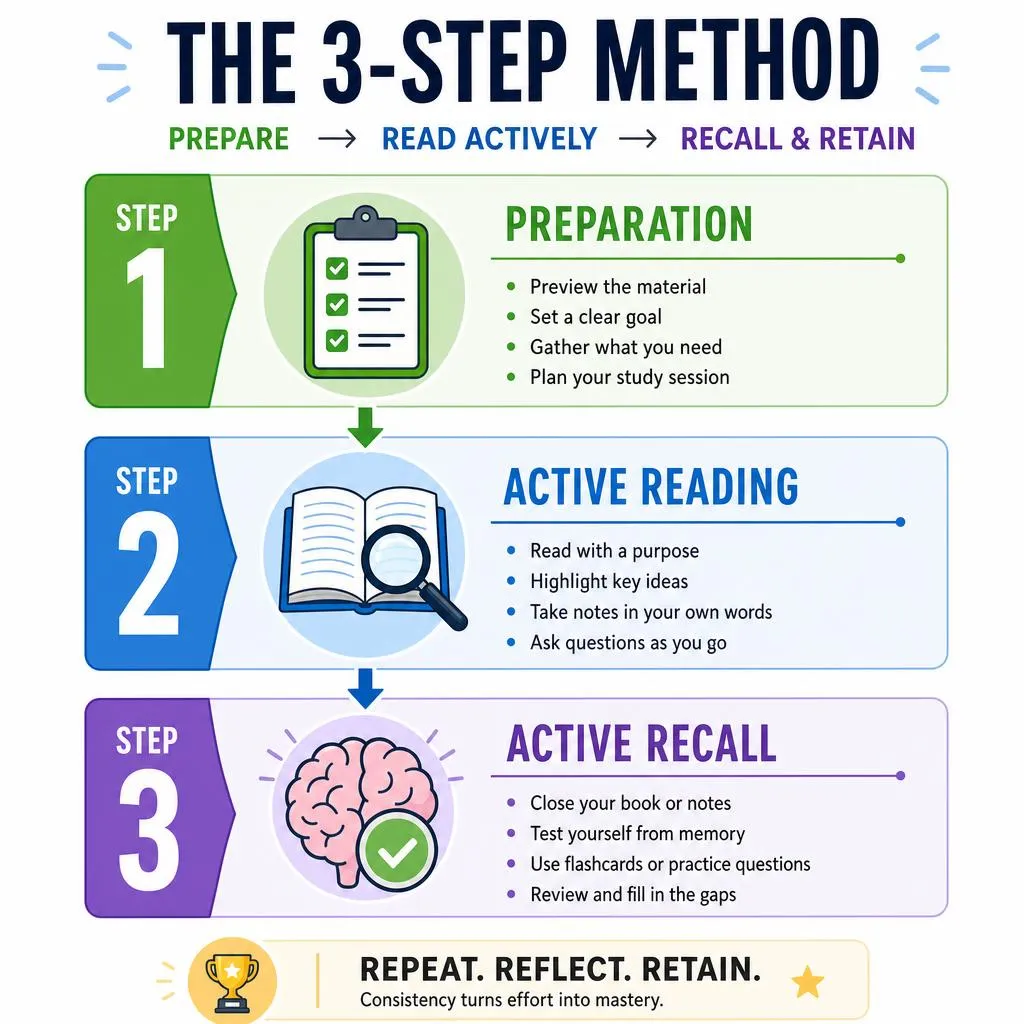
🎯 Quick Summary: The 3-Step Study Method
What You Need Before Starting:
- Identify your topic of study
- Have your notes for the subject
- Gather about 5 past papers (mock and/or MANEB) on the subject
- Identify questions that have been asked previously on your topic
Follow this method, and you'll understand concepts deeply while retaining information longer.
How to Study Effectively for Academic Success: The Proven Method
"I studied for hours but still failed the exam."
"I memorized everything but couldn't answer the questions."
"I don't know how to use my past papers effectively."
If any of these sound familiar, you're not alone. Thousands of Malawian students study hard but still struggle with exams. The problem isn't your effort — it's your study method.
The good news? There's a proven, systematic approach that top students use to excel. This method combines active recall, spaced repetition, and strategic past paper practice — all backed by educational research.
Below is the complete step-by-step guide to studying effectively, specifically designed for Malawian students preparing for PSLCE, MSCE, JCE, and other examinations.

📚 Step 1: Preparation — Gather Your Study Materials
Before you even open a book, you need the right materials. Studying without preparation is like building a house without tools.
What You Need:
- 1. Identify Your Topic: Be specific. Instead of "Mathematics," choose "Algebraic Expressions" or "Geometry - Angles."
- 2. Your Class Notes: The notes your teacher gave you or that you wrote in class.
- 3. About 5 Past Papers: MANEB papers, mock exam papers, or any official practice papers for your subject.
- 4. Question Analysis: Before studying, read through all past paper questions on your topic. Understand what's being asked.
Why This Matters: Most students skip this step and jump straight into reading. But knowing what examiners ask helps you study strategically, not just randomly.

📖 Step 2: The Active Reading Method
This is where most students go wrong. They read passively, highlight everything, and hope it sticks. Instead, use this active reading approach:
Phase A: Read Past Paper Questions First (5-10 minutes)
- Read each question carefully
- Understand what the examiner is asking
- Note the command words: "calculate," "explain," "describe," "compare"
- Don't try to answer yet — just understand
Phase B: Read Your Notes Strategically (30-45 minutes)
Now, read your notes with purpose:
- Read the entire topic from start to finish without stopping
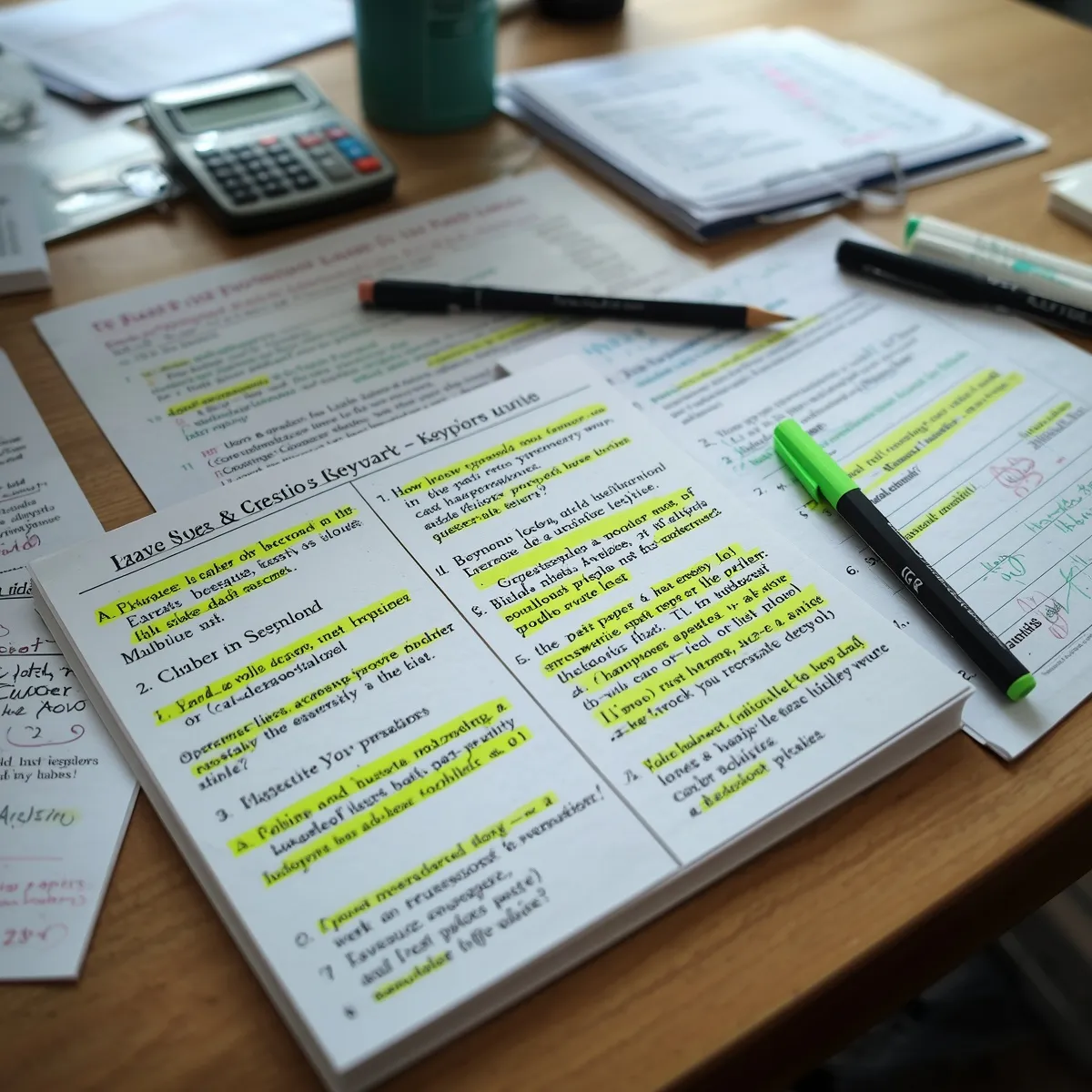
- On second reading, mark answers: Where do your notes answer the past paper questions you read? Highlight or underline those sections.
- Mark difficult words: Circle or underline any terms, concepts, or explanations you don't fully understand.
- Mark difficult points: Note any concepts that confuse you or seem too complex.
Key Tip: Don't just highlight randomly. Every mark you make should connect to a past paper question or a gap in your understanding.
✍️ Step 3: Active Recall Practice (The Game-Changer)
This is the step that separates top students from average students. It's uncomfortable at first, but it's where real learning happens.
The Process:
- Close your notes: Put away your exercise book, notebook, or device. No peeking!
- Take your past papers: Choose one question at a time
- Attempt to answer from memory: Write your answer without looking at your notes
- Struggle is good: If you can't remember, that's okay! The struggle strengthens your brain's memory pathways.
- If stuck after multiple attempts:
- Open your notes and review the relevant section
- Understand the concept fully
- Close your notes again
- Try answering the question again from memory
- Repeat for all questions on your topic
Why This Works: This method is called active recall — one of the most effective study techniques proven by research. When you force your brain to retrieve information without help, you build stronger, longer-lasting memories.
⚠️ Critical Mistakes Most Students Make (And How to Avoid Them)
Even with the right method, these common mistakes can sabotage your success:
❌ Mistake 1: Studying While Lying Down or on Your Bed
Why it's bad: Your brain associates your bed with sleep. Studying there makes you drowsy and reduces focus.
✅ Do this instead: Study at a desk or table in an upright position. Keep your study space separate from your sleeping space.
❌ Mistake 2: Just Memorizing Without Understanding
Why it's bad: Memorization without comprehension means you'll forget quickly and can't apply knowledge to new questions.
✅ Do this instead: Focus on understanding why and how. Ask yourself: "Does this make sense?" If not, ask your teacher.
❌ Mistake 3: Studying Multiple Topics at Once
Why it's bad: Your brain can't deeply learn multiple topics simultaneously. You'll end up with shallow knowledge of everything.
✅ Do this instead: Master one topic completely before moving to the next. Use the method above for each topic individually.
❌ Mistake 4: Studying in a Stressful Environment
Why it's bad: Stress releases cortisol, which impairs memory formation and concentration.
✅ Do this instead: Choose a calm, comfortable space. If home is stressful, try the library or a quiet community space.
❌ Mistake 5: Studying with Phone/Internet Accessible
Why it's bad: Notifications and social media destroy focus. It takes 23 minutes to refocus after each interruption!
✅ Do this instead: Put your phone in another room or use "Do Not Disturb" mode. If you need it for study, use apps like Forest or Freedom to block social media.
❌ Mistake 6: Studying in a Noisy Environment
Why it's bad: Noise disrupts concentration and prevents deep learning.
✅ Do this instead: Find a quiet space. If that's impossible, use noise-canceling headphones or listen to white noise/focus music.
❌ Mistake 7: Studying While Too Tired
Why it's bad: A tired brain can't form new memories effectively. You'll waste time and retain little.
✅ Do this instead: Study when you're alert (usually morning or early evening). Get 7-8 hours of sleep every night.
❌ Mistake 8: Studying Only Before Exams
Why it's bad: Cramming leads to short-term memory. You'll forget most of it within days.
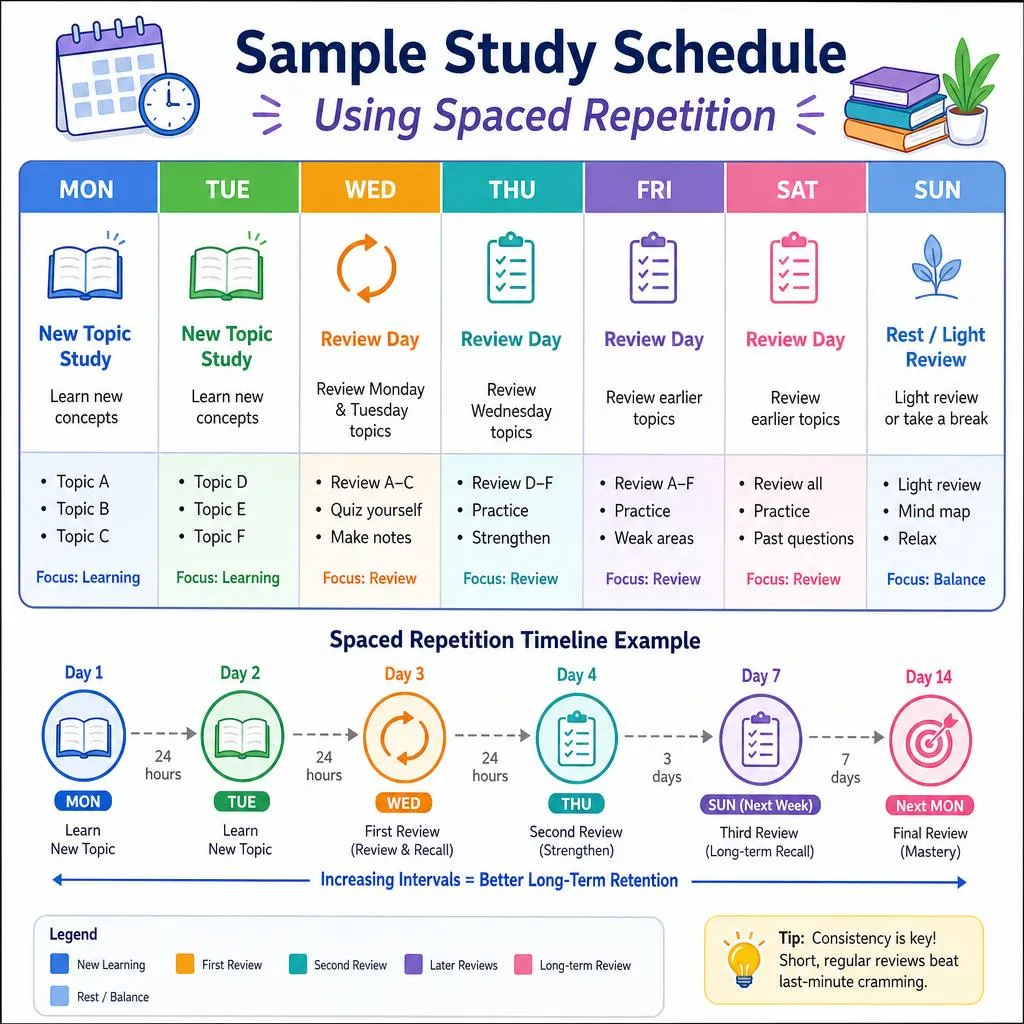
✅ Do this instead: Use spaced repetition — review topics regularly over weeks, not just before exams. Study a little every day.
❌ Mistake 9: Not Asking Questions
Why it's bad: Unresolved confusion compounds over time, making advanced topics impossible.
✅ Do this instead: Write down difficult words and concepts. Ask your teacher the next day. Never let confusion linger.
❌ Mistake 10: Passive Highlighting
Why it's bad: Highlighting feels productive but doesn't improve learning. It's passive, not active.
✅ Do this instead: Only highlight after you've read and understood. Better yet, write summaries in your own words.

💡 Bonus Tips for Maximum Success
🕐 Study at the Right Times
- Morning (6-9 AM): Best for difficult topics — your brain is fresh
- Evening (4-7 PM): Good for review and practice questions
- Avoid late night: Your brain consolidates memories during sleep, not while cramming
⏱️ Use the Pomodoro Technique
- Study for 25 minutes
- Take a 5-minute break
- After 4 sessions, take a 15-30 minute break
- This prevents burnout and maintains focus
📝 Create Summary Sheets
After studying a topic, create a one-page summary with:
- Key formulas
- Important definitions
- Main concepts
- Common question types
Review these summaries weekly for spaced repetition.
👥 Form a Study Group (Carefully)
Study groups work only if:
- Everyone is serious about studying
- You teach each other concepts
- You practice past papers together
- You stay on topic (no gossip!)
Set Specific Goals
Instead of "I'll study Mathematics," say:
- "I'll master quadratic equations today"
- "I'll complete 5 past paper questions on geometry"
- "I'll understand and memorize all biology cell structures"
📅 Sample Study Schedule Using This Method
Here's how to apply this method in real life:
Monday (Topic: Algebra - Factorization)
- 5:00-5:10 PM: Read past paper questions on factorization
- 5:10-6:00 PM: Read notes, mark answers to past questions, underline difficult parts
- 6:00-7:00 PM: Close notes, attempt past paper questions from memory
- 7:00-7:15 PM: Review mistakes, check notes, try again
Tuesday (Topic: Biology - Cell Structure)
- 5:00-5:10 PM: Read past questions on cells
- 5:10-6:00 PM: Read notes, mark key sections
- 6:00-7:00 PM: Active recall practice with past papers
Wednesday (Review Day)
- 5:00-6:00 PM: Review Monday's topic (Algebra) — quick summary + 2 past questions
- 6:00-7:00 PM: Review Tuesday's topic (Biology) — quick summary + 2 past questions
Why Wednesday matters: This is spaced repetition — reviewing after 1-2 days dramatically improves long-term retention.
🌟 Final Words: Consistency Beats Intensity
Success in exams isn't about studying 12 hours a day. It's about:
- ✅ Using the right method (active recall with past papers)
- ✅ Studying consistently (a little every day)
- ✅ Avoiding common mistakes (distractions, cramming, passive reading)
- ✅ Asking for help when stuck (teachers, classmates)
"Success is the sum of small efforts, repeated day in and day out."
— Robert Collier
Start using this method today. Pick one topic, gather your materials, and follow the 3 steps. You'll be amazed at how much more you retain and how confident you feel walking into your next exam.
📥 Free Resources to Help You Study
- 🔗 Download Past Papers & Study Notes (Free)
- 🔗 How to Pass Any Mathematics Exam: The 5-Step Strategy
- 🔗 Request Specific Study Materials
- 🔗 Join Our WhatsApp Study Group for Daily Tips
💬 Share This With a Student Who Needs It
If this guide helped you, pay it forward:
- 📱 Share on WhatsApp with your study group
- 📘 Post on your school's Facebook page
- 🗣️ Tell a teacher who might share it with their class
Every student deserves the tools to succeed. Let's help each other achieve academic excellence.
💬 Found this helpful?
Join hundreds of Malawian students getting weekly study tips and exam strategies.



Sign in securely with Google to join the discussion.