


Smart preparation is the key to MANEB success.
Preparing for a MANEB examination such as the Malawi School Certificate of Education (MSCE) isn't just about sitting and studying for hours. It is about making the best use of your time, resources, and knowledge.
There are students that study hard and still lose marks due to avoidable mistakes. There are students that begin serious revision too late, focus only on their favourite subjects, or revise without testing themselves. If you are preparing for a MANEB examination, avoiding these common mistakes can help with your preparation.
1. Starting serious revision too late
The common mistake of students is waiting for the examinations to only be a few weeks away before beginning serious revision.
When revision begins late, students can end up trying to fit too much information into a short space of time. This can create stress, poor retention, and superficial understanding.
✅ What to do instead:
Start preparing early and split the syllabus into sections so that you can work through them at a steady pace. A simple approach is:
- Learning new material during your normal study period
- Reviewing already learned topics
- Practice questions throughout the year
- Save intensive revision for the final stage
- Use the final weeks to fix weak areas
This way, you have time to discover what you do not understand.
2. Reading notes without practicing questions
Reading a textbook or copying notes can create the feeling that you understand a topic. However, examinations require you to retrieve information.
A student may understand a mathematics formula while reading it, but may struggle to use it in an unfamiliar question. The same goes for subjects such as Biology, Physics, Chemistry, Geography, and English.
Make practice part of your revision. After studying a topic, close your book and ask yourself questions.
For example, instead of only reading:
"Photosynthesis is the process by which green plants manufacture food..."
Try asking yourself:
- Define photosynthesis
- State the conditions necessary for photosynthesis
- Explain why light is important in photosynthesis
Then, compare your answers with your notes or marking scheme.
3. Ignoring past examination papers
Past papers are one of the most useful resources for examination preparation as they let students practice answering examination-style questions. However, simply collecting past papers is not enough. You must use them actively.
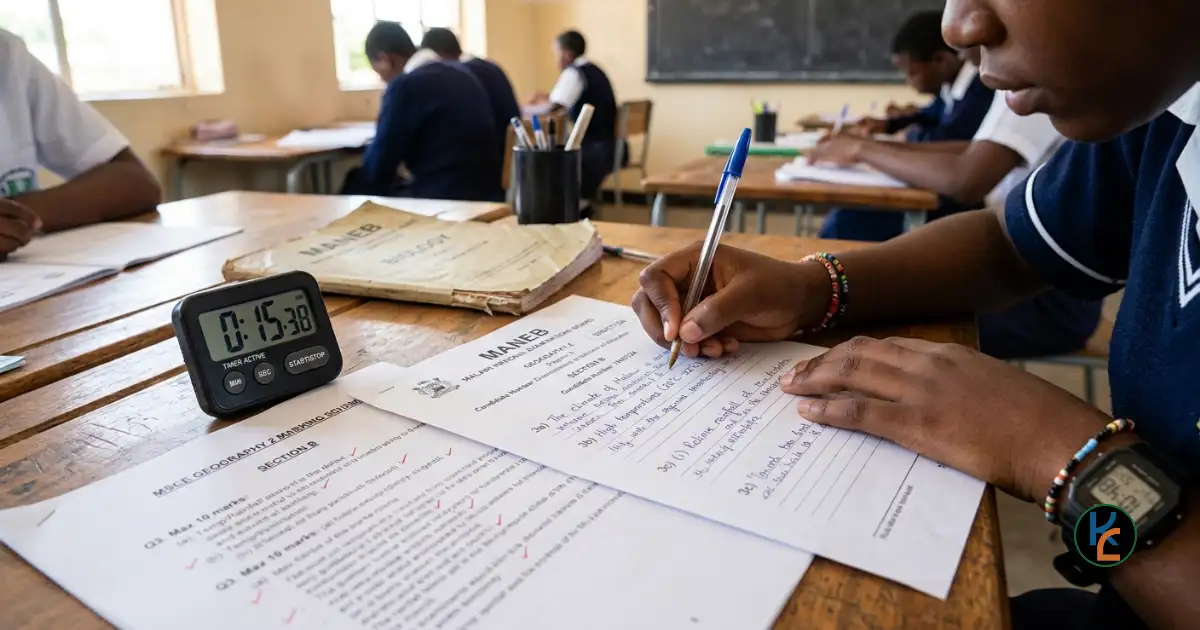
📝 A useful past-paper routine:
- Choose a topic you have already studied
- Attempt relevant questions without looking at your notes
- Mark your answers honestly
- Record the questions you got wrong
- Find out why answers were wrong
- Reattempt similar questions later
Do not only look at the answers, study your mistakes.
4. Memorizing without understanding
Memorization has its place in many subjects, but memorizing information without understanding it can become a problem. For example, learning a scientific definition word-for-word may not help if the examination asks you to explain, compare, calculate, or apply the concept.
Try to understand:
- What the concept means
- Why it happens
- How it works
- Where it can be applied
- How it differs from related concepts
Understanding makes revision more useful and makes it easier to answer questions that are phrased differently from your notes.
5. Spending too much time on one subject
Some students spend almost all their study time on the subject they enjoy most. Others avoid difficult subjects because they feel uncomfortable studying them. Both approaches can have problems.
Create a timetable that gives attention to all your registered subjects, allocating additional time to subjects or topics where you need more improvement.
6. Neglecting weak topics
It is tempting to revise topics you already know because they feel easy. But improvement comes from confronting areas that you find difficult.
| Subject | Weak Area | Action |
|---|---|---|
| Mathematics | Trigonometry | Practise 20 questions |
| Biology | Genetics | Review notes + past questions |
| English | Comprehension | Practise two passages |
| Chemistry | Organic chemistry | Revise reactions |
Update the list as you show improvement.

7. Ignoring examination instructions
MANEB examinations have rules that candidates must follow. MANEB states that candidates must visibly wear their identity cards in the examination room and may be searched before entering. Possession of reference materials in the examination room can result in disqualification and prosecution. Candidates involved in collusion can also face serious consequences.
Therefore, examination preparation should include knowing the rules - not just the syllabus.
8. Failing to check registration details
A surprisingly important part of examination preparation happens before the examination itself. MANEB's registration process requires candidates to provide their personal details and subject choices through an approved examination centre. Students are expected to verify their information before payment because corrections may not be possible after examination fees have been paid.
Check:
- Your full name
- Date of birth
- Examination subjects
- Examination number when issued
- Other details shown on your registration documents
Do not assume that someone else will notice an error for you.
9. Studying all night
Studying until extremely late at night may seem productive, particularly shortly before an examination. However, exhausted students may struggle to concentrate, remember information, and interpret questions accurately.
A better strategy is to establish a sustainable study routine. Aim for: Study → short break → study → rest → sleep → review. Your preparation should help you arrive at the examination room alert - not exhausted.
10. Depending on examination leaks or unverified materials
Students sometimes receive messages claiming that somebody has obtained the examination paper or knows what will appear in the examination. Do not build your preparation around such claims.
MANEB maintains examination security procedures and examination malpractice can have serious consequences. Focus on the syllabus, legitimate learning materials, past papers, and your teachers' guidance.
11. Ignoring practical preparation
Students taking practical subjects should not treat practical work as an optional part of revision. MANEB administers practical examinations in relevant subjects and provides examination centres with requirements for equipment, chemicals, and other materials.
If your subject contains practical work:
- Understand the procedure
- Know the purpose of each step
- Practise recording observations
- Learn how results are presented
- Review safety procedures
- Practise calculations where applicable
12. Failing to analyse your progress
Revision should not be based on guesswork. Every week ask:
- Which topics have I completed?
- Which topics remain?
- Which subjects are improving?
- Where am I repeatedly losing marks?
- Which topics need help from my teacher?
- How many questions can I now answer correctly without assistance?
Your revision timetable should change according to your progress.
🎯 A Simple MANEB Preparation Formula
Learn → Practise → Mark → Correct → Repeat
Learning gives you the knowledge. Practice shows whether you can use it. Marking identifies mistakes. Correction helps you understand what went wrong. Repetition strengthens the skill.
Final Thoughts
Success in MANEB examinations is not built during the night before the examination. It is built through consistent preparation, practice, and careful correction of mistakes.
Do not measure your preparation by the number of hours you spend with a book. Measure it by what you can remember, explain, calculate, analyse, and apply without assistance.
Start early, practice regularly, protect your sleep, follow examination rules, and use your mistakes as information about what to study next.
📚 Need Past Papers and Study Guides?
Put these tips into action today! Browse our free library of MANEB past papers, marking schemes, and study notes for PSLCE, JCE, and MSCE.
LEARN • REVISE • SUCCEED
FiloKin Edu — The wise learn together.



Sign in securely with Google to join the discussion.