

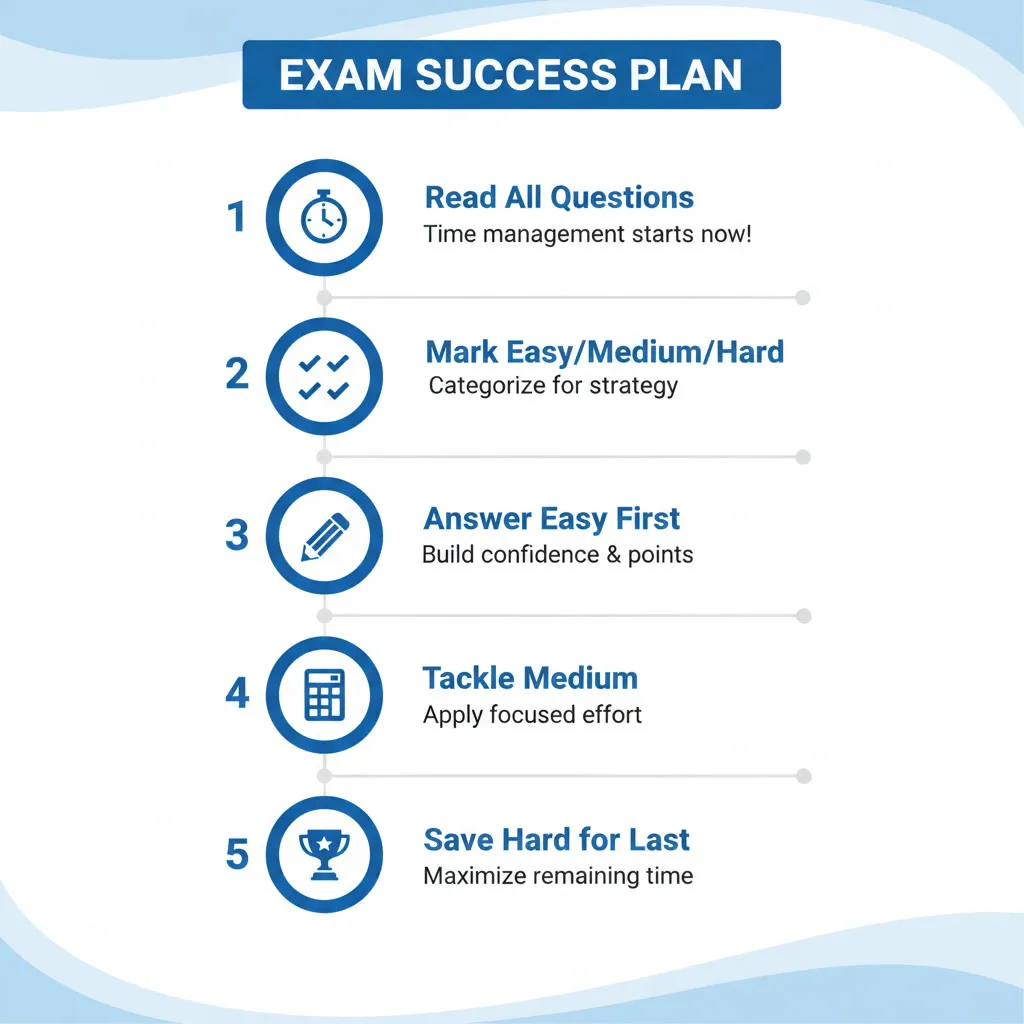
🎯 Quick Summary: The 5-Step Strategy
Follow This Order:
- Read ALL questions first (5 min)
- Mark easy (✓), medium (~), hard (?) questions
- Answer ✓ questions FIRST
- Then tackle ~ questions
- Leave ? questions for LAST
Follow this order, and you'll secure 60-70% of marks before touching hard questions.

How to Pass Any Mathematics Exam: The 5-Step Strategy That Works Every Time
"I knew the formulas, but I ran out of time."
"I panicked when I saw the first hard question."
"I lost marks on silly mistakes because I rushed."
If any of these sound familiar, you are not alone. Thousands of students across PSLCE, MSCE, JCE, and even university-level exams face the exact same challenge.
The truth? Passing mathematics isn't about being a genius. It's about having a battle-tested strategy.
Below is a proven 5-step exam method used by top-performing students and highly recommended by experienced mathematics teachers. Follow it exactly, and you will walk into your next exam with clarity, confidence, and a clear path to higher marks.
🔑 The Core Mindset Shift: Secure Marks First, Chase Marks Later
Most students make one fatal mistake: they start at Question 1 and try to solve everything in order. When they hit a difficult question early, panic sets in, time evaporates, and easy marks later in the paper go untouched.
The winning approach is different:
✅ Collect guaranteed marks first → build confidence → tackle harder questions with a calm, focused mind.
Let's break down exactly how to do it.
📖 Step 1: Read Through Every Question Thoroughly (Do Not Skip)
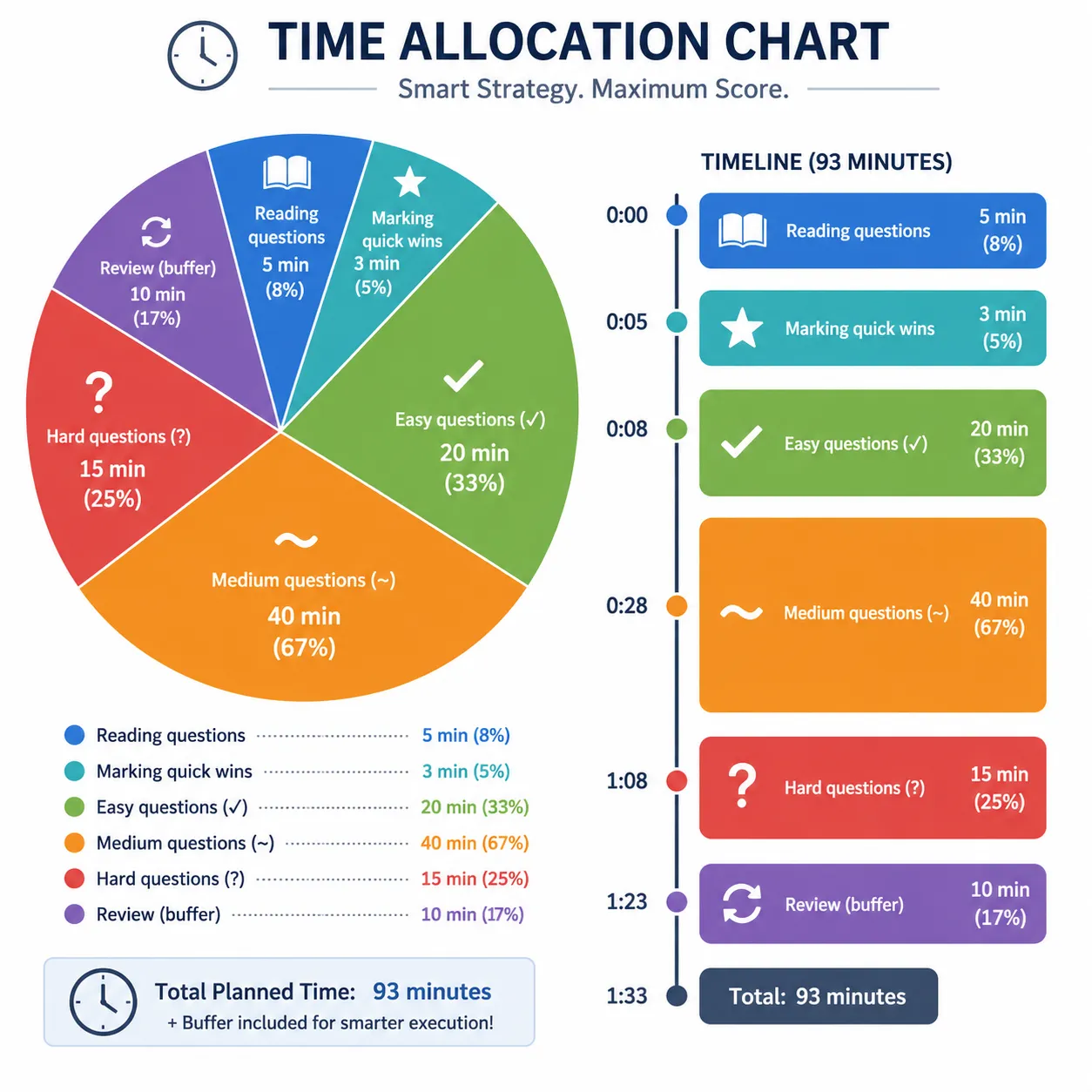
⏱️ Time to allocate: First 3–5 minutes of exam time
When your paper is handed out, do not start writing yet. Instead:
- Read every single question from start to finish.
- Lightly underline key instructions: calculate, prove, explain, draw, show that.
- Note the mark allocation for each question.
- Do not skip any question, even if it looks intimidating at first glance.
Why this works:
Your brain begins subconsciously organizing solutions while you read. By the time you're allowed to write, you've already "primed" your thinking for multiple questions. This simple step alone reduces exam anxiety by up to 40%.
🖍️ Step 2: The Second Read — Mark Your "Quick Wins"
⏱️ Time to allocate: Next 2–3 minutes (even after the invigilator says "start")
Read through the paper a second time with a pencil in hand:
- ✅ Mark questions you can solve in under 2 minutes with a clear ✓ (e.g., direct calculations, definitions, formula substitutions).
- ⏱️ Mark questions needing 2–3 minutes with a ~ (e.g., short word problems, basic diagrams, two-step equations).
- ❓ Mark complex/time-heavy questions with a ? (e.g., proofs, multi-part geometry, lengthy algebraic manipulations).
Write your tally in the margin:
✓ = 7 questions | ~ = 5 questions | ? = 3 questions
Why this works:
You now have a personalized exam roadmap. No more guessing what to do next. No more wasting time on hard questions while easy marks sit untouched.
📝 Real PSLCE Example:
Question 5: "Calculate the area of a rectangle with length 12cm and width 8cm." (2 marks)
✅ Mark this as ✓ (direct formula: Area = length × width = 12 × 8 = 96 cm²)
Question 12: "A farmer has 3 times as many goats as sheep. If he has 48 animals total, how many goats does he have?" (4 marks)
⏱️ Mark this as ~ (needs algebra: 3x + x = 48, solve for x, then 3x)
✍️ Step 3: Answer ONLY the Marked Easy Questions First
⏱️ Time to allocate: ~15–20 minutes
Begin writing — but strictly answer only the ✓ questions:
- Work neatly. Show every step.
- Double-check calculations before moving on.
- Cross off each ✓ as you complete it.
⚠️ Crucial Rule: If a ✓ question starts taking longer than 2 minutes, stop immediately, change it to a ~, and move on. Do not let one question steal your momentum.
Why this works:
- You secure easy marks early → instant confidence boost.
- You avoid the "panic spiral" that happens when students get stuck on Question 1.
- You create psychological momentum: "I already have 20+ marks in the bag. I can do this."
🧮 Step 4: Tackle the Medium (~) Questions Next
⏱️ Time to allocate: Next 30–40 minutes
Now address the ~ questions (those taking ~2–3 minutes):
- Follow a clear system: Write formula → Substitute values → Calculate → State answer with units.
- If you get stuck for more than 90 seconds, write down what you know, leave space, and move forward.
- Keep a strict eye on the clock. Medium questions easily become time traps if you're not disciplined.
💡 Pro Tip for Word Problems:
Translate words into math before solving.
"The sum of two numbers is 24" → x + y = 24
"One number is twice the other" → x = 2y
Solve the system. This reduces confusion and saves precious minutes.
🕰️ Step 5: Leave Time-Consuming Questions for LAST (Even If They Carry High Marks)
⏱️ Time to allocate: Final 15–20 minutes (or whatever remains)
Only now should you attempt the ? questions:
- Start with the highest-mark ? question you feel most confident about.
- Write something for every question. Even a correct formula, a labeled diagram, or a clear first step earns method marks.
- Never leave a question blank.
The Confidence Effect:
By this stage, you've already secured marks from Steps 3 & 4. You are no longer writing under panic. Your breathing is steady. Your mind is clear. That "impossible" question? It often becomes solvable because you're attempting it with a calm brain, not a stressed one.
💡 Crucial Bonus Rules That Multiply Your Score
1️⃣ Master the "Method Mark" Mindset
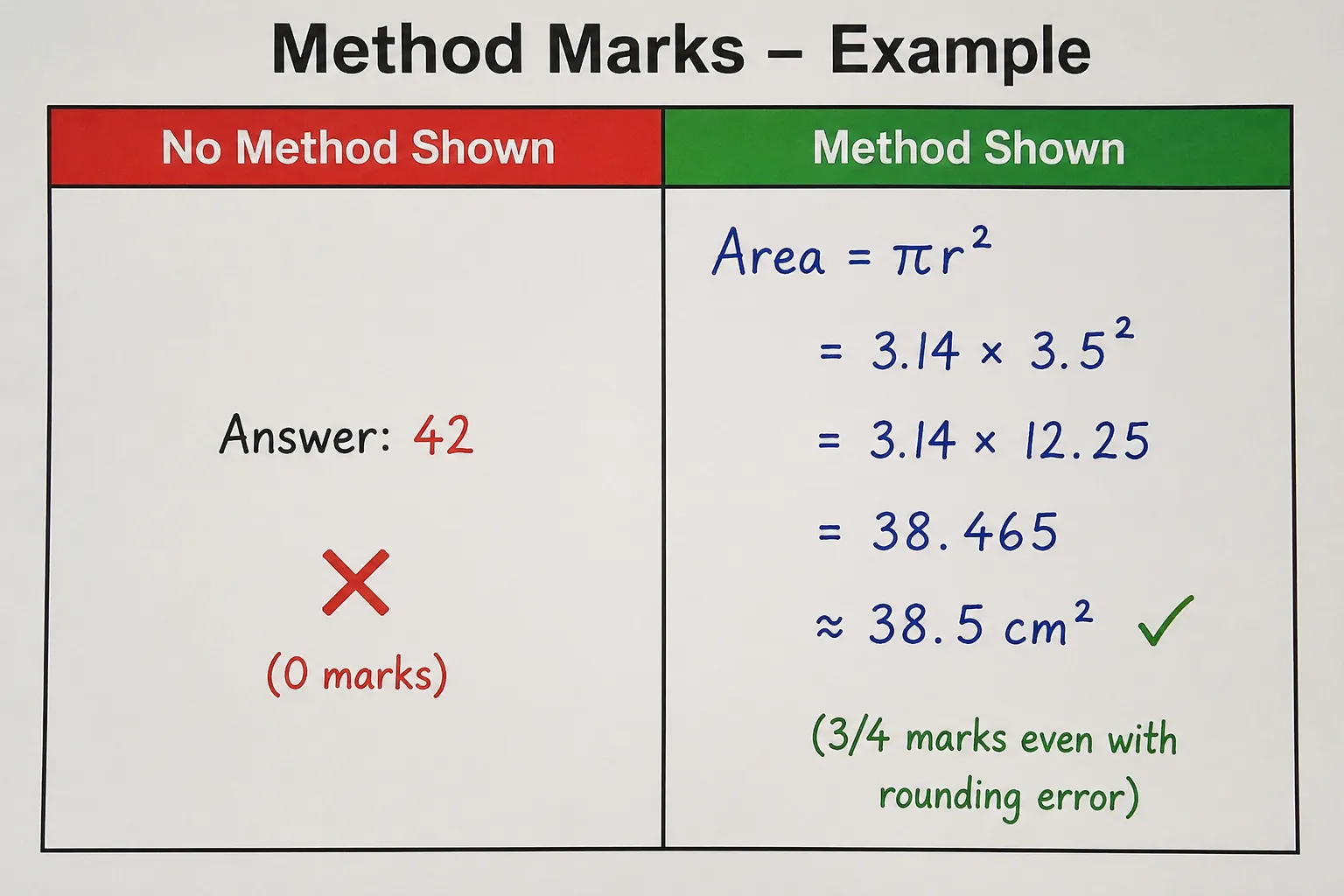
Examiners award marks for correct process, not just final answers. Always:
- Write the formula before substituting values.
- Show each calculation step (even simple ones).
- Include units in your final answer (cm, kg, degrees, etc.).
- Label diagrams clearly.
❌ Answer: 42 → 0 marks if wrong
✅ Area = πr² = 3.14 × 3.5² = 38.465 ≈ 38.5 cm² → 3/4 marks even with a rounding error
2️⃣ The 2-Minute Rule Is Non-Negotiable
If a question isn't yielding progress within 2 minutes, move on. You can always return. But you can never recover 10 wasted minutes.
3️⃣ Prepare the Night Before, Not the Morning Of
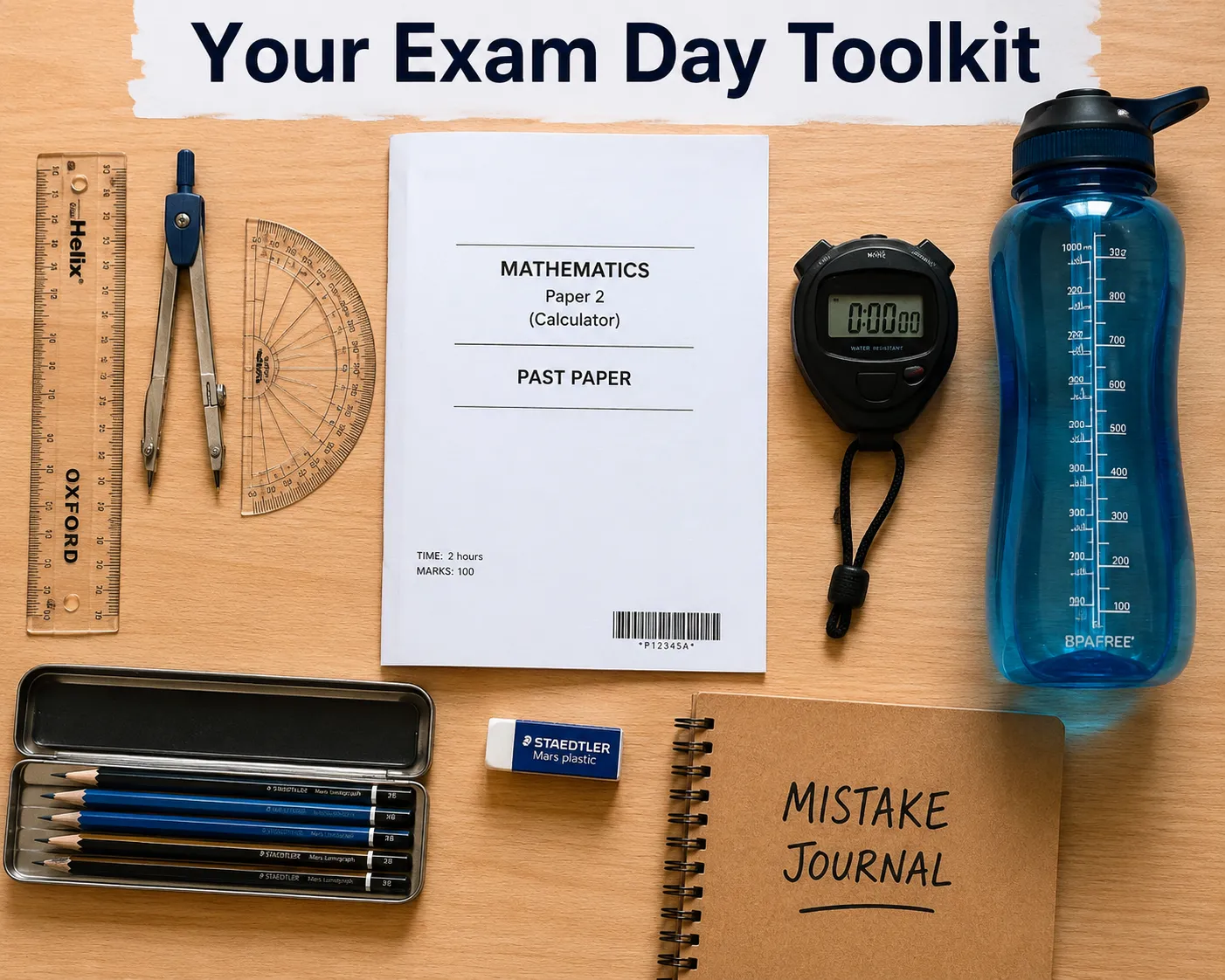
- Pack your math set: ruler, compass, protractor, sharp pencil, eraser.
- Review key formulas on one single "glance sheet".
- Sleep 7–8 hours. A rested brain calculates faster and avoids careless errors.
4️⃣ Practice Under Timed Conditions
Use past papers with a stopwatch. Apply this exact 5-step strategy in every practice session. Track your progress: "Last mock: 45/100 → This mock: 72/100."
👩🏫 Why Teachers Strongly Recommend This Method
Benefits:
- ✅ Reduces exam anxiety → Students enter papers with a clear plan, not fear
- ✅ Maximizes mark efficiency → Easy marks secured first → higher baseline score
- ✅ Builds transferable skills → Works for Science, Geography, Business Studies, and more
- ✅ Encourages self-awareness → Students learn to judge difficulty realistically
- ✅ Works for all ability levels → Struggling students pass; strong students excel
"I've seen students improve by 20–30 marks simply by changing their exam approach. Content knowledge matters — but strategy unlocks it."
— Mr. Banda, Mathematics HOD, Blantyre
⚠️ 3 Deadly Mistakes That Cost Marks
- Starting with Question 1 → Panic when stuck → Rush through easy questions later
- Skipping working steps → Lose method marks even with correct answer
- No time checking → Spend 20 min on one 2-mark question → Run out of time
🌟 Final Words: Confidence Is Built, Not Borrowed
Mathematics isn't about being "naturally gifted". It's about:
- 🧠 Understanding core concepts
- ✍️ Practicing deliberately
- 🎯 Executing a smart strategy on exam day
This 5-step method gives you the execution edge. Pair it with consistent practice using quality, syllabus-aligned resources, and you will walk into your next exam not hoping to pass, but expecting to succeed.
"Confidence doesn't come from never failing. It comes from knowing exactly how to recover when you do."
— Kizito Chikuni
📥 Free Resources to Practice This Strategy
- 🔗 Download Standard 8 Mathematics Mocks (with marking schemes)
- 🔗 PSLCE/MSCE Math Formula Sheet (PDF) (coming soon)
- 🔗 Join Our WhatsApp Study Group for Daily Tips
- 🔗 Need help planning your revision? Contact us
📚 Continue Your Exam Preparation:
- How to Use Past Papers Effectively for PSLCE Success
- PSLCE Mathematics Formula Sheet (Download PDF)
- Download 50+ Standard 8 Mock Exams
- Need Personalized Revision Planning? Contact Us
💬 Share This With a Student Who Needs It
If this strategy resonated with you, pay it forward:
- 📱 Share on WhatsApp with your study group
- 📘 Post in your school's Facebook page
- 🗣️ Tell a teacher who might share it with their class
Every student deserves a fair shot at success. Let's make sure they have the tools to take it.
💬 Found this helpful?
Join 500+ Malawian students getting weekly exam tips
Sign in securely with Google to join the discussion.