
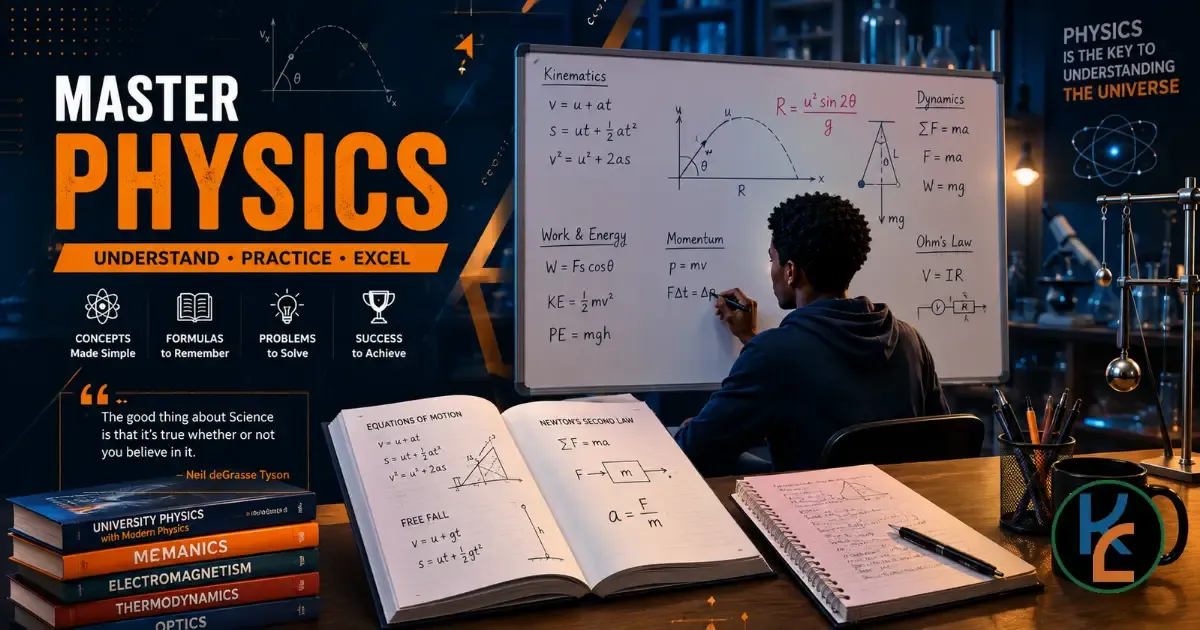
⚛️ How to Revise Physics Effectively for Secondary School Exams (MSCE/JCE)
Physics. For many students, it’s the subject that causes the most anxiety. Between the endless formulas, abstract concepts, and complex calculations, it’s easy to feel overwhelmed.
But here’s the secret: Physics is not about memorizing; it’s about understanding patterns. Whether you are preparing for your JCE or MSCE exams under the MANEB syllabus, a strategic approach to revision can transform Physics from your weakest subject into your strongest.
This guide provides a step-by-step, proven revision strategy to help you master Physics and walk into the exam room with confidence.

Master the concepts, and the marks will follow.
🎯 Step 1: Know Your Enemy (The Syllabus)
Before you open a textbook, you must know exactly what MANEB expects from you. Download the official Physics syllabus for your level.
- Identify the core topics: Mechanics, Waves, Electricity, Magnetism, and Modern Physics.
- Highlight your weak areas: Be honest with yourself. If "Electromagnetic Induction" confuses you, mark it in red and prioritize it.
- Understand the command words: Know the difference between "Define", "Explain", "Calculate", and "Describe". MANEB marks are awarded based on these specific verbs.
📐 Step 2: Master the Formulas (Don’t Just Memorize)
Writing a formula correctly is only 10% of the battle. Understanding when and how to use it is the other 90%.
💡 The "FUD" Method for Formulas:
Formula: Write it down correctly (e.g., F = ma).
Units: Know the SI units for every variable (Force in Newtons, mass in kg, acceleration in m/s²).
Data: Practice extracting hidden data from word problems (e.g., "starts from rest" means initial velocity, u = 0).
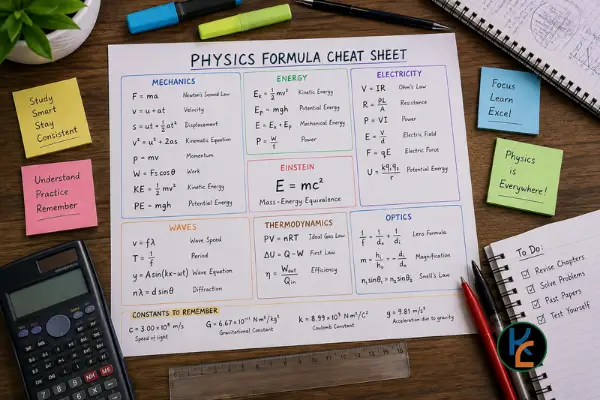
Pro Tip: Create a "Formula Cheat Sheet" on a single A4 page. Rewrite it from memory every morning for a week. By exam day, it will be permanently etched in your brain.
📝 Step 3: Practice Past Papers (The Golden Rule)
You cannot learn to swim by reading a book about swimming. Similarly, you cannot pass Physics without solving past papers.
- Simulate exam conditions: Set a timer. No phone, no notes, no music.
- Mark your own work: Use the official MANEB marking scheme. Be strict. If you forgot the unit in your final answer, deduct the mark.
- Analyze your mistakes: Did you make a calculation error? Did you misunderstand the question? Write down the reason for every lost mark.
✏️ Step 4: Draw Diagrams Like a Pro
Physics is a highly visual subject. A well-drawn diagram can earn you marks even if your calculation is slightly off.
- Use a sharp pencil and a ruler. Freehand circuits or force diagrams look unprofessional and can be misinterpreted by the examiner.
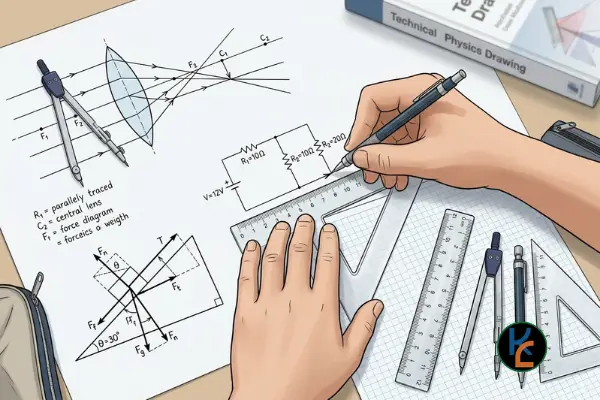
- Label everything: Arrows for force direction, positive/negative terminals in circuits, angles of incidence/reflection.
- Practice specific diagrams: Ray diagrams for lenses/mirrors, magnetic field lines, and series/parallel circuits are guaranteed to appear.
🧠 Step 5: Teach What You Learn
The highest form of learning is teaching. Gather a small study group (2-3 serious students) and take turns explaining complex topics to each other.
If you can explain Ohm’s Law or Newton’s Third Law to a friend in simple Chichewa or English, you truly understand it. If you stumble, you’ve found a gap in your knowledge that needs revision.
⚠️ 3 Common Physics Exam Mistakes to Avoid
- Forgetting Units: Writing "5" instead of "5 m/s" will cost you the final mark. Always include units.
- Showing No Working: MANEB awards "method marks". Even if your final answer is wrong due to a calculator slip, showing the correct formula and substitution can still get you 2 out of 3 marks.
- Panicking on Section A (Multiple Choice): Don’t spend 15 minutes on one MCQ. Skip it, mark it, and come back later. Secure the easy marks in Section B first.
🎯 Your 30-Day Physics Revision Plan
Week 1: Review notes and master all formulas for Mechanics and Waves.
Week 2: Focus on Electricity, Magnetism, and drawing perfect diagrams.
Week 3: Complete 3 full past papers under strict timed conditions.
Week 4: Review marking schemes, fix recurring mistakes, and rest before the exam.
📚 Ace Your Physics Exam With Free Resources
Don't revise blind. Access our library of MANEB-approved Physics past papers, marking schemes, and simplified study notes.
✅ 100% Free • MSCE & JCE Levels • Downloadable PDFs
💪 Final Thought
Physics is the language of the universe. It’s logical, it’s structured, and it’s entirely conquerable. Stop fearing the formulas, start practicing the problems, and trust the process.
You’ve got this. Now go solve that circuit!
— Kizito Chikuni, Educator & Developer



Sign in securely with Google to join the discussion.