
🌍 Best Free Educational Websites for Students in Africa (2026 Guide)
Finding quality educational resources online can make a huge difference for students, especially when textbooks, tutoring and other learning materials are expensive or difficult to access.
Fortunately, there are many websites offering free lessons, textbooks, practice questions, courses and educational materials.
For students across Africa, the challenge is not always finding information—it is finding reliable, genuinely useful and free resources.
In this guide, we highlight some of the best free educational websites students can use for school subjects, university studies, revision, literacy, science, mathematics, technology and independent learning.
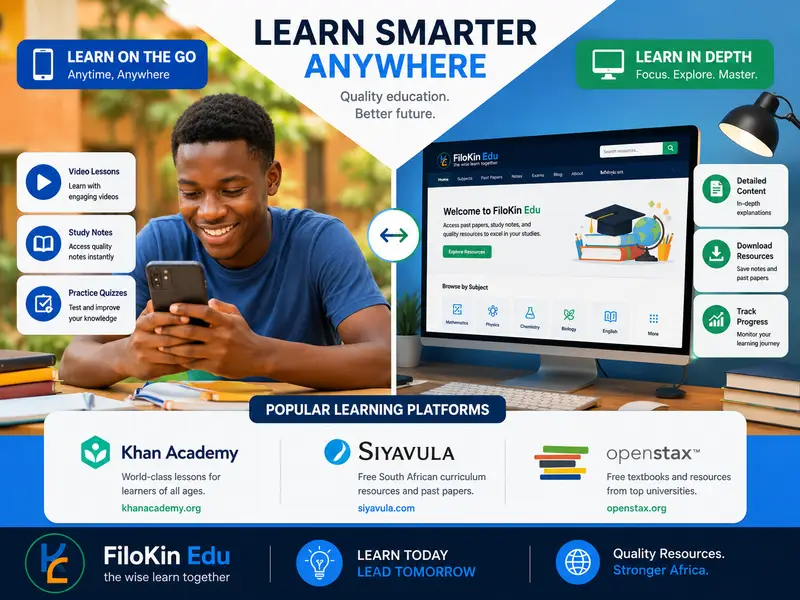
NOTE: "Free" does not always mean that every feature of a platform is free. Some websites offer their core educational content for free while charging for optional premium services.
1. Khan Academy
Website: https://www.khanacademy.org/
Best for: Mathematics, science, computing, economics and general academic learning.
Khan Academy is one of the most useful free learning platforms available to students worldwide. It provides lessons, instructional videos, practice exercises, quizzes and progress tracking across numerous subjects.
Students can learn at their own pace and practise specific skills they find difficult.
The Khan Academy mobile app also supports downloading videos for offline viewing, which can be particularly useful for students dealing with unreliable internet connections.

Good for African students who want to:
- Improve Mathematics
- Learn Physics and Biology
- Review difficult concepts
- Practise questions
- Study independently
- Learn using a smartphone
2. Siyavula
Website: https://www.siyavula.com/
Best for: Mathematics and Science.
Siyavula is particularly useful for African students because its resources are designed around African school curricula.
The platform provides free, curriculum-aligned textbooks covering subjects including Mathematics, Physical Sciences, Natural Sciences, Life Sciences, Mathematical Literacy, Information Technology and Computer Applications Technology.
Students can also work through interactive questions and receive feedback.
Siyavula's open textbooks can be read online or downloaded for offline use.
Best for students studying:
- Mathematics
- Physics
- Chemistry
- Natural Sciences
- Life Sciences
- Mathematical Literacy
- Computer-related subjects
3. OpenStax
Website: https://openstax.org/
Best for: High school and university textbooks.
If you are looking for free textbooks, OpenStax should be one of the first websites you check.
OpenStax provides free, openly licensed textbooks that students can read online or download.
University students can find textbooks covering subjects such as:
- Biology
- Physics
- Chemistry
- Mathematics
- Economics
- Psychology
- Business
- Computer Science
One major advantage is that many OpenStax textbooks are openly licensed, making them useful for students and educators who need legitimate educational resources.
4. African Storybook
Website: https://www.africanstorybook.org/
Best for: Children's reading and African-language literacy.

African Storybook is particularly valuable because it focuses on African children and African languages.
The platform provides thousands of openly licensed picture storybooks in African languages.
Students, parents and teachers can read the stories online, download them for offline use or print them.
It is especially useful for:
- Early childhood education
- Primary school reading
- Literacy development
- African-language learning
- Parents and teachers
5. OER Africa
Website: https://www.oerafrica.org/
Best for: Open educational resources and African education.
OER Africa is a valuable starting point for discovering educational resources created for or contributed to by African institutions.
Its resources include textbooks, courses, research materials and children's learning resources.
It also provides links to several African and international open educational repositories.
Why it is useful:
Instead of searching hundreds of websites individually, students and educators can use OER Africa as a gateway to open educational resources.
6. OpenLearn
Website: https://www.open.edu/openlearn/
Best for: University-level and lifelong learning.
OpenLearn is an initiative of The Open University offering free courses and educational materials.
It covers a wide range of subjects, making it useful for students who want to go beyond their normal school curriculum or explore a potential career or university subject.
Students can use it to:
- Explore new subjects
- Develop academic skills
- Learn about potential careers
- Supplement university studies
- Continue learning after school
7. MIT OpenCourseWare
Website: https://ocw.mit.edu/
Best for: University students and advanced independent learners.
MIT OpenCourseWare provides educational materials from courses taught at the Massachusetts Institute of Technology (MIT).
It is particularly useful for students interested in:
- Engineering
- Computer Science
- Mathematics
- Physics
- Economics
- Business
- Technology
It is better suited to advanced learners than young students, but motivated secondary-school graduates and university students can use it to deepen their knowledge.
8. PhET Interactive Simulations
Website: https://phet.colorado.edu/
Best for: Physics, Chemistry, Mathematics and Science.
PhET provides interactive simulations that allow students to experiment with scientific and mathematical concepts.
Instead of simply reading about electric circuits, forces, waves or chemical reactions, students can interact with simulations and observe what happens.
This can be particularly valuable when a school has limited laboratory equipment.
Students can use simulations to:
- Visualise difficult concepts
- Experiment safely
- Understand scientific relationships
- Practise mathematical concepts
- Supplement classroom lessons
9. Ubongo
Website: https://www.ubongo.org/
Best for: Children and younger learners.
Ubongo creates educational entertainment designed specifically for African children.
Its content is distributed through television, radio and digital platforms, and the organisation focuses on making quality educational content accessible to children across Sub-Saharan Africa.
This makes Ubongo different from many international educational platforms because it considers African languages, cultures and learning environments.
It can be useful for:
- Early childhood learning
- Primary education
- Mathematics
- Science
- Literacy
- Educational entertainment
10. Kolibri
Website: https://learningequality.org/kolibri/
Best for: Students and schools with limited or unreliable internet access.
Internet connectivity remains a major challenge for many learners.
Kolibri is designed to help educational content reach learners in low-connectivity environments.
Its offline-first approach makes it particularly relevant to schools, communities and learners where reliable internet access is not guaranteed.
For African students, offline learning platforms can be especially useful because educational content can be accessed without requiring a continuous internet connection.
11. TESSA
Website: https://www.tessafrica.net/
Best for: Teachers and teacher education.
TESSA, which stands for Teacher Education in Sub-Saharan Africa, provides resources designed to support teacher education across the region.
It can be particularly useful for:
- Student teachers
- Teacher educators
- Practising teachers
- Education students
- Classroom teaching resources
For anyone studying education in Africa, TESSA is a website worth exploring.
12. Open Research Africa
Website: https://openresearchafrica.org/
Best for: University students and researchers.
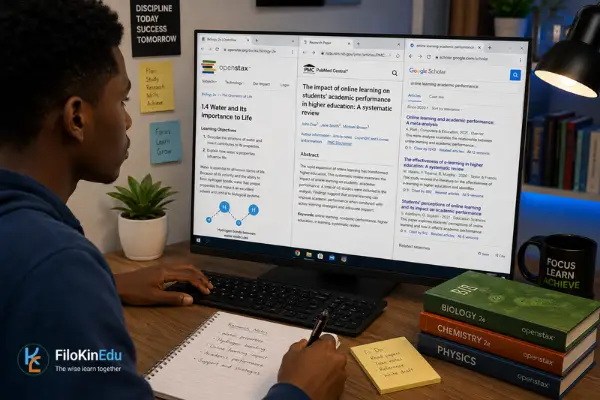
Open Research Africa provides access to scholarly articles and other research outputs.
University students can use research repositories like this when working on:
- Assignments
- Research projects
- Dissertations
- Academic papers
- Literature reviews
It can be especially useful for university students who need reliable academic sources beyond ordinary search-engine results.
13. OpenUCT
Website: https://open.uct.ac.za/
Best for: University research and academic resources.
OpenUCT is the open-access repository of the University of Cape Town.
It contains scholarly outputs including:
- Research papers
- Theses
- Dissertations
- Journal articles
- Book chapters
- Technical reports
- Open educational resources
University students can use these materials when researching academic projects and assignments.
14. OERu
Website: https://oeru.org/
Best for: Higher education and independent learners.
OERu provides free online courses and is particularly useful for learners interested in higher education.
It is an international network with participation from institutions in different parts of the world, including African institutions.
Students can explore courses and educational resources while developing knowledge outside their normal classroom environment.
15. Wikimedia Commons
Website: https://commons.wikimedia.org/
Best for: Educational images, diagrams, videos and other media.
Wikimedia Commons is not a conventional school-learning platform, but it can be extremely useful when preparing assignments, presentations and educational projects.
It contains a large collection of freely licensed and public-domain images, diagrams, audio files and videos.
IMPORTANT: Always check the licence of an individual file before reusing it and provide the required attribution where necessary.
📊 Which Educational Website Should You Use?
There isn't one website that is best for everyone.
Here is a quick guide:
| If you need... | Try... |
|---|---|
| Mathematics practice | Khan Academy / Siyavula |
| Science practice | Khan Academy / Siyavula / PhET |
| Free textbooks | OpenStax / Siyavula |
| African children's books | African Storybook |
| African educational resources | OER Africa |
| University courses | OpenLearn / OERu / MIT OpenCourseWare |
| Research materials | Open Research Africa / OpenUCT |
| Learning with limited internet | Kolibri |
| Educational media | Wikimedia Commons |
| African children's educational content | Ubongo |
| Teacher education | TESSA |
💡 How African Students Can Get More From Free Educational Websites
Having access to educational websites is only the first step. How you use them matters.
1. Don't Try to Use Everything
Choose two or three resources that match your current learning goal.
For example, a student studying Physics could use:
- Siyavula → textbook
- PhET → interactive simulations
- Khan Academy → additional explanations and practice
Using a few good resources consistently is usually better than constantly jumping between dozens of websites.
2. Combine Online Resources With Your School Curriculum
Free international resources may not follow your country's exact examination syllabus.
A student preparing for JCE, MSCE, WAEC, KCSE, NSSC or another national examination should therefore use these platforms as supplementary learning resources.
Do not assume that every topic or examination technique matches your country's curriculum.
Always compare what you study online with your school's syllabus and official examination materials.
3. Download Resources When Possible
If your internet connection is expensive or unreliable, take advantage of legitimate offline options.
Some educational platforms allow students to download videos, books or other learning materials for offline use.
This can reduce data costs and allow students to continue learning when an internet connection is unavailable.
4. Don't Just Watch — Practise
One of the biggest mistakes students make with online learning is spending hours watching educational videos without testing themselves.
A better approach is:
LEARN → PRACTISE → CHECK → CORRECT → REPEAT
For example:
Watch a Mathematics lesson → solve 10 questions → identify mistakes → review the topic → solve another set.
Active practice helps turn information into usable knowledge.
5. Use Your Smartphone as a Learning Tool
Many African students may not have access to a personal computer, but smartphones are increasingly common.
A smartphone can be used to:
- Watch educational lessons
- Download textbooks
- Read educational articles
- Complete online exercises
- Research assignments
- Join educational communities
- Access online courses
- Use educational apps
The key is to use the device intentionally rather than allowing social media and entertainment to consume all your study time.
✅ Free Doesn't Mean Low Quality
There is a common misconception that free educational resources are automatically inferior to paid resources.
That isn't necessarily true.
Organisations such as Khan Academy, OpenStax, Siyavula and African Storybook provide substantial amounts of free educational content.
However, students should still evaluate the quality of any resource they use.
Before relying on educational material, consider:
- Who created it?
- Is the information accurate?
- Is the material suitable for your level?
- Does it match your curriculum?
- Is the information current?
- Is the source trustworthy?
Free resources should complement your school textbooks, teachers and official curriculum materials rather than automatically replace them.
🌍 Why Free Online Education Matters in Africa
Access to quality education remains a major challenge in many parts of the world.
Students may face challenges such as:
- Shortages of textbooks
- Large classes
- Limited laboratory equipment
- High cost of private tutoring
- Limited access to libraries
- Unreliable internet connectivity
- Long distances to educational institutions
Free online educational resources cannot solve all of these problems, but they can provide another pathway to knowledge.
A student with a smartphone and an internet connection can potentially access textbooks, lessons, simulations, research papers and courses created by institutions around the world.
This creates opportunities for students to learn beyond the physical classroom.
Final Thoughts
For students in Africa, the internet can provide access to learning materials that may not be available in their local school or library.
Whether you need Mathematics practice, science simulations, free textbooks, children's books, university courses, research papers or teacher-training resources, there are legitimate free platforms available.
You don't necessarily need an expensive computer to benefit from online education.
A smartphone, downloaded learning materials and a consistent study routine can already provide access to a surprisingly large amount of educational content.
Start with one subject, choose one reliable platform and begin learning.
Your education does not have to stop at the classroom door.
📚 Explore More Educational Resources
FiloKin Edu Provides Educational Resources for Malawian Learners
Access free past papers, revision materials, study guides, and educational articles.
FiloKin Edu is not affiliated with or endorsed by the organisations mentioned in this article.
Availability, content, languages and platform features can change over time.
Sign in securely with Google to join the discussion.