

💰 Basic Financial Literacy Every Malawian Teen Should Know (Before Turning 18)
You can solve complex equations in Mathematics, but do you know how to budget MWK 5,000 for a week? School teaches you about photosynthesis, but not about compound interest. It's time to change that.
Financial literacy isn't just for adults with jobs. The habits you build now — at 15, 16, 17 — will determine whether you struggle with money or build wealth in your 20s and 30s. This guide teaches you the 7 essential money skills that school forgot to teach you.
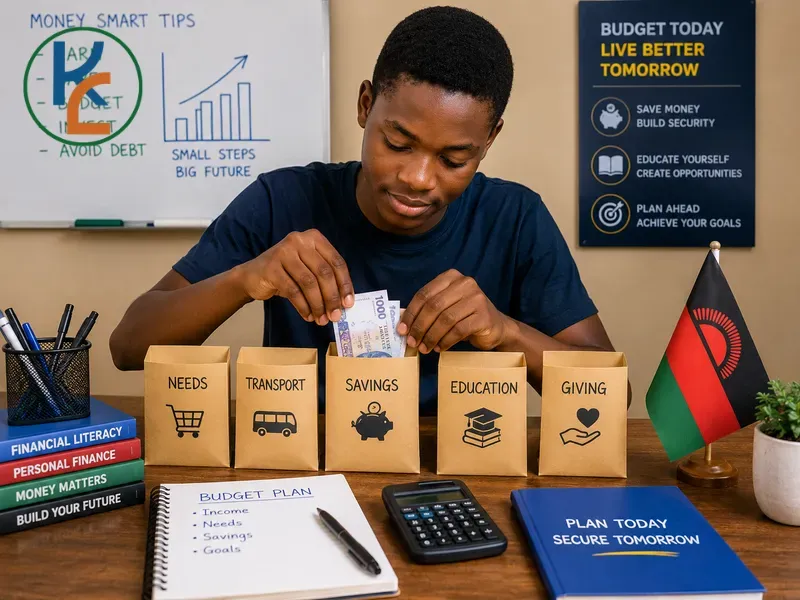
Money skills aren't taught in school — but they're more important than most subjects.
💸 Why Financial Literacy Matters (Even If You're Still in School)
You might think: "I'm just a student, I don't earn money yet, why should I care?"
Here's the truth:
- 80% of Malawian adults don't have a budget — and live paycheck to paycheck (or handout to handout)
- Most university graduates in Malawi struggle with debt within 2 years of getting their first job
- The "get rich quick" trap (sports betting, pyramid schemes) preys on young people who don't understand money
The good news? You can start building financial skills today — even with just MWK 500. Here's how.
🎯 Skill #1: The 50/30/20 Budget Rule (Simplified for Students)
Most adults don't budget. That's why they're broke. Here's the simplest budgeting rule that works:
The 50/30/20 Rule:
- 50% — Needs: Things you must pay for (transport, airtime for school, basic food)
- 30% — Wants: Things you enjoy (snacks, data bundles, entertainment)
- 20% — Savings: Money you never touch (builds your emergency fund)
Real Example (MWK 10,000/month):
- MWK 5,000 → Transport + airtime + school supplies
- MWK 3,000 → Snacks, data, social activities
- MWK 2,000 → Savings account (never touch this)
Pro Tip: Even if you only get MWK 1,000 per week, apply the rule: MWK 500 for needs, MWK 300 for wants, MWK 200 saved.
🏦 Skill #2: Open a Savings Account NOW (Yes, Even as a Student)
Most Malawian teens keep their money under a mattress, in a sock, or "with a friend." This is dangerous and wasteful.
Why You Need a Bank Account:
- ✅ Security: If your house is broken into, you don't lose your savings
- ✅ Interest: Banks pay you 5-8% per year just for keeping money there
- ✅ Discipline: You can't "accidentally" spend money that's in the bank
- ✅ Financial history: When you're 18 and need a loan, banks check your history
How to Open an Account (Under 18):
- Go to any bank (National Bank, Standard Bank, CDH, etc.) with a parent/guardian
- Ask for a "Youth Savings Account" or "Student Account"
- Bring your birth certificate and a parent's ID
- Deposit at least MWK 1,000 to activate
Pro Tip: Set up an automatic transfer: Every time you receive money (allowance, birthday gift, holiday cash), immediately move 20% to your savings account.
🚫 Skill #3: Avoid the "Get Rich Quick" Trap
Let's be honest: You've seen the WhatsApp messages. "Invest MWK 5,000, get MWK 50,000 in 3 days!" or "Join this sports betting group, guaranteed wins!"
These are scams. Always.
Red Flags of a Scam:
- ❌ "Guaranteed returns" (no investment is guaranteed)
- ❌ "Bring 3 friends to earn more" (pyramid scheme)
- ❌ "Only 5 spots left!" (fake urgency)
- ❌ No physical office or registered business
- ❌ Promises that sound too good to be true
The Reality:
Real wealth is built slowly through:
- ✅ Consistent saving (even small amounts)
- ✅ Learning valuable skills (coding, writing, design)
- ✅ Starting small businesses (selling airtime, phone charging, tutoring)
- ✅ Investing in education (your brain is your best asset)
Rule of Thumb: If someone promises you'll double your money in less than a year, run away.
📊 Skill #4: Track Every Kwacha (The Envelope Method)
You don't need a fancy app. You need 3 envelopes (or containers):
The Envelope System:
- Envelope 1: "Needs" — Transport, airtime, school supplies
- Envelope 2: "Wants" — Snacks, data, fun
- Envelope 3: "Savings" — Money you're building for the future
Every time you receive money, divide it into the 3 envelopes immediately. When an envelope is empty, you stop spending in that category.
Why This Works:
- ✅ You see where your money goes
- ✅ You can't "accidentally" spend savings
- ✅ It builds discipline without needing willpower
Pro Tip: At the end of each month, write down what you spent in each envelope. You'll be shocked at how much you waste on "wants."
💳 Skill #5: Understand Debt (And Why It's Dangerous)
In Malawi, debt is everywhere:
- Borrowing MWK 2,000 from a friend "until next week"
- Taking a mobile loan (Airtel Money, Mpamba) at 30% interest
- Using a "check-off loan" from your future employer before you even start working
The Debt Trap:
Let's say you borrow MWK 10,000 from a mobile lender at 30% monthly interest:
- Month 1: You owe MWK 13,000
- Month 2: You owe MWK 16,900
- Month 3: You owe MWK 21,970
- Month 6: You owe MWK 48,268
In 6 months, you owe 5x what you borrowed. This is how people become permanently broke.
The Golden Rules of Debt:
- ✅ Never borrow for "wants" (only for emergencies or investments)
- ✅ Never borrow if you don't know the interest rate
- ✅ Never borrow from multiple sources (this is how debt spirals)
- ✅ Pay off high-interest debt first (mobile loans, not family)
🎯 Skill #6: Set SMART Financial Goals
"I want to be rich" is not a goal. It's a wish. Here's how to set real goals:
SMART Goals Framework:
- Specific: "I want to save MWK 50,000"
- Measurable: "I'll track it in my notebook every week"
- Achievable: "I can save MWK 2,000 per week"
- Relevant: "This will help me buy a laptop for university"
- Time-bound: "I'll reach this in 25 weeks (6 months)"
Example Goals for Malawian Students:
- 💰 "Save MWK 20,000 by December for MSCE registration fees"
- 💻 "Save MWK 150,000 by Form 4 graduation for a second-hand laptop"
- 📚 "Save MWK 5,000 per month to buy past papers and study guides"
Pro Tip: Write your goal on a card. Put it where you'll see it every day (mirror, phone wallpaper, notebook cover).
🚀 Skill #7: Start a Micro-Business (Even With MWK 500)
You don't need capital to start earning. You need creativity and hustle.
5 Micro-Business Ideas for Malawian Students:
1. Phone Charging Station (MWK 500 startup)
- Buy a power bank and extension cord
- Charge MWK 100 per phone
- Charge 10 phones per day = MWK 1,000/day
2. Airtime Reselling (MWK 1,000 startup)
- Buy airtime in bulk (Airtel/TNM wholesale)
- Sell at small markup (MWK 50-100 profit per sale)
- Target classmates, neighbors, market vendors
3. Tutoring Younger Students (MWK 0 startup)
- Tutor Standard 5-7 students in Math/English
- Charge MWK 500-1,000 per hour
- Use your own past papers and notes (free from this site!)
4. Selling Snacks at School (MWK 2,000 startup)
- Buy biscuits, sweets, or mandasi in bulk
- Sell at break time with small markup
- Target: MWK 500-1,000 profit per day
5. Digital Services (MWK 0 startup)
- Type/print documents for neighbors
- Create WhatsApp status designs (Canva is free)
- Help elders send/receive mobile money
Key Principle: Start small. Reinvest profits. Scale up.
📚 Free Resources to Build Your Financial Skills
We've created free resources to help you master these skills:
📘 Mathematics Study Notes — Master percentages, interest calculations, and budgeting math
📗 English Revision Guides — Improve reading comprehension (critical for understanding financial contracts)
📁 Browse All Secondary Resources — 250+ free PDFs to boost your grades and future earning potential
🎯 Your 30-Day Financial Challenge
Ready to put this into practice? Here's your 30-day challenge:
Week 1: Awareness
- Day 1-7: Track every single kwacha you spend in a notebook
- Day 7: Review — where did your money go? What surprised you?
Week 2: Budgeting
- Day 8: Set up the 50/30/20 budget (or envelope system)
- Day 9-14: Stick to your budget — no exceptions
Week 3: Saving
- Day 15: Open a savings account (or designate a "savings envelope")
- Day 16-21: Save 20% of every kwacha you receive
Week 4: Goal Setting
- Day 22: Write down 3 SMART financial goals
- Day 23-30: Take one action toward each goal
📥 Free Study Resources to Boost Your Future
Education is the best investment you can make. Start with free resources today.
Access Free Study Resources
✅ 100% free • No signup required • Works offline
Written for every Malawian teen who wants to build wealth, not just earn grades.
— Kizito Chikuni, Educator & Developer



Sign in securely with Google to join the discussion.