
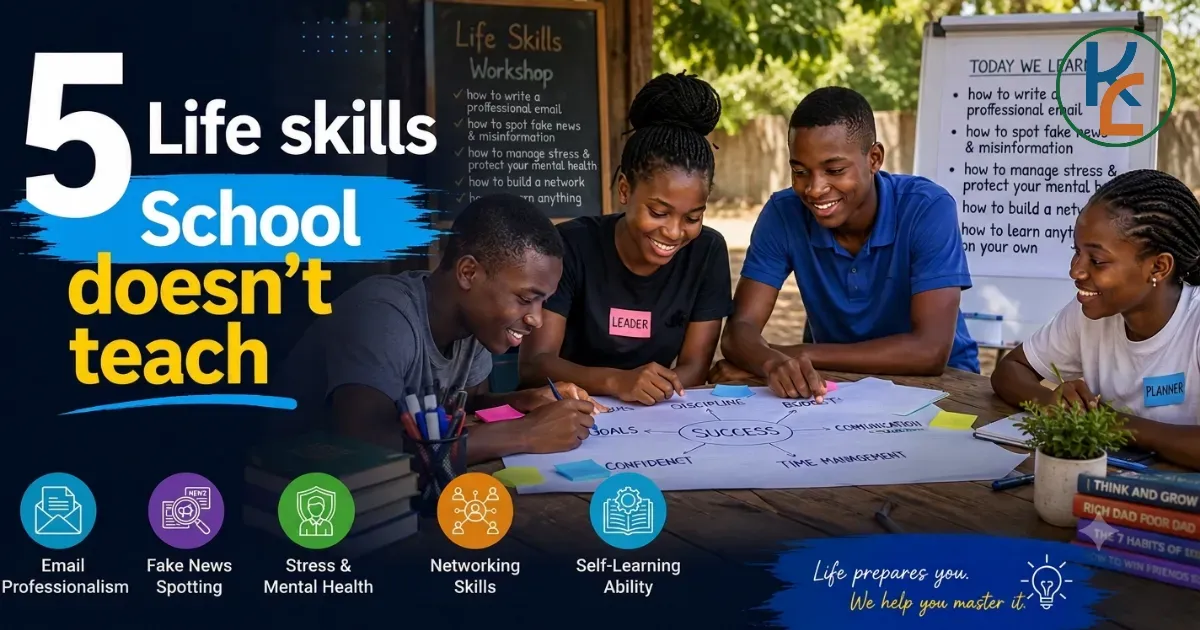
🎓 5 Life Skills School Doesn't Teach (But You Actually Need)
You can balance chemical equations and analyze Shakespeare. But can you write a professional email to a university? Can you tell if a WhatsApp message is fake news? Can you handle the stress of exam season without breaking down?
If you answered "no" to any of these, don't worry — you're not alone. Malawian schools are excellent at teaching academic subjects, but they completely skip the real-world skills that determine success in life.
This post fills that gap. Here are 5 essential life skills every Malawian student needs — and exactly how to learn them, even if your school never taught them.

The most important lessons in life aren't found in any textbook.
📧 Skill #1: How to Write a Professional Email
You've sent hundreds of WhatsApp messages. But have you ever written a formal email?
Here's the truth: When you apply for university, a scholarship, a job, or even contact a teacher for help — you'll need to write an email. And most Malawian students have no idea how to do it properly.
Why This Matters:
- 🎓 University applications often require email communication
- 💼 Job applications start with a professional email
- 🤝 Networking with professionals happens via email
- 📚 Requesting help from teachers or mentors is easier via email
The 5-Part Email Formula:
1. Subject Line (Clear & Specific)
❌ Bad: "Hello" or "Question"
✅ Good: "Inquiry About MSCE Mathematics Past Papers - Standard 8 Student"
2. Greeting (Professional)
❌ Bad: "Hey" or "Hi sir"
✅ Good: "Dear Mr. Chikuni," or "Dear Admissions Team,"
3. Body (Short & Clear)
Introduce yourself in one sentence. State your purpose in one paragraph. Ask your question or make your request clearly.
4. Closing (Polite)
✅ Use: "Thank you for your time," or "I look forward to your response,"
5. Signature (Your Details)
Full name, school/class, phone number (optional)
Real Example:
Subject: Request for Guidance on MSCE Subject Selection
Dear Career Guidance Counselor,
My name is Grace Banda, a Form 3 student at Nakondi Secondary School. I am writing to seek your advice on choosing MSCE subjects that align with my goal of studying Medicine at UNIMA.
Could you please share information about the required subject combinations and any resources you recommend?
Thank you for your time and guidance.
Sincerely,
Grace Banda
Form 3, Nakondi Secondary School
grace.banda@email.com
Pro Tip: Always proofread your email before sending. Use Grammarly (free) to catch mistakes.
🔍 Skill #2: How to Spot Fake News & Misinformation
Every day, Malawians share thousands of fake messages on WhatsApp:
- ❌ "MANEB has announced MSCE results will be released tomorrow!"
- ❌ "Drink hot water to cure COVID-19"
- ❌ "Government is giving MWK 50,000 to every citizen — click here to claim"
If you can't spot fake news, you'll be manipulated, scammed, or misinformed.
The 5-Question Fake News Test:
1. Who shared this?
Is it a credible source (government, reputable newspaper, official MANEB page)? Or just "a friend of a friend"?
2. Is there proof?
Does the message link to an official source? Or is it just text with no evidence?
3. Does it sound too good (or too scary)?
Fake news often triggers strong emotions: "You won't believe this!" or "Share before they delete this!"
4. Can you verify it elsewhere?
Search the claim on Google. Check if reputable news sites (Times Group, Nation Publications, MANEB official website) are reporting it.
5. When was it posted?
Old news is often reshared as "breaking." Check the date.
Red Flags of Fake News:
- ❌ ALL CAPS headlines
- ❌ "Share this or something bad will happen"
- ❌ No author or source named
- ❌ Grammar mistakes and typos
- ❌ Requests for personal information or money
Trusted Sources for Malawian Students:
- ✅ MANEB Official Website — For exam dates, results, and announcements
- ✅ Ministry of Education — For education policies and updates
- ✅ Reputable newspapers: The Nation, The Times, Daily Times
Rule of Thumb: If it sounds too dramatic, it probably is. Don't share until you verify.
🧠 Skill #3: How to Manage Stress & Protect Your Mental Health
Let's be honest: Being a student in Malawi is stressful.
You're juggling:
- 📚 Academic pressure (MSCE, PSLCE, continuous assessments)
- 👨👩👧 Family expectations ("You must pass and make us proud!")
- 💰 Financial worries (school fees, transport, materials)
- 🤔 Future uncertainty ("What if I fail? What's my career?")
But here's what nobody tells you: Stress is normal. Suffering in silence is not.
Signs You're Overwhelmed:
- 😴 Can't sleep (or sleeping too much)
- 😤 Irritable or angry for no reason
- 😢 Feeling hopeless or worthless
- 🍽️ Loss of appetite or overeating
- 📉 Grades dropping, motivation gone
5 Practical Stress Management Techniques:
1. The 4-7-8 Breathing Technique
When you feel panic rising:
- Inhale through your nose for 4 seconds
- Hold your breath for 7 seconds
- Exhale slowly through your mouth for 8 seconds
- Repeat 3-4 times
This activates your parasympathetic nervous system and calms you down instantly.
2. The "Brain Dump" Method
When your mind is racing with worries:
- Take a piece of paper
- Write down everything that's bothering you (no filtering)
- Once it's on paper, your brain can relax
- Then organize: What can you control? What can't you control?
3. The 20-20-20 Rule (For Screen Fatigue)
If you're studying on a phone or laptop:
- Every 20 minutes
- Look at something 20 feet away
- For 20 seconds
This reduces eye strain and mental fatigue.
4. Physical Movement (Even 10 Minutes)
Stress lives in your body. Move it out:
- Walk around the compound
- Do 10 push-ups or jumping jacks
- Stretch for 5 minutes
- Dance to your favorite song
Exercise releases endorphins — natural mood boosters.
5. Talk to Someone (Don't Suffer Alone)
You don't have to face stress alone. Reach out to:
- 👨👩👧 A trusted parent or guardian
- 👨🏫 A teacher or school counselor
- 👥 A close friend who listens
- 📞 A helpline (if available in your area)
When to Seek Professional Help:
If you experience these for more than 2 weeks, talk to a counselor or doctor:
- ⚠️ Persistent sadness or hopelessness
- ⚠️ Thoughts of harming yourself
- ⚠️ Inability to function (can't go to school, eat, sleep)
- ⚠️ Withdrawing from everyone
Remember: Asking for help is not weakness. It's the bravest thing you can do.
🤝 Skill #4: How to Build a Network (Even as a Student)
You've heard the phrase: "It's not what you know, it's who you know."
In Malawi, this is very true. Many opportunities — scholarships, internships, jobs, mentorship — come through relationships, not job boards.
But here's the good news: You can start building your network right now, even in Form 3.
What Is Networking? (It's Not What You Think)
Networking isn't about collecting business cards or attending fancy events. It's simply:
- ✅ Building genuine relationships with people who inspire or support you
- ✅ Offering value (even small things like sharing resources)
- ✅ Staying in touch over time
5 Ways to Start Networking as a Student:
1. Connect with Your Teachers
Teachers are your first professional network. They:
- Know people in your field of interest
- Can write recommendation letters
- Can introduce you to alumni
Action: After class, ask a teacher about their career path. Show genuine interest.
2. Join Clubs & Organizations
Whether it's:
- 📚 Debate club
- ⚽ Sports team
- 🎭 Drama group
- 💻 Coding club
- 🙏 Religious youth group
These are networking goldmines. You'll meet peers with similar interests — future colleagues, collaborators, and friends.
3. Use LinkedIn (Yes, Students Can Use It)
LinkedIn isn't just for professionals. Create a profile now:
- Add your school and interests
- Follow professionals in fields you admire
- Engage with their posts (thoughtful comments, not just "nice post")
- Connect with alumni from your school
4. Attend Events (Even Online Ones)
Look for:
- 🎤 Career talks at school
- 💻 Free webinars (many are online)
- 📚 Library events
- 🏛️ Community gatherings
Action: After an event, send a thank-you email to the speaker (see Skill #1!).
5. Give Before You Ask
The best networkers don't just take — they give:
- Share a useful article with a contact
- Introduce two people who should know each other
- Offer to help with a small task
- Congratulate someone on their achievement
When you give value, people remember you.
The "Weak Ties" Principle:
Research shows that opportunities often come from "weak ties" — people you know casually, not your close friends.
So don't just hang out with your best friends. Talk to the quiet student in class. Chat with the neighbor who works in a field you admire. You never know who will open a door for you.
📚 Skill #5: How to Learn Anything on Your Own (Self-Directed Learning)
Here's a secret: The most successful people in the world are self-taught.
Elon Musk learned rocket science from books. Malawian entrepreneurs learn business by doing. Top students master subjects beyond the syllabus.
The ability to teach yourself anything is the ultimate superpower. And you can start practicing it today.
The 4-Step Self-Learning Framework:
Step 1: Define What You Want to Learn
Be specific:
- ❌ "I want to learn math"
- ✅ "I want to master quadratic equations in 2 weeks"
Step 2: Find Free Resources
You don't need expensive courses. Start with:
- 📚 Free PDFs (like the 250+ on this website!)
- 🎥 YouTube tutorials (Khan Academy, Organic Chemistry Tutor)
- 📖 Library books (your school or local library)
- 🌐 Free online courses (Coursera, edX — many are free)
Step 3: Create a Study Schedule
Self-learning fails without structure. Set:
- 📅 When: "Monday, Wednesday, Friday from 4-5 PM"
- ⏱️ How long: "1 hour per session"
- 🎯 What: "Complete Chapter 3 and do 10 practice problems"
Step 4: Test Yourself (Active Recall)
Don't just read — test yourself:
- Close the book and write down what you remember
- Do practice problems without looking at solutions
- Teach the concept to someone else (or explain it out loud)
This is called active recall, and it's 50% more effective than passive reading.
The Feynman Technique (Learn Anything in 4 Steps):
- Choose a concept you want to understand
- Explain it in simple terms (as if teaching a 10-year-old)
- Identify gaps in your understanding
- Go back to the source and fill those gaps
Repeat until you can explain it clearly.
Real Example: Learning to Code (With Zero Experience)
Let's say you want to learn basic HTML (to build a simple website):
- Week 1: Watch free YouTube tutorials (The Net Ninja, Traversy Media)
- Week 2: Practice on freeCodeCamp.org (interactive lessons)
- Week 3: Build a simple "About Me" page
- Week 4: Share it with friends and ask for feedback
In one month, you'll have a real skill — and you spent MWK 0.
Free Learning Resources for Malawian Students:
- 📘 250+ Free PDFs — Past papers, notes, and guides for every subject
- 🎥 Khan Academy (khanacademy.org) — Free math, science, and economics courses
- 💻 freeCodeCamp (freecodecamp.org) — Learn coding for free
- 📚 Project Gutenberg (gutenberg.org) — Thousands of free books
🎯 How to Start Practicing These Skills Today
You don't need to master all 5 skills at once. Start small:
This Week:
- ✉️ Write one professional email (to a teacher, mentor, or organization)
- 🔍 Fact-check one WhatsApp message before sharing it
- 🧘 Try the 4-7-8 breathing technique when you feel stressed
This Month:
- 🤝 Connect with one teacher or professional on LinkedIn
- 📚 Spend 30 minutes learning something new (use the self-learning framework)
This Term:
- 🎯 Join one club or organization
- 📧 Build the habit of writing professional emails
- 🧠 Practice stress management daily
📥 Free Resources to Build Real-World Skills
Education doesn't stop at the classroom door. Access free study guides, past papers, and revision materials.
Access Free Study Resources
✅ 100% free • No signup required • Works offline
Written for every Malawian student who wants to succeed — not just in exams, but in life.
— Kizito Chikuni, Educator & Developer



Sign in securely with Google to join the discussion.