
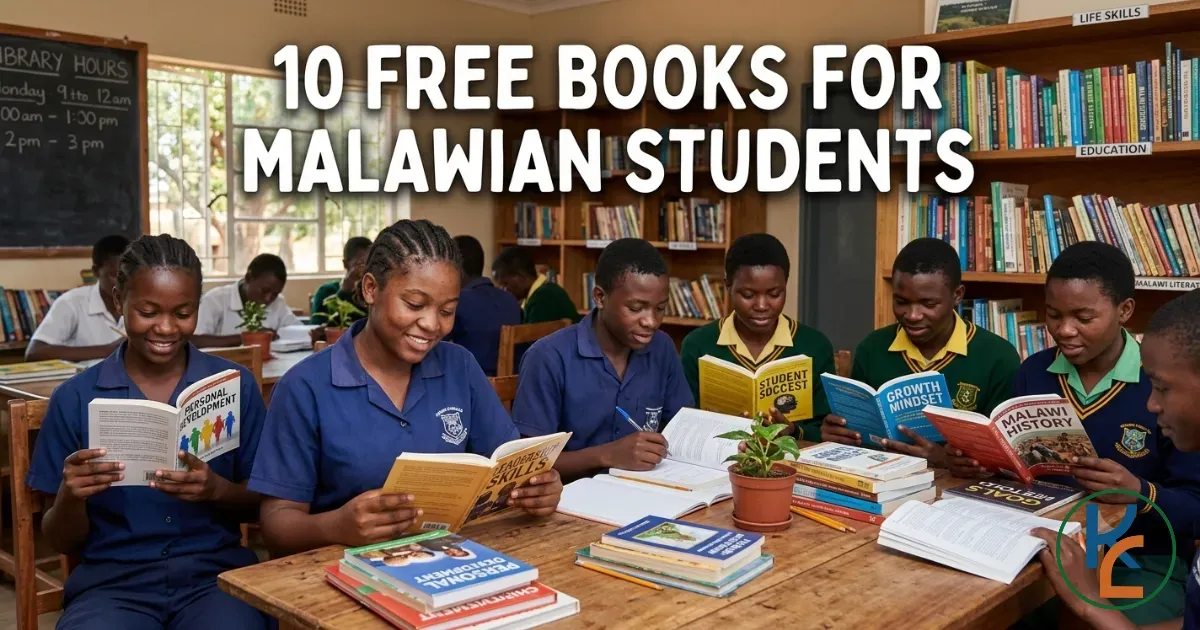
📚 10 Free Books Every Malawian Student Should Read Before Form 4
School will teach you how to pass exams. But these books will teach you how to succeed in life. The best part? They're all completely free and legally available online.
Before you dive into Form 4 and the pressure of MSCE exams, there's something more important than memorizing formulas: building the mindset, skills, and knowledge that will serve you for life.
School teaches you what to think. These books teach you how to think — about money, about learning, about yourself, and about your future.

The best investment you can make is in your own mind.
📖 Book #1: "Rich Dad Poor Dad" by Robert Kiyosaki
Why You Should Read It:
This book will completely change how you think about money. Most Malawian students graduate without knowing the difference between an asset and a liability. This book fixes that.
Key Lessons:
- 💰 The rich don't work for money — they make money work for them
- 📊 Assets vs. Liabilities: Assets put money in your pocket; liabilities take money out
- 🏠 Your house is NOT an asset (controversial but important)
- Financial education > Academic education (you need both)
How It Applies to You:
Instead of saving MWK 50,000 under your mattress (where inflation eats it), you'll learn to invest it. Instead of buying the latest phone on credit (a liability), you'll learn to buy assets first.
Where to Get It Free:
✅ Internet Archive (free borrowing)
✅ Your local library (most have copies)
✅ Ask a teacher or mentor who has read it
📖 Book #2: "Atomic Habits" by James Clear
Why You Should Read It:
This book teaches you how to build good habits and break bad ones — the exact skill you need to go from average student to top performer.
Key Lessons:
- 📈 1% better every day = 37x better in a year
- ⏰ Systems > Goals: Focus on daily systems, not just end goals
- Make it obvious, attractive, easy, satisfying (the 4 laws)
- 🔄 Identity-based habits: "I'm a reader" vs "I want to read more"
How It Applies to You:
Instead of saying "I'll study 5 hours today" (and burning out), you'll build a habit of studying 25 minutes every day. Small, consistent actions compound into massive results.
Where to Get It Free:
✅ Author's website (free first chapter + resources)
✅ Internet Archive (free borrowing)
✅ PDF summary + worksheets online
📖 Book #3: "How to Win Friends and Influence People" by Dale Carnegie
Why You Should Read It:
MSCE is important, but your ability to work with people matters more in the long run. This 1936 classic is still the best book on human relations ever written.
Key Lessons:
- Be genuinely interested in other people
- 😊 Smile (sounds simple, but it works)
- 👂 Listen more than you talk
- 💬 Talk in terms of the other person's interests
- ✅ Make the other person feel important
How It Applies to You:
Whether you're asking a teacher for extra help, networking for a scholarship, or leading a group project — these principles work. People who master human relations go further than people who only master academics.
Where to Get It Free:
✅ Project Gutenberg (100% free, public domain)
✅ Audiobook on YouTube (free)
📖 Book #4: "The 7 Habits of Highly Effective People" by Stephen Covey
Why You Should Read It:
This isn't just a productivity book — it's a complete framework for living with integrity, purpose, and effectiveness.
Key Lessons:
- 🎯 Begin with the end in mind (know your destination)
- Put first things first (prioritize what matters)
- 🤝 Think win-win (abundance mindset)
- 👂 Seek first to understand, then to be understood
- 🔄 Sharpen the saw (continuous self-improvement)
How It Applies to You:
Instead of drifting through Form 4 reacting to whatever happens, you'll create a personal mission statement, set clear goals, and proactively work toward them. You'll become the author of your life, not just a character in someone else's story.
Where to Get It Free:
✅ Internet Archive (free borrowing)
✅ Local library
✅ PDF summaries and study guides online
📖 Book #5: "Thinking, Fast and Slow" by Daniel Kahneman
Why You Should Read It:
This Nobel Prize-winning book teaches you how your brain actually works — and why you make irrational decisions even when you think you're being logical.
Key Lessons:
- 🧠 System 1 (fast) vs System 2 (slow) thinking
- ⚡ Cognitive biases: Your brain takes shortcuts that lead to errors
- 📊 Anchoring effect: First information you get influences all later decisions
- Loss aversion: You fear losing more than you enjoy winning
How It Applies to You:
When choosing subjects for MSCE, you'll recognize if you're making emotional vs rational decisions. When studying, you'll understand why cramming doesn't work (System 1 illusion of competence). You'll make better decisions in every area of life.
Where to Get It Free:
✅ University library (if you have access)
✅ PDF summaries online
Book #6: "Mindset: The New Psychology of Success" by Carol Dweck
Why You Should Read It:
This book will change how you view intelligence, talent, and failure. It's the difference between giving up when things get hard and pushing through to mastery.
Key Lessons:
- Growth mindset: "I can't do this yet"
- Fixed mindset: "I'm just not good at this"
- 💪 Effort is the path to mastery, not a sign of weakness
- 📉 Praise effort, not intelligence
How It Applies to You:
When you fail a Math test, instead of thinking "I'm stupid," you'll think "I need to change my study strategy." When you struggle with English, instead of giving up, you'll embrace the challenge. This mindset shift is the foundation of all academic success.
Where to Get It Free:
✅ TED Talk by Carol Dweck on YouTube (free, 10 minutes)
✅ PDF summaries and worksheets online
📖 Book #7: "The Subtle Art of Not Giving a F*ck" by Mark Manson
Why You Should Read It:
This counterintuitive book teaches you how to choose what to care about — because you can't care about everything, and trying to will destroy you.
Key Lessons:
- 🎯 You have limited f*cks to give — choose wisely
- 😤 Pain is inevitable; choose your pain
- 📏 Failure is the foundation of success
- 🎭 Don't be special — be ordinary and happy
How It Applies to You:
Instead of stressing about what everyone thinks of you, you'll focus on what actually matters: your values, your goals, your growth. You'll stop comparing yourself to others on social media and start building your own path.
Where to Get It Free:
✅ Local library
✅ Audiobook samples on YouTube
📖 Book #8: "The Power of Now" by Eckhart Tolle
Why You Should Read It:
Form 4 is stressful. Exams are stressful. Life is stressful. This book teaches you how to find peace in the present moment instead of constantly worrying about the past or future.
Key Lessons:
- The present moment is all you have
- Most suffering comes from resisting what is
- 🎭 You are not your thoughts
- Accept the present, then take action
How It Applies to You:
Instead of panicking about MSCE exams 6 months away, you'll focus on what you can do today. Instead of dwelling on a bad test score, you'll learn from it and move forward. This mental peace is crucial for high performance under pressure.
Where to Get It Free:
✅ YouTube: Full audiobook readings (free)
✅ Local library or meditation center
📖 Book #9: "The Alchemist" by Paulo Coelho
Why You Should Read It:
This beautiful novel teaches you about following your dreams, listening to your heart, and recognizing omens. It's a quick read but will stay with you for life.
Key Lessons:
- ⭐ When you want something, the universe conspires to help you
- 💎 Your "Personal Legend" is your purpose
- 👁️ The treasure is often where you started (but the journey transforms you)
- ❤️ Listen to your heart, but also listen to the world
How It Applies to You:
Whether you dream of becoming a doctor, engineer, teacher, or entrepreneur — this book will inspire you to pursue it with courage. It reminds you that the journey itself is the reward, and that setbacks are part of the path.
Where to Get It Free:
✅ Local library
✅ PDF versions online (check copyright in your country)
Book #10: "Man's Search for Meaning" by Viktor Frankl
Why You Should Read It:
This book will give you perspective on suffering, purpose, and resilience. Written by a Holocaust survivor, it's one of the most powerful books ever written about finding meaning in life.
Key Lessons:
- 🎯 Those who have a 'why' can bear any 'how'
- 💪 Suffering is inevitable, but despair is optional
- Everything can be taken from you except your attitude
- 🌟 Find meaning in your suffering
How It Applies to You:
When studying feels impossible, when exams feel overwhelming, when life feels unfair — this book reminds you that you always have a choice in how you respond. It gives you the mental toughness to push through any challenge.
Where to Get It Free:
✅ Local library
✅ PDF summaries and study guides online
How to Read These Books (When You're Busy with School)
You don't need to read all 10 books in one month. Here's a realistic plan:
The 20-Minute Rule:
- 📱 Read 20 minutes per day (before bed, during lunch, on the bus)
- 📅 That's 2-3 books per year
- 🎓 By Form 4, you'll have read 6-9 of these books
The 10-Page Rule:
- 📖 Read 10 pages per day
- 📚 That's 3,650 pages per year
- 📈 Average book = 250 pages = 14 books per year
The Audio Method:
- Listen to audiobooks while walking, doing chores, or commuting
- ⏱️ Most books = 5-10 hours
- 📱 Use YouTube or library apps (many are free)
📚 Free Resources to Build Your Reading Habit
We've created free resources to help you succeed:
📘 English Revision Guides — Improve reading comprehension
Study Notes — Learn how to learn effectively
📁 Browse All Secondary Resources — 250+ free PDFs
💡 Your Reading Challenge
Ready to start? Here's your challenge:
Month 1: Foundation
- ✅ Read "Atomic Habits" (build the reading habit)
- ✅ Read 20 minutes per day
- ✅ Keep a reading journal (note key insights)
Month 2: Money Mindset
- ✅ Read "Rich Dad Poor Dad"
- ✅ Start tracking your spending
- ✅ Open a savings account (if you haven't)
Month 3: People Skills
- ✅ Read "How to Win Friends and Influence People"
- ✅ Practice one principle per week
- ✅ Notice how people respond differently
Months 4-10: Continue the Journey
- ✅ Read 1 book per month from the list
- ✅ Share what you learn with friends
- ✅ Apply the lessons to your life
📥 Free Study Resources to Support Your Learning
Reading builds your mind. Study resources build your grades. Get both for free.
Access Free Study Resources
✅ 100% free • No signup required • Works offline
Written for every Malawian student who wants to build a mind that lasts a lifetime.
— Kizito Chikuni, Educator & Developer
Sign in securely with Google to join the discussion.