
Description
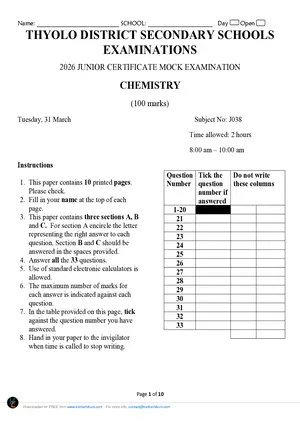
Master chemical principles with the Thyolo Secondary School 2026 Chemistry Mock Paper. This 100-mark JCE assessment mirrors the MANEB examination structure, testing both conceptual knowledge and practical application:
- Section A (20 marks): Multiple choice questions covering atomic structure, bonding, states of matter, and chemical reactions.
- Section B (50 marks): Structured questions requiring equation balancing, mole calculations, experimental analysis, and data interpretation.
- Section C (30 marks): Three long descriptive questions (10 marks each) focusing on industrial processes, environmental chemistry, and reaction mechanisms.
This paper is designed to develop precise scientific communication, laboratory reasoning, and real-world chemical literacy.
Study Tips / Exam Strategy
1. Equation Mastery: Practice balancing chemical equations daily. Remember to check atom counts on both sides and include state symbols (s, l, g, aq).
2. Mole Calculations: Memorize the mole triangle (n = m/M = V/22.4 = C × V). Always convert masses to grams and volumes to dm³ before substituting.
3. Descriptive Precision: Use exact chemical terminology (e.g., "oxidation", "exothermic", "catalyst", "precipitate"). Avoid vague phrases like "it reacts" or "changes happen".
4. Lab Context: When questions reference experiments, mention safety precautions, apparatus names, and observable changes (color, temperature, gas evolution).
5. Periodic Table Practice: Familiarize yourself with group trends (reactivity, metallic character) and period trends (atomic radius, electronegativity) to quickly eliminate MCQ options.
Key Concepts to Master for Chemistry (Form 2)
This resource covers essential chemistry topics for Form 2 learners. Before attempting the paper, ensure you understand these foundational concepts:
• Atomic Structure & Bonding Electron configuration, ionic/covalent bonds, periodic trends. Use dot-and-cross diagrams for bonding questions.
• Chemical Reactions
Balancing equations, reaction rates, acids/bases. Show state symbols (s, l, g, aq) in equations.
• Organic Chemistry Basics
Hydrocarbons, functional groups, polymerization. Practice naming compounds using IUPAC rules.
Pro Tip: After completing this paper, revisit any concepts you struggled with using your textbook or FiloKin's study notes. Browse more Chemistry resources →
Preview
Share This Resource
Need Help?
- Free for personal educational use by Malawian students & teachers
- 10 downloads per day per device to ensure fair access
- Always verify with official MANEB/MoEST publications for exam prep
- Do not redistribute, sell, or republish without permission
Discussion (0)
No comments yet. Be the first to share your thoughts!
Sign in securely with Google to join the discussion.