
Description
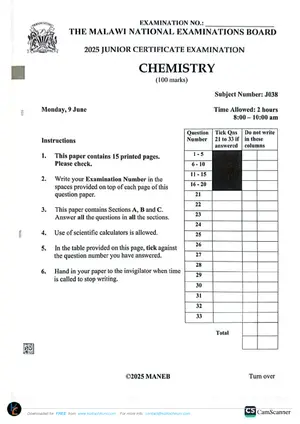
The 2025 MANEB Junior Certificate Examination (JCE) Chemistry paper assesses foundational chemical knowledge and scientific investigation skills essential for Malawian junior secondary learners exploring matter, its properties, and transformations. This 100-mark compulsory paper tests core competencies in states of matter, atomic structure basics, chemical bonding introduction, acids and bases, simple chemical reactions, and laboratory safety principles – all aligned with the JCE syllabus requirements and contextualized within Malawi's natural resources, health priorities, and everyday chemical applications.
Questions require candidates to demonstrate both conceptual understanding and practical application: identifying physical vs. chemical changes, explaining properties of common substances, predicting products of simple reactions, or interpreting experimental observations related to chemical phenomena. Topics frequently include water purification methods, soil pH and agricultural productivity, basic metallurgy concepts relevant to local crafts, and safe handling of household chemicals. The marking scheme rewards accurate chemical terminology, logical explanation of processes, integration of scientific principles with local contexts, and clear communication of chemical concepts suitable for junior secondary understanding.
This paper is particularly valuable for students building scientific literacy for MSCE-level chemistry, technical vocations, or informed participation in community health and environmental initiatives. By practicing with these questions, learners develop the ability to apply chemical concepts to real-world situations, evaluate product information critically, and appreciate the role of chemistry in addressing Malawi's development challenges. The 2025 JCE Chemistry paper emphasizes foundational knowledge that supports success in science subjects, promotes evidence-based decision-making about materials and health, and fosters scientific curiosity aligned with Malawi's educational and economic priorities. Mastery of this content strengthens analytical thinking, observational precision, and the capacity to use chemical understanding for practical problem-solving in academic, vocational, and community contexts.
Study Tips / Exam Strategy
⚗️ Matter & Changes:
• Memorize states of matter properties: Solid (fixed shape/volume), Liquid (fixed volume, takes container shape), Gas (no fixed shape/volume)
• Practice distinguishing changes: "Melting ice is physical (reversible); burning wood is chemical (new substances formed)"
• Link to Malawi contexts: "Understanding evaporation helps explain traditional salt production methods using solar energy"
🧪 Acids, Bases & Everyday Chemistry:
• Master indicators: Litmus paper (red=acid, blue=base), natural indicators like hibiscus extract
• Practice explaining applications: "Adding lime (base) to acidic soils improves crop growth by adjusting pH to optimal range"
• Connect to health: "Antacids contain bases that neutralize excess stomach acid, relieving indigestion"
🔬 Laboratory Safety & Techniques:
• Memorize key rules: Wear eye protection, tie back long hair, never taste chemicals, know emergency procedures
• Practice explaining procedures: "When diluting acid, always add acid to water slowly to prevent dangerous splashing"
• Link to school contexts: "Proper chemical storage prevents accidents and ensures reagents remain effective for student experiments"
🌍 Chemistry in Malawi's Development:
• Understand applications: Water treatment (chlorination), food preservation (drying, salting), local crafts (pottery firing, metalworking)
• Practice explaining principles: "Chlorine kills harmful microorganisms in water, making it safer for drinking and reducing disease transmission"
• Connect to sustainability: "Understanding chemical properties helps communities select appropriate, affordable materials for construction and crafts"
⏱️ Exam Strategy:
• For explanation questions, use "Observation → Principle → Application" structure with clear chemical terminology
• Always specify Malawian contexts in application questions: local materials, health challenges, resource constraints
• Practice writing balanced chemical equations when required, showing correct formulas and state symbols
✅ Self-Check:
Can you explain one everyday example of a chemical change and how you know it is chemical? If yes, you're prepared for applied chemistry questions.
Key Concepts to Master for Chemistry (Form 2)
This resource covers essential chemistry topics for Form 2 learners. Before attempting the paper, ensure you understand these foundational concepts:
• Atomic Structure & Bonding Electron configuration, ionic/covalent bonds, periodic trends. Use dot-and-cross diagrams for bonding questions.
• Chemical Reactions
Balancing equations, reaction rates, acids/bases. Show state symbols (s, l, g, aq) in equations.
• Organic Chemistry Basics
Hydrocarbons, functional groups, polymerization. Practice naming compounds using IUPAC rules.
Pro Tip: After completing this paper, revisit any concepts you struggled with using your textbook or FiloKin's study notes. Browse more Chemistry resources →
Preview
Share This Resource
Need Help?
- Free for personal educational use by Malawian students & teachers
- 10 downloads per day per device to ensure fair access
- Always verify with official MANEB/MoEST publications for exam prep
- Do not redistribute, sell, or republish without permission
Discussion (0)
No comments yet. Be the first to share your thoughts!
Sign in securely with Google to join the discussion.