
Description
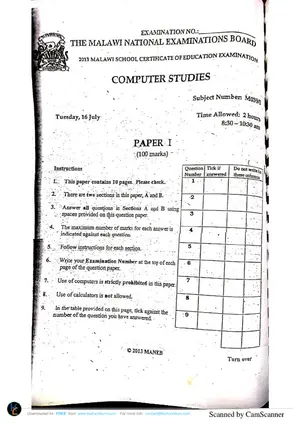
The 2013 MANEB MSCE Computer Studies Paper 1 (Theory) places increased emphasis on data management principles, logical reasoning frameworks, and the ethical dimensions of computing technology. This 100-mark theory paper features compulsory questions distributed across two sections, testing candidates' ability to analyze database concepts, apply algorithmic thinking to problem-solving scenarios, evaluate network communication protocols, and articulate responsible technology practices within educational and community contexts.
Questions frequently require candidates to move beyond technical description to strategic evaluation: comparing relational database structures for specific record-keeping needs, justifying algorithm design choices based on efficiency and clarity, or discussing how digital privacy principles apply to student data management in Malawian schools. The marking scheme rewards clear, structured reasoning supported by accurate terminology and context-aware applications.
This paper is particularly valuable for students developing critical thinking skills necessary for higher-level computer science studies. By engaging with these questions, learners build the ability to assess technology solutions based on data integrity, user accessibility, and long-term sustainability – competencies directly applicable to ICT roles in healthcare, education, agriculture, and public administration. The 2013 paper also introduces foundational concepts in system documentation, user interface design principles, and intellectual property awareness, preparing candidates for both examination success and responsible digital citizenship. Mastery of this content strengthens analytical writing, logical problem decomposition, and ethical decision-making frameworks essential for modern technology environments.
Study Tips / Exam Strategy
🗄️ Database Concepts:
• Memorize key terms: Field (single data item), Record (complete row), Table (related records), Primary Key (unique identifier)
• Practice explaining normalization simply: "Organizing data into separate tables reduces duplication and improves update efficiency."
• Compare file systems vs. DBMS: "DBMS provides query capabilities, concurrent access control, and data integrity checks lacking in flat files."
🔤 Algorithmic Thinking:
• Use decomposition: Break complex problems into smaller, manageable steps before writing solutions
• Practice dry-running algorithms with sample data tables to verify logic flow and edge-case handling
• Focus on clarity over complexity: Examiners reward readable, well-structured pseudocode more than advanced syntax
🌐 Protocol & Communication:
• Define clearly: "Protocols are agreed rules that ensure devices interpret data consistently during transmission"
• Compare HTTP (web pages), FTP (file transfer), SMTP (email) with one-sentence use cases
• Practice explaining handshake processes simply: "Sender requests connection → Receiver acknowledges → Data transfers in packets → Confirmation sent upon completion"
⚖️ Ethics & Professional Practice:
• Memorize core principles: Privacy, Consent, Attribution, Security, Accessibility
• Structure responses: State principle → Explain relevance → Provide Malawi-appropriate example
• Example: "Attribution ensures original creators receive recognition; schools should teach proper citation when using online research materials for projects."
📝 Answer Structuring:
• Use the "Define → Explain → Apply" framework for theory questions
• Avoid vague statements like "computers are important"; specify "computers automate record-keeping, reducing human error in school administration."
• Practice writing 1-paragraph responses within 4 minutes to build exam pacing discipline
✅ Self-Check:
Can you explain why a primary key is essential in a student database using one clear example? If yes, data management questions will be manageable.
Key Concepts to Master for Computer Studies (Form 4)
This resource covers essential computer studies topics for Form 4 learners. Before attempting the paper, ensure you understand these foundational concepts:
• Core Computer Studies Concepts
Review your textbook chapters related to this paper. Focus on definitions, formulas, and worked examples.
Pro Tip: After completing this paper, revisit any concepts you struggled with using your textbook or FiloKin's study notes. Browse more Computer Studies resources →
Preview
Share This Resource
Need Help?
- Free for personal educational use by Malawian students & teachers
- 10 downloads per day per device to ensure fair access
- Always verify with official MANEB/MoEST publications for exam prep
- Do not redistribute, sell, or republish without permission
Discussion (0)
No comments yet. Be the first to share your thoughts!
Sign in securely with Google to join the discussion.