
Description
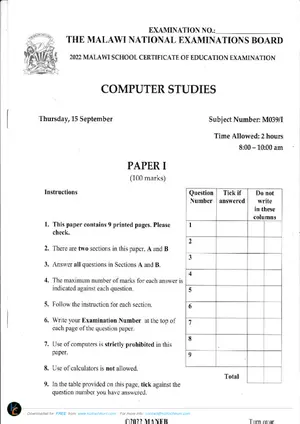
The 2022 MANEB MSCE Computer Studies Paper 1 (Theory) reflects contemporary examination standards emphasizing critical analysis, adaptive technological understanding, and secure computing practices within rapidly evolving digital environments. This 100-mark theory paper features compulsory questions across two sections, testing advanced integration of computer architecture principles, generational technological shifts, software development methodologies, network security frameworks, and modern programming logic applications.
Questions require candidates to demonstrate sophisticated reasoning capabilities: evaluating cloud infrastructure decisions based on data sovereignty and accessibility requirements, analyzing how encryption standards protect information during transmission across public networks, or justifying algorithmic approaches based on computational efficiency and maintenance scalability. The marking scheme rewards precise technical communication, logical argumentation, and the ability to contextualize computing principles within Malawi's expanding digital education and public service sectors.
This paper is essential for final-year candidates aiming for distinction-level performance and university-ready ICT competencies. By engaging with these questions, learners develop strategic thinking skills needed to assess technology solutions holistically, anticipate security vulnerabilities in system designs, and communicate technical concepts clearly to diverse audiences. The 2022 paper also reinforces foundational concepts in data integrity verification, user experience design principles, and ethical digital citizenship – competencies directly aligned with tertiary admission requirements and entry-level technology professional standards. Mastery of this content strengthens analytical precision, structured problem decomposition, and context-aware technical reasoning that distinguish high-performing MSCE candidates in increasingly competitive academic and professional landscapes.
Study Tips / Exam Strategy
🌐 Advanced Network Security:
• Memorize defense layers: Physical access control, firewall rules, encryption protocols, user authentication, regular audits
• Practice explaining defense-in-depth: "Multiple security layers ensure that if one control fails, others continue protecting sensitive institutional data."
• Link to Malawi context: "Implementing role-based access controls in school management systems prevents unauthorized grade modifications while maintaining transparency."
💻 Modern Programming Practices:
• Emphasize modularity, reusability, error handling, and documentation
• Practice explaining: "Well-structured programs separate data, logic, and interface components, enabling independent updates without system-wide disruption."
• Focus on logical clarity over language complexity – exam questions assess problem-solving approach, not specific syntax mastery.
📊 Data Integrity & Verification:
• Define clearly: Checksum (error detection), Hash function (data fingerprint), Digital signature (authentication + integrity)
• Explain purpose simply: "Verification mechanisms ensure data remains unaltered during storage or transmission, maintaining trust in digital records."
• Practice application responses: "School examination databases use hash verification to detect unauthorized modifications between result compilation and official release."
🔍 Critical Evaluation Framework:
• Use the "Claim → Evidence → Limitation → Conclusion" structure for analysis questions
• Avoid absolute statements; use qualified language: "typically improves," "generally reduces," "under standard conditions"
• Practice writing balanced responses that acknowledge both advantages and constraints of technology solutions.
⏱️ Final Revision Strategy:
• Complete one full theory paper weekly under strict examination timing
• Review marking schemes to understand point allocation patterns and expected terminology precision
• Maintain a concept glossary updated regularly with accurate definitions, examples, and syllabus references
• Practice explaining complex concepts aloud to refine technical communication clarity and confidence
✅ Self-Check:
Can you explain how a firewall protects a school network using two clear technical points? If yes, security questions will be manageable.
Key Concepts to Master for Computer Studies (Form 4)
This resource covers essential computer studies topics for Form 4 learners. Before attempting the paper, ensure you understand these foundational concepts:
• Core Computer Studies Concepts
Review your textbook chapters related to this paper. Focus on definitions, formulas, and worked examples.
Pro Tip: After completing this paper, revisit any concepts you struggled with using your textbook or FiloKin's study notes. Browse more Computer Studies resources →
Preview
Share This Resource
Need Help?
- Free for personal educational use by Malawian students & teachers
- 10 downloads per day per device to ensure fair access
- Always verify with official MANEB/MoEST publications for exam prep
- Do not redistribute, sell, or republish without permission
Discussion (0)
No comments yet. Be the first to share your thoughts!
Sign in securely with Google to join the discussion.