
Description
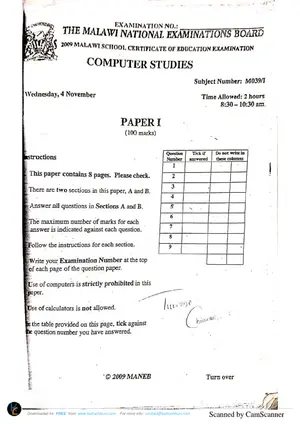
The 2009 MANEB MSCE Computer Studies Paper 1 (Theory) marks a strategic progression toward applied computational thinking, requiring candidates to demonstrate not only factual recall but logical reasoning across core computing domains. This 100-mark theory paper features compulsory questions distributed across two sections, systematically testing knowledge of computer classifications, generational technological shifts, hardware-software interdependence, foundational networking principles, and introductory programming logic.
Questions frequently present scenario-based prompts that demand justified decision-making: selecting appropriate input devices for specific data collection tasks, explaining why certain software licenses restrict commercial use, or tracing how binary data translates into human-readable output through system layers. The marking scheme rewards candidates who articulate technical relationships clearly, using precise terminology while maintaining logical flow from cause to effect.
This paper is particularly valuable for learners transitioning from basic ICT literacy to analytical problem-solving. By engaging with these questions, students develop the ability to evaluate technology choices based on functionality, cost-efficiency, and environmental constraints – skills directly applicable to Malawian school laboratories, community ICT centers, and small business operations. The 2009 paper also introduces structured approaches to algorithm design and basic data representation concepts, laying essential groundwork for practical programming tasks examined in Paper 2. Mastery of this content strengthens both theoretical exam performance and the conceptual framework needed for real-world technology troubleshooting, making it a critical revision resource for Form 4 candidates aiming for consistent, high-scoring responses across all MSCE Computer Studies papers.
Study Tips / Exam Strategy
🖥️ Hardware Selection & Justification:
• For scenario questions, use: Identify task → Match device feature → Explain suitability → Note limitation
• Example: "Barcode scanners are ideal for inventory tracking because they read optical patterns quickly, reducing manual entry errors in busy retail environments."
💾 Software Classification Clarity:
• Memorize categories: System (OS, utilities), Application (word processors, spreadsheets), Programming (compilers, IDEs)
• Practice explaining licensing: "Open-source allows modification and distribution; proprietary restricts access but provides dedicated support."
🌐 Networking Fundamentals:
• Define protocols simply: "Rules that govern how devices communicate (e.g., TCP/IP ensures reliable data delivery across networks)"
• Compare topologies: Star (central hub, easy troubleshooting), Bus (single cable, cost-effective but single point of failure)
• Link to Malawi: "Star topology is preferred in school labs because one faulty computer doesn't disrupt the entire network."
🔤 Algorithm & Logic Practice:
• Master pseudocode structure: INPUT → PROCESS → DECISION → OUTPUT
• Trace algorithms manually with sample values to verify logic before writing final answers
• Practice converting flowcharts to text and vice versa – exam questions frequently test this translation skill
⏱️ Exam Technique:
• Short answers: 1 mark = 1 clear point; 2 marks = 2 distinct points or 1 point + brief explanation
• Structured essays: Use paragraphs with topic sentences, avoid bullet points unless explicitly requested for lists
• Always define technical terms at first use, then apply them to the question context
✅ Quick Drill:
Can you explain why an operating system must be loaded into RAM before applications run? If yes, system architecture questions will be straightforward.
Key Concepts to Master for Computer Studies (Form 4)
This resource covers essential computer studies topics for Form 4 learners. Before attempting the paper, ensure you understand these foundational concepts:
• Core Computer Studies Concepts
Review your textbook chapters related to this paper. Focus on definitions, formulas, and worked examples.
Pro Tip: After completing this paper, revisit any concepts you struggled with using your textbook or FiloKin's study notes. Browse more Computer Studies resources →
Preview
Share This Resource
Need Help?
- Free for personal educational use by Malawian students & teachers
- 10 downloads per day per device to ensure fair access
- Always verify with official MANEB/MoEST publications for exam prep
- Do not redistribute, sell, or republish without permission
Discussion (0)
No comments yet. Be the first to share your thoughts!
Sign in securely with Google to join the discussion.