
Description
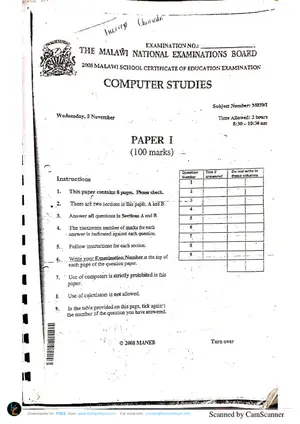
The 2008 MANEB MSCE Computer Studies Paper 1 (Theory) emphasizes systematic understanding of computing systems, requiring candidates to explain not just what components do, but how they interact within a complete information processing cycle. This 100-mark theory paper features compulsory questions across two sections, testing integrated knowledge of computer generations, hardware architecture, software layers, networking fundamentals, and structured programming concepts.
Questions increasingly demand causal explanations: describing how transistor technology enabled smaller, faster computers; explaining why an operating system must load into RAM before applications can run; or outlining how data packets travel across a network using protocols. The marking scheme rewards candidates who demonstrate logical sequencing and technical precision in their responses.
This paper is particularly valuable for learners aiming to bridge theory with practical troubleshooting. By mastering the content tested here, students develop the ability to diagnose common computer issues (e.g., slow performance, connectivity problems) by understanding underlying system interactions. The 2008 paper also introduces foundational concepts in data security and ethical computing – topics of growing relevance as Malawi expands digital access in schools and communities. Practicing with this paper builds the analytical framework needed for both exam success and responsible technology use in real-world contexts.
Study Tips / Exam Strategy
🔄 System Interaction Mastery:
• Practice explaining the boot process in 4 steps: Power on → BIOS checks hardware → OS loads from storage to RAM → User interface appears
• Use cause-and-effect language: "Because RAM is volatile, unsaved work is lost when power fails."
• Draw simple system diagrams: CPU connected to memory, storage, input/output – label data flow arrows
💾 Memory Hierarchy Clarity:
• Memorize order: Registers → Cache → RAM → Hard Drive → External Storage (fastest to slowest, smallest to largest)
• Explain trade-offs: "Cache is fast but expensive; hard drives are slow but high-capacity and affordable."
• Link to user experience: "More RAM allows more applications to run simultaneously without slowing down."
🔐 Security & Ethics Basics:
• Define key terms: Password, firewall, backup, copyright, plagiarism
• Practice 2-sentence answers: "A firewall monitors network traffic to block unauthorized access. Schools should use firewalls to protect student data and prevent malware infections."
• Connect to Malawi: "Backing up school records to external drives protects against data loss from power surges common in some regions."
🔤 Structured Programming Logic:
• Master the three control structures: Sequence (steps in order), Selection (IF-THEN-ELSE), Iteration (loops: FOR, WHILE)
• Practice tracing simple algorithms with sample inputs to predict outputs
• Write pseudocode with clear indentation to show logical blocks
⏱️ Exam Execution:
• For explanation questions, use the "Point → Explain → Example" structure
• Always define acronyms first use: "Local Area Network (LAN)…"
• Underline command words: "State" (brief), "Explain" (cause/effect), "Compare" (similarities + differences)
✅ Quick Drill:
Can you explain why a computer needs both RAM and hard storage in two clear sentences? If yes, memory architecture questions will be manageable.
Key Concepts to Master for Computer Studies (Form 4)
This resource covers essential computer studies topics for Form 4 learners. Before attempting the paper, ensure you understand these foundational concepts:
• Core Computer Studies Concepts
Review your textbook chapters related to this paper. Focus on definitions, formulas, and worked examples.
Pro Tip: After completing this paper, revisit any concepts you struggled with using your textbook or FiloKin's study notes. Browse more Computer Studies resources →
Preview
Share This Resource
Need Help?
- Free for personal educational use by Malawian students & teachers
- 10 downloads per day per device to ensure fair access
- Always verify with official MANEB/MoEST publications for exam prep
- Do not redistribute, sell, or republish without permission
Discussion (0)
No comments yet. Be the first to share your thoughts!
Sign in securely with Google to join the discussion.