
Description
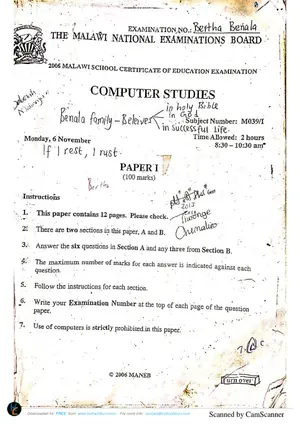
The 2006 MANEB MSCE Computer Studies Paper 1 (Theory) establishes foundational knowledge in computing principles that remain relevant for digital literacy today. This 100-mark theory paper features compulsory questions across two sections, testing core competencies in computer types, generations of computing technology, hardware components, software classification, basic networking concepts, and introductory programming logic.
Candidates encounter questions requiring clear definitions, comparative analysis, and practical application of concepts. For example: distinguishing between system software and application software with Malawi-relevant examples; explaining how hardware components interact during data processing; or outlining the evolution from vacuum tubes to microprocessors with emphasis on size, speed, and reliability improvements. The paper rewards candidates who can articulate technical concepts in clear, accessible language while demonstrating understanding of cause-and-effect relationships in computing systems.
This paper is particularly valuable for students building baseline computer literacy before advancing to practical programming tasks. By mastering the content tested here, learners develop the conceptual framework needed to troubleshoot hardware issues, evaluate software suitability for specific tasks, and understand how networking enables resource sharing in school or community settings. The 2006 paper emphasizes timeless principles – such as the fetch-decode-execute cycle, memory hierarchy, and algorithmic thinking – that underpin all modern computing, making it an essential revision resource for MSCE candidates aiming for strong theory performance.
Study Tips / Exam Strategy
🖥️ Hardware & Software Mastery:
• Create a comparison table: Hardware (physical components) vs. Software (programs/instructions)
• Memorize CPU components: ALU (calculations), CU (coordination), Registers (temporary storage)
• Practice explaining the fetch-decode-execute cycle in 3 clear sentences
💾 Generations of Computers:
• Use mnemonic: "Very Tall Indians Make Apples" → Vacuum tubes, Transistors, ICs, Microprocessors, AI
• For each generation, note: key technology, size change, speed improvement, one limitation
• Link to Malawi context: "Microcomputers enabled affordable ICT access in Malawian schools from the 2000s onward."
🌐 Networking Basics:
• Memorize: LAN (local area, e.g., school lab), WAN (wide area, e.g., internet), protocols (rules for communication)
• Practice defining: IP address, modem, router, bandwidth – with simple analogies
• Explain one benefit of networking for Malawian students: "Resource sharing reduces costs for schools with limited budgets."
🔤 Programming Fundamentals:
• Master flowchart symbols: oval (start/end), rectangle (process), diamond (decision), parallelogram (input/output)
• Practice writing simple algorithms in pseudocode: "INPUT number, IF number > 0 THEN PRINT 'Positive', ELSE PRINT 'Non-positive'"
• Focus on logic over syntax – exam questions test problem-solving approach, not language-specific code
⏱️ Exam Strategy:
• Section A (short answers): Aim for 1-2 sentences per mark (e.g., 2-mark question = 2 clear points)
• Section B (structured essays): Use bullet points for lists, full sentences for explanations
• Always define technical terms before using abbreviations: "Random Access Memory (RAM) is…"
✅ Quick Drill:
Can you explain the difference between ROM and RAM in one sentence each? If yes, memory questions will be straightforward.
Key Concepts to Master for Computer Studies (Form 4)
This resource covers essential computer studies topics for Form 4 learners. Before attempting the paper, ensure you understand these foundational concepts:
• Core Computer Studies Concepts
Review your textbook chapters related to this paper. Focus on definitions, formulas, and worked examples.
Pro Tip: After completing this paper, revisit any concepts you struggled with using your textbook or FiloKin's study notes. Browse more Computer Studies resources →
Preview
Share This Resource
Need Help?
- Free for personal educational use by Malawian students & teachers
- 10 downloads per day per device to ensure fair access
- Always verify with official MANEB/MoEST publications for exam prep
- Do not redistribute, sell, or republish without permission
Discussion (0)
No comments yet. Be the first to share your thoughts!
Sign in securely with Google to join the discussion.