


Choosing the right MSCE subjects is a thoughtful process, not a popularity contest.
MSCE Subject Selection Guide: How to Choose the Right Subjects
Choosing MSCE subjects is one of the most important academic decisions a secondary school student can make.
Your subjects affect what you learn in secondary school, what programmes you may qualify for after MSCE and, in some cases, the careers and further-study pathways available to you.
However, there is no single perfect subject combination for every student.
Different university programmes have different requirements. For example, current programme information from Malawian universities shows that some science programmes require combinations involving Mathematics, Biology and Physical Science, while humanities and language programmes may require subjects such as English, Chichewa, Geography or History.
The right question is therefore not:
«“Which subjects are easiest?”»
A better question is:
«“Which subjects fit my abilities, interests and future study plans?”»
1. Start With Your Career Direction
Before choosing subjects, think about the fields you may want to enter after secondary school.
You do not need to have your entire career decided at a young age. But having a few possible directions can help you choose wisely.
For example:
If you are interested in health sciences
Science subjects can be particularly important.
KUHeS currently lists requirements for its MBBS programme that include six MSCE credits including English, together with specified performance in Mathematics, Biology, Physics and Chemistry or General Science.
This means a student considering medicine should not choose subjects without checking the specific programme requirements.
If you are interested in science and technology
Mathematics and science subjects can be important for many programmes.
For example, the University of Malawi's current Bachelor of Science entry information specifies six credits including English, Mathematics, Biology and Physical Science/General Science.
MUST also specifies science-subject requirements for many of its undergraduate programmes.
If you are interested in humanities or social sciences
Subjects such as Geography, History, Chichewa, Social Studies and languages may be relevant depending on the programme.
For example, UNIMA's current Bachelor of Science in Geography requirements include Geography, Mathematics, English and three other specified credits.

Take time to thoughtfully review your subject combination form before finalising your choices.
2. Check University Requirements Before Finalising Your Choices
Do not select subjects first and investigate university requirements years later.
Instead, work backwards.
Possible career → university programme → entry requirements → MSCE subjects
For example:
Possible career: Software developer
↓
Possible programme: Computer Science
↓
Check programme requirements
↓
Choose relevant MSCE subjects
UNIMA's current Computer Science requirements include six MSCE/O-Level/IGCSE credits including Mathematics, English and Physics/Physical Science.
Requirements can change, so students should check the latest programme information when applying.
3. Do Not Choose Subjects Only Because Friends Are Taking Them
Your friend's subject combination may be completely unsuitable for your intended programme.
Two students can attend the same school and have very different academic goals.
Ask:
- What subjects do I enjoy?
- What subjects am I good at?
- What subjects are required for my possible university programmes?
- What subjects can I realistically handle?
- Does my school offer the combination?
- What does my teacher recommend?
4. Consider Your Academic Strengths
Interest matters, but so does academic performance.
If you consistently perform well in a subject and enjoy studying it, that is useful information.
However, do not automatically abandon a subject simply because you initially find it difficult.
Ask whether the difficulty comes from:
- Weak foundations
- Lack of practice
- Poor study habits
- Difficulty understanding a particular topic
- Lack of learning resources
Some weaknesses can be improved with consistent practice.
5. Do Not Select Subjects Only Because They Seem Easy
A subject that appears easy today may not remain easy at MSCE level.
More importantly, a subject that is easy for one student may be difficult for another.
Your selection should consider the future value of the subject for your intended programmes, not just its perceived difficulty.
6. Understand the Difference Between General and Programme-Specific Requirements
A student may hear:
«“You need six credits for university.”»
That is only part of the picture.
The current harmonised Public Universities Selection system states a general minimum requirement of six credit passes, including English, for eligible MSCE/IGCSE/O-Level applicants. But the programmes presented to applicants depend on the subjects and grades they provide.
Individual programmes can then impose additional subject requirements.
Therefore: Six credits does not automatically mean that you qualify for every degree programme.
7. Keep More Than One Future Pathway Open
You may be interested in medicine today and technology tomorrow.
If possible, choose a combination that keeps several realistic pathways open.
For example, a strong science foundation can be relevant to multiple science-related programmes. However, always check individual programme requirements rather than assuming that one combination guarantees eligibility.
8. Think About the Subjects You Will Actually Study
Do not choose a subject simply because its name sounds useful.
Find out:
- What topics are covered?
- Is there practical work?
- How much writing is required?
- Does it involve calculations?
- What resources are available?
- How has the subject been taught at your school?
Talk to subject teachers and students who have already taken the subject.
9. Check Your School's Available Combinations
Not every school offers every possible subject.
Before making a final decision, find out what your school actually offers and whether the timetable allows the combination.
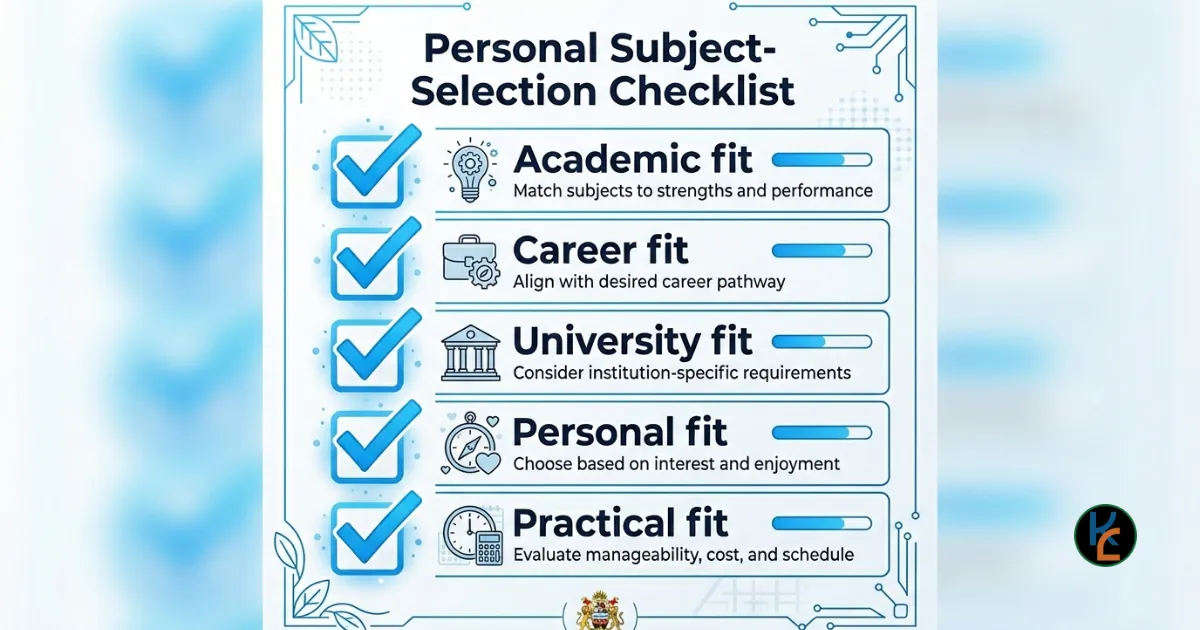
Use a personal checklist to ensure your subject choices are based on evidence, not pressure.
10. Create a Personal Subject-Selection Checklist
Before confirming your subjects, ask yourself:
Academic fit
- Am I capable of handling these subjects?
- Do I have the necessary foundation?
Career fit
- Do these subjects support my possible career interests?
University fit
- Have I checked actual entry requirements for relevant programmes?
Personal fit
- Do I have a genuine interest in these subjects?
Practical fit
- Does my school offer them?
- Can I access the required learning materials?
If most answers are yes, your selection is based on evidence rather than pressure.
Subject Selection Example
Suppose a student is considering three possible fields:
| Possible field | Subjects to investigate carefully |
|---|---|
| Health sciences | Mathematics, Biology, Chemistry/Physical Science, English |
| Computing | Mathematics, English, Physics/Physical Science |
| Geography-related programmes | Geography, Mathematics, English + relevant additional subjects |
These are examples of subjects to investigate, not universal combinations. Actual requirements must be checked against the specific programme and institution.
Final Advice
Choosing MSCE subjects should be a thoughtful process rather than a popularity contest.
Do not ask only:
“Which subjects are easiest?”
Ask:
“Which subjects will give me a strong foundation for the future I am considering?”
Your interests may change, and that is normal. The goal is to make an informed subject choice based on your abilities, interests, school options and verified programme requirements.
Choose with purpose. Study with consistency. Keep your options open.
LEARN • REVISE • SUCCEED
FiloKin Edu — The wise learn together.



Sign in securely with Google to join the discussion.