

How Many Subjects Should You Take for MSCE?

Choosing the right MSCE subjects is the first step toward your future career.
A question many secondary school students in Malawi ask themselves is:
How many subjects should I take for MSCE?
The answer is important, because the number of subjects you register for (see: registration), differs from the number of subjects required for the award of the MSCE certificate.
How many subjects are needed to obtain the MSCE certificate?
According to MANEB's current MSCE information, a candidate can qualify to receive the MSCE certificate by satisfying either of two conditions:
Option 1: A candidate obtains a pass in six subjects, including English, with at least one distinction/credit.
Option 2: A candidate obtains a pass in five subjects, including English, with at least three distinctions/credits.
The result announcement of the 2026 MSCE results confirms the same certification conditions.
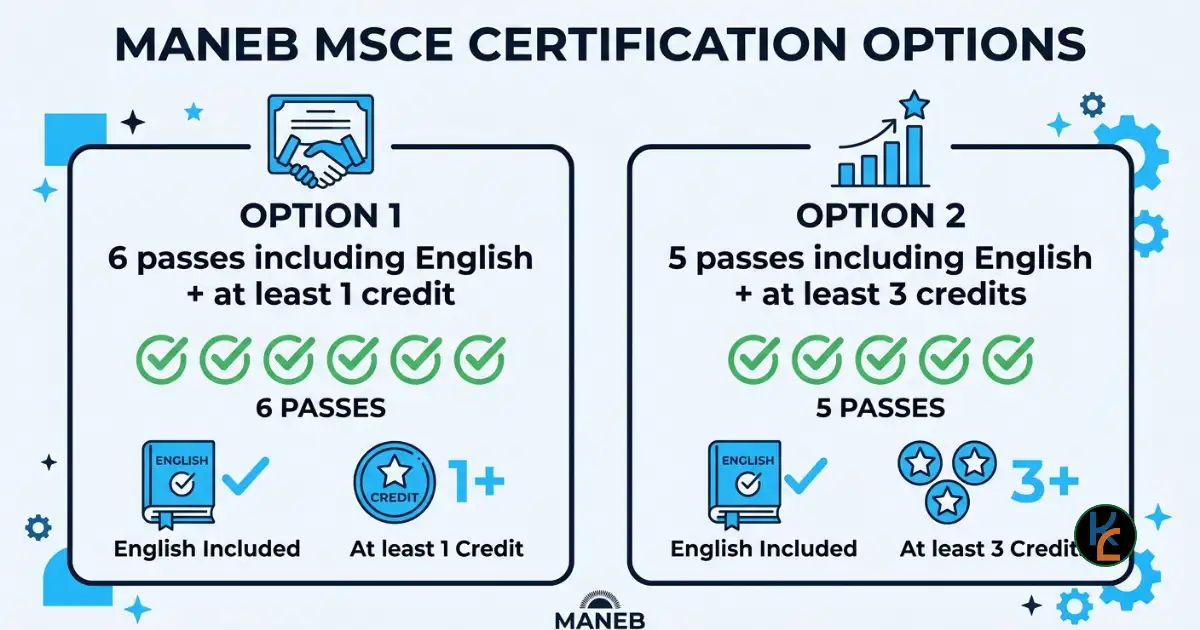
The two official routes to qualify for your MSCE certificate.
Does that mean I should register for only five or six subjects?
Not necessarily.
The certificate-award rules specify the requirements to qualify for the certificate. They do not, per se, indicate that all students should register for exactly five or six subjects.
The students select the subjects they wish to take by visiting an approved MANEB examination centres, and MANEB's registration process records the candidate's choice of subjects.
The more important question is:
Which subjects should I take to meet my academic goals while maintaining a realistic workload?
Why subject choice matters
University programmes can have subject-specific requirements.
For example, the current Public Universities Selection system requires at least six credit passes including English for the general minimum requirement, while the system uses the applicant's subjects and grades to determine programme eligibility.
Individual programmes may require particular subjects.
UNIMA's Bachelor of Science, for example, requires six credits including English, Mathematics, Biology and Physical Science/General Science.
Therefore, simply asking: "How many subjects should I take?" is less useful than asking: "Which subjects do I need, and how many can I manage successfully?"
Taking more subjects is not necessarily better
Some students may feel that registering for a very large number of subjects automatically gives them an advantage.
That is not necessarily true.
Every additional subject requires:
- study time
- revision
- practice
- notes
- past-paper preparation
- examination time
- mental energy
If taking too many subjects causes you to neglect important subjects, then the extra workload may become difficult to manage.

Balancing your workload is key to MSCE success.
Taking too few subjects can also be problematic
The opposite mistake is to choose too few subjects without considering future requirements.
Suppose you are interested in a university programme that requires Mathematics, Biology, Physical Science and English. A subject-combination that leaves out one of those requirements could affect eligibility for that particular programme.
For example, UNIMA's current Bachelor of Science in Computer Science requires Mathematics, English and Physics/Physical Science among the six credits.
Think about your future programme
Before finalising your subjects, make a list of possible university programmes.
For example:
| Possible interest | Requirements to investigate |
|---|---|
| Medicine | Mathematics, Biology, Chemistry/Physical Science, English and programme-specific grades |
| Computer Science | Mathematics, English, Physics/Physical Science and other required credits |
| Geography | Geography, Mathematics, English and additional specified subjects |
| Language Education | English, Chichewa, French and other specified subjects |
These examples are from current programme information, and should be rechecked when you eventually apply.
What about the six-credit requirement?
There is an important distinction here.
MANEB's certificate rules and university admission requirements serve different purposes.
MANEB certificate
MANEB's certificate rules currently allow qualification via either:
- Six passes including English + at least one credit
- or Five passes including English + at least three credits.
Public university selection
The current harmonised public-university selection system states a minimum of six credit passes including English for the relevant MSCE/O-Level applicants.
Therefore, a student planning to continue to university should not prepare only for the minimum conditions for obtaining an MSCE certificate. The student should also consider the requirements of the intended university programme.
What is the best approach?
Instead of choosing a number first, try this process:
- Step 1: Identify your possible career interests.
You do not need to have everything figured out, so choose two or three areas that you might realistically pursue. - Step 2: Find possible university programmes.
Look at actual degree or diploma programmes related to those interests. - Step 3: Check their subject requirements.
Write down the required MSCE subjects and minimum grades. - Step 4: Compare them with your abilities.
Ask your teachers about your performance and areas that need improvement. - Step 5: Consider your workload.
Make sure your subject combination is realistic for your study time and available resources. - Step 6: Confirm your final registration.
When registering with MANEB, carefully verify your subject choices and personal information before payment. MANEB specifically instructs candidates to verify their details because corrections may not be possible after examination fees have been paid.
A simple rule for students
Think of your MSCE subjects in three groups:
Group A — Essential subjects
Subjects required for your intended university programmes.
Group B — Strong subjects
Subjects in which you perform well and that support your future plans.
Group C — Additional subjects
Subjects you may choose if they are useful and you can manage the workload effectively.
This approach is more useful than choosing subjects simply because other students are taking them.
What if I'm unsure about my career?
That is completely normal.
If you do not know exactly what you want to study after secondary school, focus on building a broad academic foundation while paying attention to subjects you perform well in.
Speak to:
- Your subject teachers
- Your head of department
- Your guidance and counselling teacher
- Parents or guardians
- Students already studying at university
- Official university admission offices
Most importantly, check official admission information when you eventually apply because requirements can change.
Final answer
There is no single number that is automatically right for every MSCE candidate.
For the award of the MSCE certificate, MANEB currently provides two qualification routes, based on five or six passed subjects, with specific English and credit requirements.
But students planning for university should think beyond the certificate minimum. The number and combination of subjects should be considered alongside university programme requirements, academic ability, career interests and workload.
Your goal should not simply be to take the largest possible number of subjects.
Your goal should be to build a subject-combination that you can prepare for seriously while keeping relevant future opportunities open.
Choose wisely. Prepare consistently. Verify requirements.
LEARN • REVISE • SUCCEED
FiloKin Edu — The wise learn together.



Sign in securely with Google to join the discussion.