
Description
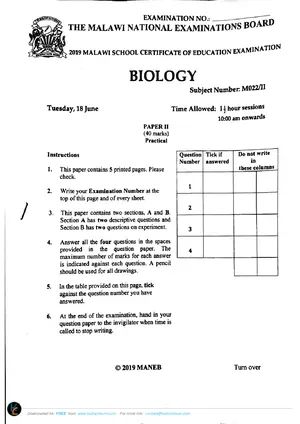
The 2019 MANEB MSCE Biology Paper 2 emphasizes the scientific method as a cohesive investigative process, guiding students from microscopic observation to hypothesis testing and real-world ecological implications. This paper tests higher-order practical competencies including slide preparation techniques, transpiration-potometer correlations, enzyme denaturation controls, and ethical specimen handling protocols.
Candidates are required to move beyond simple identification, demonstrating how each experimental step serves a specific scientific purpose. Questions frequently ask students to justify apparatus choices, explain the biological significance of observed patterns, and connect laboratory findings to broader environmental or physiological contexts. The marking scheme rewards candidates who can articulate the "why" behind procedures, not just the "how."
This paper is particularly valuable for high-achieving students refining answers to distinction-level depth and coherence. It mirrors the assessment style increasingly favored in modern MANEB cycles: integrated, context-rich, and demanding clear scientific communication. By working through these questions, learners develop the ability to design logically sequenced investigations, evaluate methodological limitations, and present findings with academic precision. These competencies not only maximize exam scores but also build foundational research skills applicable to tertiary education and scientific careers in Malawi and beyond.
Study Tips / Exam Strategy
🔬 Microscope & Slide Prep:
• Master the 5-step sequence: Cut thin section → Place on slide → Add drop of stain/water → Lower cover slip at 45° → Blot excess liquid
• Explain stain purpose: "Iodine highlights starch grains and nuclei; methylene blue stains animal cell nuclei for visibility."
• Practice describing field of view changes: "At low power, locate specimen; at high power, adjust fine focus only."
💧 Transpiration & Potometer:
• Memorize setup sequence: Cut shoot underwater → Insert into apparatus → Ensure airtight seals → Introduce air bubble → Record movement over time
• Link results to environmental factors: "Increased fan speed → faster bubble movement → higher transpiration rate due to reduced boundary layer humidity."
• Always state: "This measures water uptake, which approximates transpiration rate under controlled conditions."
⚖️ Ethical & Safety Awareness:
• Include 1 ethical consideration per practical question: "Specimens were handled gently to minimize stress," or "Waste solutions were disposed of in designated containers."
• Safety phrases: "Wear gloves when handling reagents," "Use heat-resistant tongs for hot water baths," "Wash hands after handling biological materials."
📝 Answer Structuring:
• Use bullet points ONLY for materials and step-by-step procedures
• Write full sentences for aims, explanations, conclusions, and ethical notes
• Apply the "Evidence → Principle → Conclusion" format for high-mark questions
⏱️ Revision Strategy:
• Draft your own mark scheme for one past question weekly. Highlight where "application" and "evaluation" marks sit.
• Practice converting 5 bullet points into a cohesive paragraph – examiners reward scientific fluency
• Time yourself: 20 minutes per experimental essay, 15 minutes per drawing/analysis question
✅ Quick Check:
Can you explain why a cover slip must be lowered at an angle? If yes, you understand slide preparation fundamentals tested in this paper.
Key Concepts to Master for Biology (Form 4)
This resource covers essential biology topics for Form 4 learners. Before attempting the paper, ensure you understand these foundational concepts:
• Cell Biology
Organelles, diffusion/osmosis, cell division. Label diagrams accurately with biological terminology.
• Human Physiology
Digestion, respiration, circulation, excretion. Link structure to function in explanations.
• Ecology & Genetics
Food chains, photosynthesis, Mendelian inheritance. Use Punnett squares for genetic crosses.
Pro Tip: After completing this paper, revisit any concepts you struggled with using your textbook or FiloKin's study notes. Browse more Biology resources →
Preview
Share This Resource
Need Help?
- Free for personal educational use by Malawian students & teachers
- 10 downloads per day per device to ensure fair access
- Always verify with official MANEB/MoEST publications for exam prep
- Do not redistribute, sell, or republish without permission
Discussion (0)
No comments yet. Be the first to share your thoughts!
Sign in securely with Google to join the discussion.