
Description
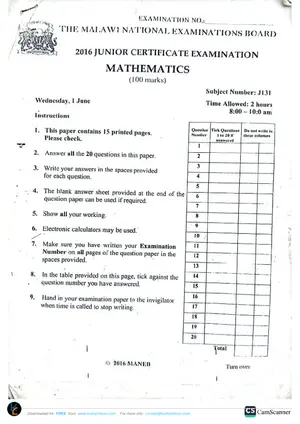
The 2016 MANEB Junior Certificate Examination (JCE) Mathematics paper focuses on developing mathematical communication, logical reasoning, and strategic problem-solving skills within the junior secondary curriculum framework. This 100-mark compulsory paper tests candidates' ability to interpret mathematical language, select appropriate solution methods, execute calculations accurately, and present answers with clear working and correct notation – competencies essential for progression to MSCE-level mathematics.
Questions require systematic thinking: analyzing patterns in number sequences, formulating equations from verbal descriptions, applying geometric properties to find unknown angles or lengths, and interpreting simple statistical representations. Topics frequently include linear equations, percentage applications in financial contexts, Pythagorean theorem problems, basic trigonometric ratios for right-angled triangles, and probability calculations for everyday events. The marking scheme rewards methodical working, precise mathematical vocabulary, logical justification of steps, and verification of solutions through alternative approaches or estimation.
This paper is particularly valuable for students building the analytical habits needed for advanced mathematical study and technical vocations. By practicing with these questions, learners develop the discipline to approach unfamiliar problems with confidence, the flexibility to adapt strategies when initial approaches prove inefficient, and the precision to communicate mathematical reasoning clearly. The 2016 JCE Mathematics paper emphasizes transferable skills – logical sequencing, pattern recognition, quantitative verification – that support success not only in examinations but in science courses, agricultural planning, small business management, and informed citizenship in Malawi's developing economy. Mastery of this content strengthens problem-solving resilience, mathematical fluency, and the capacity to use quantitative reasoning as a tool for understanding and improving everyday situations.
Study Tips / Exam Strategy
🔍 Problem Analysis Technique:
• Practice identifying problem type before solving: Is this algebra? Geometry? Proportion? Probability?
• Translate word problems into mathematical expressions systematically: "Sum of two numbers is 15" → x + y = 15
• Draw diagrams for geometry and word problems – visual representation often reveals solution pathways
📐 Geometry Reasoning:
• Memorize angle properties: angles on straight line = 180°, angles in triangle = 180°, vertically opposite angles equal
• Practice labeling diagrams clearly with given information before attempting calculations
• Use logical chains: "Since AB = AC, triangle ABC is isosceles, therefore base angles are equal…"
🔤 Algebraic Communication:
• Show every step when solving equations – examiners award method marks for correct approach
• Practice writing explanations: "Subtract 5 from both sides to isolate the variable term"
• Verify solutions by substituting back into original equation
📊 Data Interpretation:
• Practice extracting information from tables, bar charts, and pie charts accurately
• Calculate percentages from raw data: "12 out of 30 students = 12/30 × 100 = 40%"
• Always state what conclusions are supported by the data, avoiding overgeneralization
⏱️ Exam Execution:
• Start with questions you find easiest to build momentum and secure quick marks
• For multi-mark questions, allocate time proportionally and show sufficient working for full credit
• Reserve final minutes to verify calculations, check units, and ensure all questions are attempted
✅ Quick Drill:
Can you find the missing angle in a triangle when two angles are given, explaining the property used? If yes, geometry questions will be manageable.
Key Concepts to Master for Mathematics (Form 2)
This resource covers essential mathematics topics for Form 2 learners. Before attempting the paper, ensure you understand these foundational concepts:
• Algebraic Manipulation
Factorization, quadratic equations, simultaneous equations. Show all steps for method marks in JCE/MSCE.
• Geometry & Trigonometry
Circle theorems, Pythagoras, sin/cos/tan ratios. Draw accurate, labeled diagrams for full credit.
• Statistics & Probability
Mean/median/mode, tree diagrams, basic probability rules. Interpret graphs and tables carefully.
Pro Tip: After completing this paper, revisit any concepts you struggled with using your textbook or FiloKin's study notes. Browse more Mathematics resources →
Preview
Share This Resource
Need Help?
- Free for personal educational use by Malawian students & teachers
- 10 downloads per day per device to ensure fair access
- Always verify with official MANEB/MoEST publications for exam prep
- Do not redistribute, sell, or republish without permission
Discussion (0)
No comments yet. Be the first to share your thoughts!
Sign in securely with Google to join the discussion.