
Description
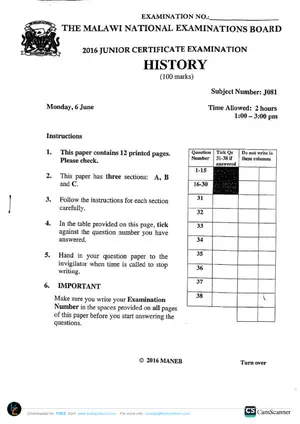
The 2016 MANEB Junior Certificate Examination (JCE) History paper focuses on developing historical interpretation skills through analysis of primary and secondary sources related to Malawi's and Africa's historical journey. This 100-mark compulsory paper tests candidates' ability to extract information from historical maps, photographs, official documents, and eyewitness accounts, while contextualizing these sources within broader chronological frameworks of pre-colonial societies, colonial encounters, and nationalist movements.
Questions require candidates to demonstrate source literacy: identifying author perspective, recognizing bias, corroborating information across multiple sources, and drawing evidence-based conclusions about historical events. Topics frequently include the impact of long-distance trade on African societies, missionary-colonial relationships, early resistance movements, and the evolution of political consciousness leading to independence. The marking scheme rewards precise source referencing, logical inference, and the ability to distinguish between factual reporting and interpretive commentary.
This paper is particularly valuable for students transitioning from factual recall to critical historical thinking. By practicing with these questions, learners develop the analytical toolkit needed to evaluate historical claims, construct nuanced arguments supported by evidence, and appreciate the complexity of interpreting the past. The 2016 JCE History paper also reinforces foundational research skills – noting source details, organizing chronological information, and citing evidence appropriately – competencies directly transferable to MSCE-level historical investigation and tertiary education requirements. Mastery of this content strengthens information literacy, argumentative writing, and the capacity to engage thoughtfully with historical narratives that shape national identity.
Study Tips / Exam Strategy
🔍 Source Literacy Framework:
• Practice the "3 Questions" for every source: What does it say? What does it imply? What does it omit?
• Identify perspective markers: "The author uses words like 'civilizing mission' which suggests a colonial viewpoint."
• Corroborate across sources: "Both the missionary diary and colonial report mention drought, but differ on its impact – cross-check with climate records if available."
🗺️ Map and Visual Source Analysis:
• For historical maps: Identify date, legend, scale, and purpose before extracting information
• Practice describing visual sources systematically: "This photograph shows [subject], taken in [location/date], likely intended to [purpose], revealing [historical insight]."
• Always connect visual evidence to the specific question: "The map's trade routes explain why certain towns became administrative centers."
⚖️ Bias Recognition Technique:
• Memorize common bias indicators: Absolute language ("always," "never"), emotional adjectives, omission of counter-evidence
• Practice neutral rephrasing: "Instead of 'backward societies,' write 'societies with different technological development levels at that time.'"
• Explain bias impact: "This source's colonial authorship may underrepresent African agency in historical events."
📝 Evidence-Based Writing:
• Use the "Quote → Explain → Link" structure: "The document states 'X' (quote), which indicates Y (explanation), supporting the argument that Z (link to question)."
• Practice integrating short source excerpts smoothly into your own sentences.
• Always attribute sources: "According to the 1902 colonial report…" rather than vague "Some sources say…"
✅ Quick Drill:
Can you identify one potential bias in a colonial-era document and explain how it might affect historical interpretation? If yes, source analysis questions will be straightforward.
Key Concepts to Master for History (Form 2)
This resource covers essential history topics for Form 2 learners. Before attempting the paper, ensure you understand these foundational concepts:
• Pre-Colonial Malawi
Maravi Empire, trade routes, social structures. Use timelines to organize events chronologically.
• Colonial Period
British rule, independence movement, key figures. Analyze cause-effect relationships in answers.
• Post-Independence
Development challenges, governance, regional cooperation. Evaluate policies with evidence.
Pro Tip: After completing this paper, revisit any concepts you struggled with using your textbook or FiloKin's study notes. Browse more History resources →
Preview
Share This Resource
Need Help?
- Free for personal educational use by Malawian students & teachers
- 10 downloads per day per device to ensure fair access
- Always verify with official MANEB/MoEST publications for exam prep
- Do not redistribute, sell, or republish without permission
Discussion (0)
No comments yet. Be the first to share your thoughts!
Sign in securely with Google to join the discussion.