
Description
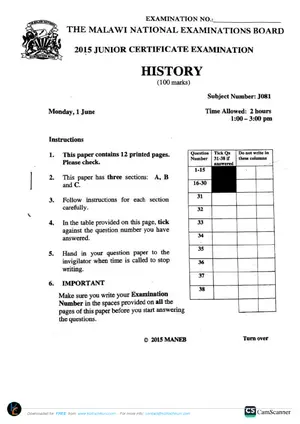
The 2015 MANEB Junior Certificate Examination (JCE) History paper emphasizes thematic understanding of Africa's historical development, requiring candidates to analyze patterns of change and continuity across pre-colonial, colonial, and early post-independence periods. This 100-mark compulsory paper tests knowledge of African political systems, economic transformations through trade and colonization, social changes under missionary influence, and the emergence of nationalist movements in Malawi and broader Southern Africa.
Questions increasingly demand comparative analysis: contrasting governance structures of different African kingdoms, evaluating varying impacts of colonial policies across regions, or assessing the roles of different actors in independence struggles. The marking scheme rewards candidates who demonstrate logical sequencing, use historical evidence to support claims, and articulate connections between local Malawian experiences and continental African historical trends.
This paper is particularly valuable for learners developing analytical writing skills and historical empathy. By engaging with these questions, students build the ability to interpret multiple perspectives on historical events, evaluate the reliability of different source types, and construct balanced arguments that acknowledge complexity. The 2015 JCE History paper also introduces foundational concepts in historiography – understanding how historical narratives are constructed – preparing candidates for more advanced source criticism at MSCE level. Mastery of this content strengthens critical reading, structured argumentation, and the capacity to draw informed conclusions about how historical forces continue to shape contemporary Malawian society.
Study Tips / Exam Strategy
🔄 Change and Continuity Analysis:
• Use a 2-column approach: What Changed? | What Stayed the Same? → then convert to exam sentences
• Example: "Colonial rule introduced cash crops (change) but many communities retained traditional leadership structures for local dispute resolution (continuity)."
• Practice writing balanced responses that acknowledge both transformation and persistence.
⚖️ Comparative History Technique:
• For comparison questions, use parallel structure: "While Kingdom A centralized power through royal councils, Kingdom B distributed authority among clan elders, reflecting different approaches to governance."
• Always justify comparisons with specific historical evidence, not generalizations.
• Link comparisons to broader themes: "These differing systems influenced how each kingdom responded to external pressures from trade or colonization."
📚 Source Evaluation Framework:
• Apply the "OPVL" method simply: Origin (who/when), Purpose (why created), Value (what it tells us), Limitation (what it misses)
• Practice one-sentence evaluations: "This colonial report provides official policy perspectives but may underrepresent African community viewpoints."
• Always connect source analysis to the specific question asked.
🗣️ Essay Writing Structure:
• Introduction: Restate question + outline 3 key points you will address
• Body paragraphs: One point per paragraph with evidence + explanation
• Conclusion: Summarize argument + link to broader historical significance
• Practice writing introductions in under 3 minutes to build exam pacing.
✅ Self-Check:
Can you compare two African kingdoms' responses to European contact using specific historical examples? If yes, comparative questions will be manageable.
Key Concepts to Master for History (Form 2)
This resource covers essential history topics for Form 2 learners. Before attempting the paper, ensure you understand these foundational concepts:
• Pre-Colonial Malawi
Maravi Empire, trade routes, social structures. Use timelines to organize events chronologically.
• Colonial Period
British rule, independence movement, key figures. Analyze cause-effect relationships in answers.
• Post-Independence
Development challenges, governance, regional cooperation. Evaluate policies with evidence.
Pro Tip: After completing this paper, revisit any concepts you struggled with using your textbook or FiloKin's study notes. Browse more History resources →
Preview
Share This Resource
Need Help?
- Free for personal educational use by Malawian students & teachers
- 10 downloads per day per device to ensure fair access
- Always verify with official MANEB/MoEST publications for exam prep
- Do not redistribute, sell, or republish without permission
Discussion (0)
No comments yet. Be the first to share your thoughts!
Sign in securely with Google to join the discussion.