
Description
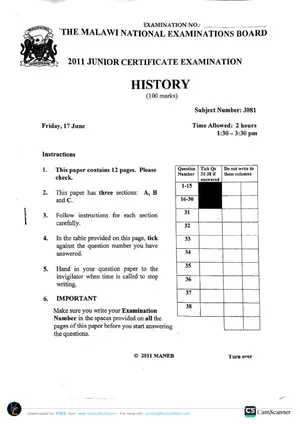
The 2011 MANEB Junior Certificate Examination (JCE) History paper assesses foundational historical knowledge and analytical skills essential for Malawian junior secondary learners. This 100-mark compulsory paper tests understanding of pre-colonial African societies, the impact of trade networks (including Indian Ocean and Trans-Saharan routes), early European contact with Africa, and the development of Malawi's national identity through key historical milestones.
Questions require candidates to move beyond rote memorization, demonstrating the ability to sequence events chronologically, compare cause-and-effect relationships in historical developments, and evaluate the significance of primary sources. Topics frequently include the rise and fall of African kingdoms, the effects of slavery on African communities, missionary activities in Central Africa, and the establishment of colonial administration in Nyasaland. The marking scheme rewards clear, structured responses that use historical terminology accurately while connecting past events to contemporary Malawian contexts.
This paper is particularly valuable for Form 3 students building chronological reasoning skills before advancing to MSCE-level historical analysis. By practicing with these questions, learners develop the ability to construct evidence-based arguments, interpret historical maps and timelines, and articulate how historical forces shaped modern Malawi's political, social, and economic landscape. The 2011 JCE History paper emphasizes critical thinking over factual recall alone, preparing students not only for examination success but for informed citizenship grounded in historical awareness. Mastery of this content strengthens essay-writing discipline, source evaluation skills, and the capacity to draw meaningful lessons from Africa's rich historical heritage.
Study Tips / Exam Strategy
🗓️ Chronology Mastery:
• Create timeline flashcards for major events: Pre-colonial kingdoms → Trade networks → Missionary arrival → Colonial rule → Independence
• Practice sequencing: "First, then, subsequently, finally" to build coherent historical narratives
• Link dates to significance: "1891: British Central Africa Protectorate established – marked beginning of formal colonial administration in Malawi."
🌍 Cause-and-Effect Framework:
• Use the "Event → Immediate Impact → Long-term Consequence" structure for explanation questions
• Example: "Slave trade (event) → Population decline and social disruption (immediate) → Weakened resistance to colonial rule (long-term)"
• Practice writing 3-sentence causal chains for high-mark questions
📜 Source Analysis Technique:
• Identify source type: Primary (eyewitness account, official document) vs. Secondary (textbook, historian's analysis)
• Ask: Who created this? When? Why? What perspective might influence their account?
• Practice evaluating reliability: "This missionary diary provides valuable insight but may reflect European biases about African cultures."
🇲🇼 Malawi Context Integration:
• Connect historical themes to national identity: "Understanding pre-colonial Chewa social structures helps appreciate modern community-based governance traditions."
• Practice 2-sentence answers linking past to present: "Colonial infrastructure development focused on resource extraction; independent Malawi repurposed railways for domestic trade connectivity."
⏱️ Exam Strategy:
• Short answers: 1 mark = 1 precise fact; 2 marks = fact + brief explanation
• Essay questions: Plan with 3 key points before writing; use paragraphs with topic sentences
• Always define historical terms at first use: "Indentured labor refers to…"
✅ Quick Drill:
Can you explain one economic and one social impact of the slave trade on Central Africa in two clear sentences? If yes, you're ready for impact-analysis questions.
Key Concepts to Master for History (Form 2)
This resource covers essential history topics for Form 2 learners. Before attempting the paper, ensure you understand these foundational concepts:
• Pre-Colonial Malawi
Maravi Empire, trade routes, social structures. Use timelines to organize events chronologically.
• Colonial Period
British rule, independence movement, key figures. Analyze cause-effect relationships in answers.
• Post-Independence
Development challenges, governance, regional cooperation. Evaluate policies with evidence.
Pro Tip: After completing this paper, revisit any concepts you struggled with using your textbook or FiloKin's study notes. Browse more History resources →
Preview
Share This Resource
Need Help?
- Free for personal educational use by Malawian students & teachers
- 10 downloads per day per device to ensure fair access
- Always verify with official MANEB/MoEST publications for exam prep
- Do not redistribute, sell, or republish without permission
Discussion (0)
No comments yet. Be the first to share your thoughts!
Sign in securely with Google to join the discussion.