
Description
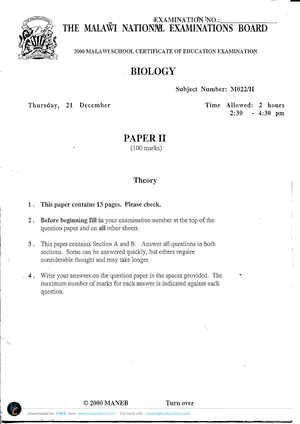
This foundational practical paper from the year 2000 tests core laboratory competencies that remain essential for success in MANEB MSCE Biology today. Students encounter classic specimen-based questions focusing on seed structure analysis (bean and maize), leaf venation identification, and fundamental food tests for starch, proteins, and reducing sugars. The paper emphasizes accurate biological drawing using sharp pencils, magnification calculations with clear working steps, and basic experimental design with control setups.
What makes this paper valuable for revision is its focus on observation skills over complex theory – perfect for building baseline practical confidence. Candidates practice dichotomous key construction using local Malawian flora, osmosis experiments with potato strips, and proportional drawing of irregular specimens. The questions reward careful attention to detail: labeling lines must be straight and non-crossing, diagrams should occupy at least half the allocated space, and procedural essays must follow logical sequencing.
This paper is particularly useful for Form 3 students beginning practical preparation or Form 4 learners needing to reinforce foundational skills before tackling more complex recent papers. By mastering the competencies tested here – accurate observation, clear scientific communication, and methodical experimental planning – students build the muscle memory needed to excel in higher-stakes assessments. The 2000 paper also reflects timeless MANEB marking priorities: accuracy in biological representation, clarity in procedural writing, and the ability to link observations to biological principles.
Study Tips / Exam Strategy
🎯 Master the Basics First:
• Practice drawing specimens exactly as observed – not from memory. Use a sharp HB pencil, light initial sketches, then darken final lines.
• Label with straight, horizontal lines that never cross. Write labels clearly in print, not cursive.
• Ensure your drawing occupies at least half the space provided – small drawings lose marks regardless of accuracy.
🔬 Food Test Fluency:
• Memorize the 5 core tests: starch (iodine → blue-black), proteins (Biuret → purple), reducing sugars (Benedict's + heat → brick red), lipids (ethanol emulsion → cloudy white), Vitamin C (DCPIP → colorless).
• Practice writing each procedure as a flowing paragraph: "Add 2cm³ of solution X to 2cm³ of Benedict's reagent, heat in a water bath for 3 minutes, observe color change…"
• Always state the initial color and final color – examiners award marks for complete observations.
📐 Magnification & Calculations:
• Formula: Magnification = Length of Drawing ÷ Actual Length of Specimen. Always show substitution steps.
• Use a ruler for measurements; record to the nearest millimeter. Include units in every calculation.
• Practice with real specimens: measure a bean seed, draw it, calculate magnification – repeat until automatic.
⏱️ Time Management Strategy:
• Section A (essays): Aim for ≤20 minutes per question. Write bullet-point plans first, then expand.
• Section B (practical tasks): Allocate 10 minutes for observation/drawing, 5 minutes for labeling, 5 minutes for calculations.
• Leave 5 minutes at the end to review labels, spelling, and unit consistency.
🇲🇼 Local Context Boost:
• Connect specimens to Malawi: "Bean seeds are a key protein source in Malawian diets; understanding their structure supports nutrition education."
• When describing adaptations, reference local environments: "Sisal's thick cuticle reduces water loss – an advantage in Malawi's dry seasons."
✅ Final Exam Checklist:
☑ Pencil sharp? Ruler ready? Eraser clean?
☑ Can I explain the purpose of a control setup in one sentence?
☑ Can I convert an observation ("solution turned blue-black") into a conclusion ("starch is present")?
☑ Have I practiced writing under timed conditions this week?
Key Concepts to Master for Biology (Form 4)
This resource covers essential biology topics for Form 4 learners. Before attempting the paper, ensure you understand these foundational concepts:
• Cell Biology
Organelles, diffusion/osmosis, cell division. Label diagrams accurately with biological terminology.
• Human Physiology
Digestion, respiration, circulation, excretion. Link structure to function in explanations.
• Ecology & Genetics
Food chains, photosynthesis, Mendelian inheritance. Use Punnett squares for genetic crosses.
Pro Tip: After completing this paper, revisit any concepts you struggled with using your textbook or FiloKin's study notes. Browse more Biology resources →
Preview
Share This Resource
Need Help?
- Free for personal educational use by Malawian students & teachers
- 10 downloads per day per device to ensure fair access
- Always verify with official MANEB/MoEST publications for exam prep
- Do not redistribute, sell, or republish without permission
Discussion (0)
No comments yet. Be the first to share your thoughts!
Sign in securely with Google to join the discussion.