

The night before an examination can be stressful. You may feel like you have not studied enough, or you may be tempted to stay awake trying to learn everything. However, it is important that the night before the exam should not centre around learning an entire subject from scratch.
It should be about reviewing important topics, preparing your examination materials, and getting enough rest. Whether it is for the PSLCE, JCE, MSCE, school examinations, or class tests, what you do the night before can greatly affect how you feel and perform on the day.

What Students Should Do the Night Before an Exam
1. Review important topics
Use the night before the examination to revise important topics, formulas, definitions, diagrams, rules, and concepts that you have already studied. Avoid reading every single page of your book. Instead, focus on the topics that you find difficult and those that are likely to require critical thinking.
For example, a Mathematics student can quickly go over important formulas and work through a few questions, while a Biology student can revise important definitions, processes, and diagrams.
2. Use your past papers
Past examination papers (like MANEB past papers) can be very useful for final revision. Pick a few questions from the topics you have studied and attempt them without immediately looking at the answers. Focus on:
- How questions are worded
- The type of answers required
- Marks allocated for each question
- Topics that you find difficult
- Common mistakes that you tend to make
You do not need to complete many papers on the final night. A focused revision is usually more effective than rushing through several papers.

3. Prepare everything you need
Never wait until the morning to look for your examination materials. Prepare everything you need such as pens, pencils, ruler, eraser, sharpener, mathematical instruments, calculator (where allowed), school uniform or examination clothing, and your examination slip or documents (where required). Check your examination instructions to make sure you know what is allowed in the examination room.
4. Check the examination timetable
Make sure you know what subject you are writing, the date, and the starting time of the examination. Take a few minutes to confirm the examination venue and any special instructions. This simple step can save you a lot of stress in the morning.
5. Set your alarm
Set an alarm that gives you enough time to wake up, prepare, and get to school or the examination centre. It is also important to have a backup alarm. You do not want to start an important examination already stressed because you woke up late.
6. Eat a normal meal
Enjoy a normal meal. There is no need to eat an unusually large meal just because you have an examination the next day. Eat well and drink enough water.
7. Get enough sleep
Sleep is an essential part of exam preparation. Although staying awake all night gives you more hours to study, it can also leave you exhausted and unfocused on the day. Try to finish your serious studying in time to give yourself time to sleep.
8. Stay calm and positive
It is normal to feel anxious before an examination. Avoid telling yourself that you are not prepared as much as possible and focus on what you have already studied. Take a few deep breaths, organize your materials, and focus on what you can control.
What Students Should NOT Do the Night Before an Exam
Avoid These Common Mistakes:
- Do not study the whole night: Studying when you are extremely tired can be counterproductive. Give yourself time to sleep.
- Do not try to learn everything from scratch: Review the material you have already studied. Do not let one difficult topic waste your whole night.
- Do not panic because of what other students say: Nobody can predict the exact questions unless MANEB has officially revealed them. Ignore the rumours.
- Do not rely on examination leaks: Prepare using legitimate learning resources such as textbooks, notes, and past papers.
- Do not spend the whole night on your phone: Social media and games will waste your revision and sleeping time. Put your phone away when done studying.
- Do not experiment with unfamiliar food or drinks: Avoid energy drinks or excessive caffeine. Get natural rest instead.
- Do not compare your preparation with everyone else: Use the remaining time to prepare wisely and focus on your own studies.
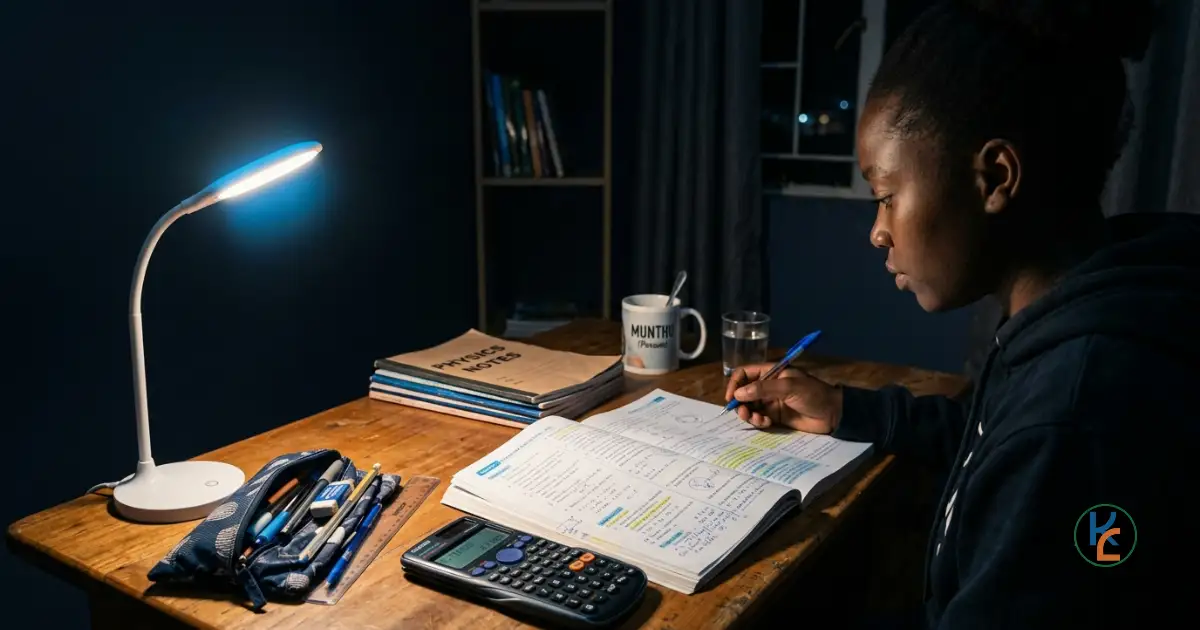
A Simple Night-Before-Exam Routine
- Review: Spend some time reviewing important topics.
- Practice: Answer a few relevant questions or go over selected past-paper questions.
- Prepare: Pack your examination materials and confirm the timetable.
- Relax: Take a short break and let your mind settle.
- Sleep: Go to bed early enough to get adequate rest.
What to Do on the Morning of the Exam
When you wake up, avoid trying to read an entire new topic. Instead:
- Get ready calmly
- Eat something if you normally do
- Drink some water
- Take your examination materials
- Leave early enough to get to the examination centre on time
- Review only a few key points if necessary
- Stay calm
Once you enter the examination room, make sure that you understand all the instructions before you start.
Final Advice
The night before an examination is about preparation, not panic. You do not need to know everything by heart before you enter the examination room. Use your final evening to revise important topics, prepare your examination materials, check your timetable, and get a good rest.
Remember that good examination preparation is a process, and the night before should only help you to arrive at the examination room prepared and rested.
For more free study resources, revision materials, and examination resources for Malawi students, visit FiloKin Edu.
Sign in securely with Google to join the discussion.